
How Community Mentions Help Get Your Brand Featured in ChatGPT
Artificial intelligence (AI) is changing the way that people are searching for information. Tools like…


For years, brands across industries have had one focus: getting higher Google rankings so their target audiences can discover them over competitors. SEO has been the leading marketing technique for helping businesses achieve this, but with the advancement of AI, a new method has emerged: AI SEO. While continuing to invest in your traditional SEO work will help you keep ranking in Google, without introducing AI SEO, you stand little chance of appearing in recommendations, summaries, or comparison answers.
If you are currently struggling with AI search visibility, understanding the differences, or want to enhance your knowledge about AI SEO, you are in the right place.
When you start looking into your AI visibility, you may be left disappointed to see that you aren’t performing as well as you’d have hoped. Given that you’ve been investing in SEO and your current Google rankings are strong, this can cause confusion. However, AI visibility and rankings do not respond to the same signals, so just because you have great rankings, this does not guarantee AI visibility.
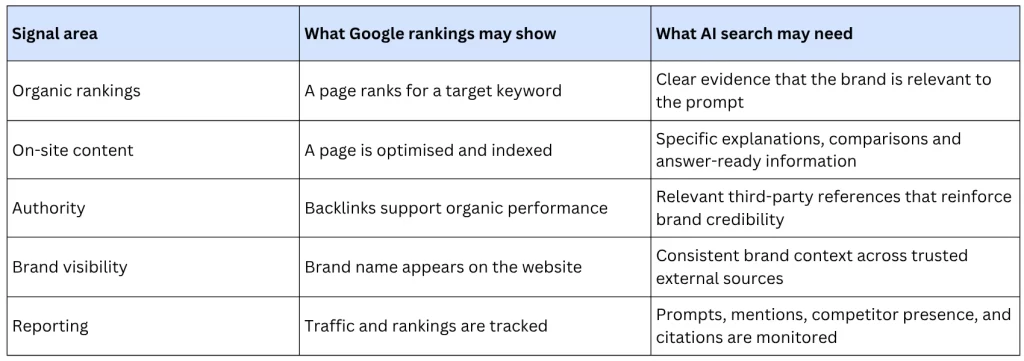
Google rankings measure how well your page is performing by considering factors such as your backlink profile, technical performance, E-E-A-T, and relevance, among others. As AI systems don’t simply show results but instead display carefully crafted answers, they need different signals to help them decide whether a brand has clear, credible, and relevant information they can include in their answer with the utmost confidence. Some of these include entity signals, brand context, and trusted third-party references. If you aren’t meeting these and their other signals, your AI visibility falls short.
Upon discovering that your brand is missing these AI opportunities, the question arises: how can you change this? The first step is to find out exactly how AI systems determine which brands to recommend in their responses and which to exclude. The signals that you should be aiming to hit to increase your chances of being recommended include:
If you follow your SEO campaigns closely, you’ll notice some overlap between traditional SEO ranking factors and AI SEO signals. For example, content relevance, topical authority, and backlinks all contribute to both strong search rankings and increased AI visibility. That’s because the goal of both traditional and AI search remains the same: to surface the most reliable, relevant, and useful information for their users. It’s how they use these signals that sets them apart.
It is important to note that making changes to your site to align with these AI signals, such as adopting a clear content structure or applying structured data, will not negatively affect your SEO. So long as you use the right techniques for both traditional SEO and AI SEO campaigns, neither will negatively impact the other.
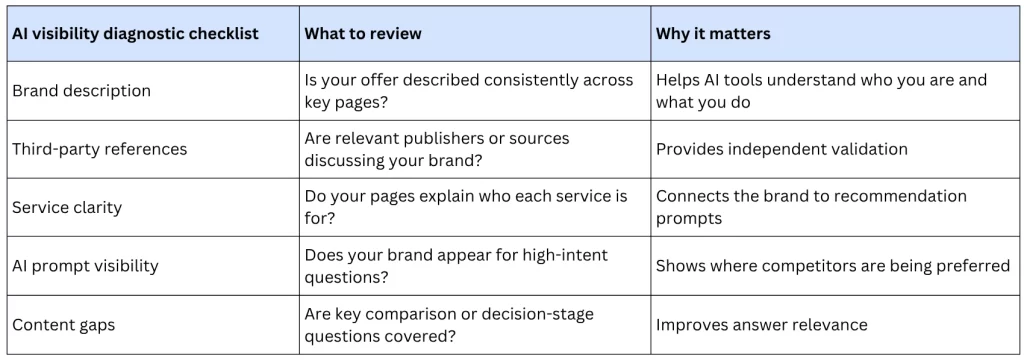
The second step to securing AI recommendations for yourself is to assess your website. Using our checklist, take note of all the immediate signals you believe you are hitting as well as those that you don’t think you are, as these could well be impacting your AI search recommendations. It is important to be honest if you want to succeed with AI SEO. The best way to confirm your immediate thoughts on what you may be missing is through an audit.
To kickstart an AI audit, pick an AI tool of your choice. For the purpose of this article, we will use ChatGPT.
Once on your website, you will need to:
Away from your site, look into whether you have good enough:
We’d also recommend that you do a competitor analysis as part of your SEO visibility audit that should investigate:
Seeing all this may sting, but it is better to harness this information than to remain in the dark. It allows you to identify the signals your competitors have that you don’t, highlighting which of them are helping them achieve these results and, therefore, what you need to focus on, which gives your AI SEO campaign direction.
Although this may seem like a lot of manual work, there are tools out there that can help. For instance, Click Insights offers a dedicated AI Overview and LLM brand recommendations audit. Of course, we can also do this all for you when you select our AI SEO services.
One signal that can strengthen AI recommendations is a brand’s authority, credibility, and recognition. While these qualities have always been important for traditional SEO, they are playing a more significant role for AI because they draw on signals and information from across the web, not just your website. Brand mentions and digital PR are two of the most effective ways to build on those signals.
Although running digital PR campaigns can generate brand mentions, we recommend exploring both services when you are first getting started with AI recommendations.
Here at Click Intelligence, we aren’t just skilled in SEO; we have the experience, know-how, and techniques to help you see improvements in AI recommendations across a range of LLM systems and Overviews. Our help always starts with an AI visibility audit. This allows us to see the full picture of why your brand may be being overlooked in AI search and what level of support you will need to strengthen recommendation visibility.
From here, let us use our digital PR services to boost authority signals, then help you craft comparison content that increases your chances of appearing for comparison prompts like “which [product] brand should I choose?” If we can increase your brand mentions, too, and build on your topical authority, over time your audience will see your name appear rather than your competitors’ in AI search.

Artificial intelligence (AI) is changing the way that people are searching for information. Tools like…

Local SEO has always been one of the most powerful and effective tools for local…
Ah, 2021 – the year of volatile Google algorithm updates that shook marketers from within and left website owners scratching…
Outreach emailing is a traditional marketing strategy that involves sending an email to someone with whom you have no previous…
If Google's latest Web Core Vitals update has caused havoc to your SEO results, find your solution in our latest in-depth ebook.

Some backlinks can help a key service page gain authority, while others help to strengthen…

SEO can be complicated. It’s constantly changing and is not a one-and-done job. That’s something…

AI has become part of how people research and look for products, as well as…

Growing an SEO agency takes a lot of hard work. You've got to keep up…

Google announced it was rolling out a further spam update on August 18, 2026. It…

Instead of scrolling through pages and pages of endless search results, more people are now…

When your target customer heads to Google to search for a product or service, or…
Artificial intelligence (AI) is changing the way that people are searching for information. Tools like…
If you are looking to increase your traffic, sales & leads, let's have a chat!

The team will usually respond within 1 hour.