
How Strong Is Your Backlink Profile Beyond DR?
Domain Rating (DR) is one of the most talked about SEO metrics. It’s used to…


If you look back at films from the 80s, filmmakers created visions of flying cars and space colonisation, but there are some scarily good guesses for what our future would look like when it comes to technology. While we may not exactly have an actual robot doing our housework, we have video calling, virtual reality, and, of course, AI technology.
It is with AI technology that we are seeing huge transformations across multiple industries. You can write an essay in seconds, translate text effortlessly, filter through data quickly, and even research online.
It is the latter that is making waves across the digital marketing world, particularly in SEO. Search discovery is moving beyond traditional rankings, and users are starting to ask AI-powered search experiences questions like “What are the best agencies for X?”, “Which companies offer Y?”, or “Who should I use for Z?”
Systems like ChatGPT and Google AI Overviews can retrieve information to answer these questions in a matter of seconds, turning to relevant web pages to build their own answer, supported by evidence in the form of AI citationsA citation is a mention of your company, product, or service in an online publication. Citations increase the ranking of your site on search engines. The appeal to users is obvious, and their usage of it is making businesses explore how they can start showing up in these answers. This is where listicles step up to the plate.
If you are ready to get your AI search journey started or improve your SEO visibility, this blog is for you.
Time is a limited resource for many, but with the introduction of AI systems, this is something people are slowly claiming back. They are seeing the appeal, and it has helped expand search into what it is now: a place for ranked linksHyperlinks, also known as links, are the connection points on a webpage that take you to other webpages., AI-generated answers, comparisons, and AI recommendations. A change such as this leads to one question:
If you are already running SEO campaigns, do you need to do anything differently to see visibility boosts in AI?
The short answer is yes. While there is some natural crossover, you will need to focus on AI SEO strategies if you are trying to see an improvement here. If you are ready to get started on your AI search campaign, get in touch with our experts today.
If, however, you want to see improvements across AI search, LLM Discovery, and SEO visibility, you need a slightly different approach, and that starts with listicles. Listicles are online articles that naturally sit within commercial and comparison-led searches, such as “best”, “top”, and recommended”. You might create an article like “the best SEO agencies in the UK” or “comparing # SEO services”, and within this, then be able to place your brand within it and publish it.
If your first question is “can listicles help my business appear in AI search?”, this is a common train of thought. It’s important to understand early on exactly how listicles help AI SEO. Gaining a third-party listicle inclusion is a fantastic opportunity for brands to become discoverable beyond their own websites, particularly as this is one of the ways AI systems find, evaluate, and recommend brands within their answers.
To display answers for their users, AI systems have a process in which they discover content across the entire web and then use it. For anyone who wants to be cited, this is a process worth knowing.
AI systems begin by crawling, something most will be familiar with if they run SEO campaigns. To allow this step to happen, websites must make their pages publicly accessible, crawlable, eligible for indexing, and free from technical issues. After a page has been crawled and discovered, they’ll index it so that when a query arises, they can then check whether your content is relevant enough for retrieval before generating their answer, in which you may be cited.
If you want to know exactly how specific AI systems carry this out, we recommend reading the article Bing: AI performance in Webmaster Tools.
We’ve also created two side-by-side examples of Google AI Search and ChatGPT below once content has been published:
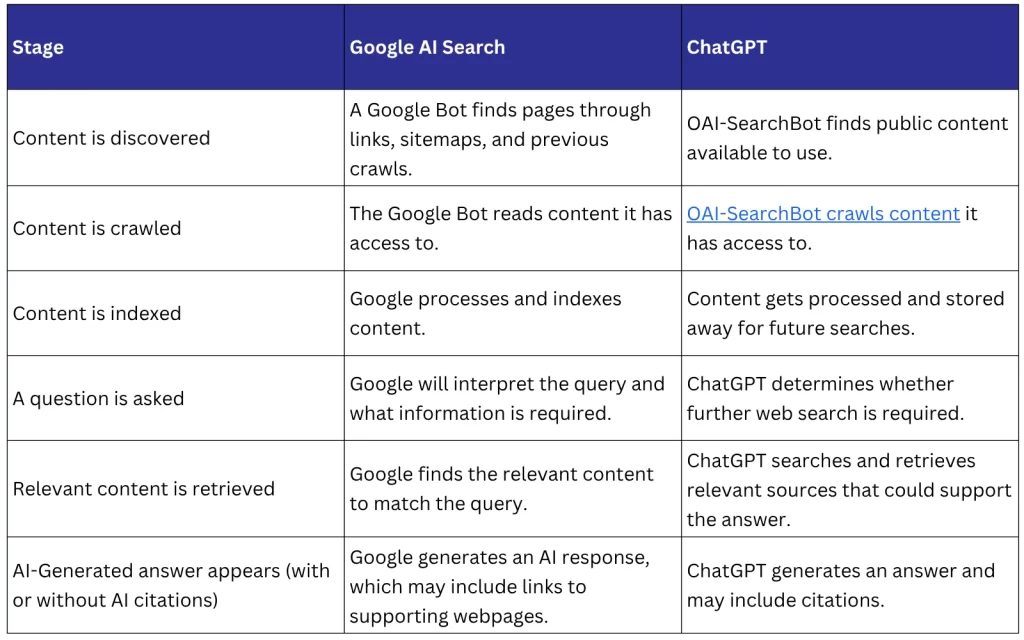
For particularly complex or comparison-based questions, relevant third-party listicles can support AI search discovery by creating crawlable sources that connect a brand with its products, services, expertise, and competitive category.
However, it should be said that creating content specifically to help with crawlability and inclusion is never a guarantee of citation or visibility. It is simply giving you an opportunity for AI visibility.
Building up third-party mentions is a great way to establish a relationship between a brand, its categories, services, and its competitors, as this is how LLMs understand the world. They don’t read the content in the way that you do. Instead, they seek out these signals, understanding what the brand is and how it fits in. Appearing in relevant comparison content gives AI systems another source to discover information about your business. Now, they don’t just have your website. They’ve got further evidence from unbiased websites that explain who you are and what you do.
When someone asks an AI search engine to recommend businesses in your market, what trusted third-party sources connect your brand with that category? If you don’t have many, it’s time to get in touch with us to get a content strategy up and running. When you come to our experts, we will ensure that you are able to connect the pieces for AI systems. How? This is best explained through an example.
Example title: “10 Best Link BuildingLink building is a process of acquiring links pointing to your website. These links are obtained by creating content, participating in social media or commenting on other blogs. Agencies for SaaS Companies in 2026”
Example Click Intelligence entry: Click Intelligence provides scalable link building and digital PR services for brands and agencies, with options including Blogger Outreach, Brand Mentions, and Managed Campaigns.
Why this matters: A placement such as this on a third-party page connects Click Intelligence to link building, SaaS, Digital PR, and SEO agency.
Click Intelligence → Link Building → SaaS → Digital PR → SEO Agency
If someone asks an AI-powered search experience for recommended link building agencies for SaaS businesses, this listicle then becomes one of the publicly available sources that AI systems could retrieve or reference alongside other relevant sources.
*Note: Inclusion does not guarantee recommendation; the strategic value is increasing the number of credible, relevant places where the relationship between the brand and its services is documented.
Real people are using these AI systems, and if you can start appearing where they are by helping AI systems narrow down their options to you, you can start to see a lot of value in this, from brand awareness, referral traffic, sales and revenue, authority, recognition, and leads. If you are able to create a listicle of your own like the above example, while you won’t guarantee yourself results, you are doing all the right things to help you get there.
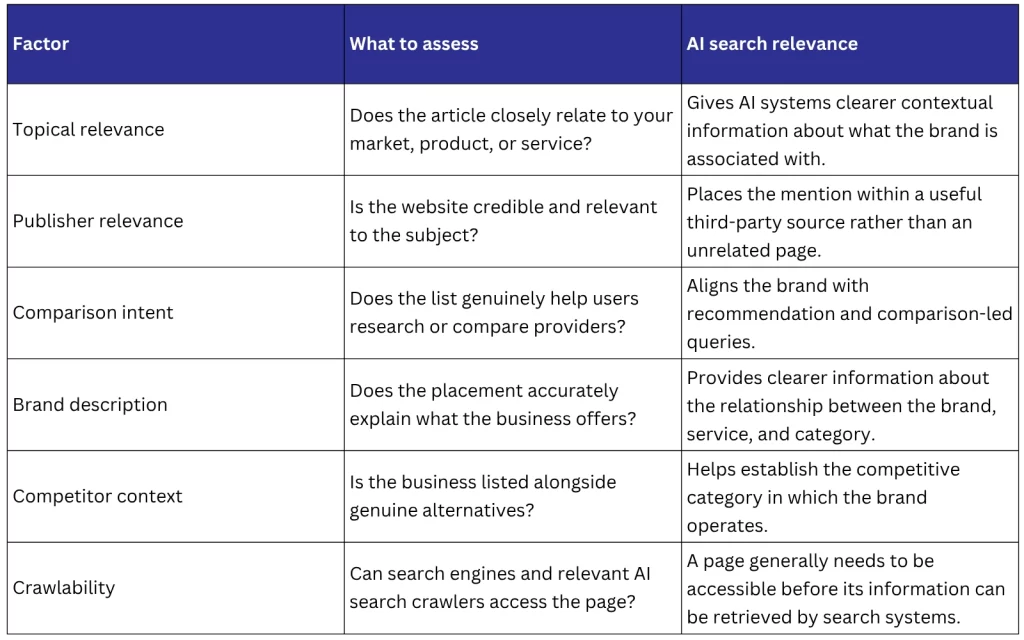
AI systems favour third-party signals, like brand mentions, alongside many others, so how can you make yours the most valuable it can be? If you want to create listicles for AI search, we first recommend starting with an AI SEO audit to help you spot gaps in the market and evaluate your content to confirm it’s AI-retrievable, among other tasks. As you build the listicles yourself, focus on:
The goal of any listicle should be to strengthen the relationship between your brand and its products or services that they want to be discovered for. If you would like more information on how to optimise your content for generative AI, see Google’s official blog.
A word of caution should be noted here: Third-party mentions will only hold value when you are following the correct AI SEO practices. Mass-producing irrelevant brand mentions, or even artificial ones, is not a shortcut to success.
Listicles are a great SEO strategy, but they shouldn’t be used alone, particularly when they complement so many other fantastic techniques and practices. For example, you can opt for our Brand Mentions service but then also make the most of our Content, Technical SEO, Digital PR, and Backlinks services as well to build out your overall campaign for both traditional search and AI visibility.
Our recommendation is to always include third-party visibility campaigns as part of a broader and more consistent digital footprint because AI visibility comes from creating strong signals across the entire web. While it does frequently use listicles to its advantage, it does not rely on them alone, so neither should you.
Listicles are becoming strategically valuable to those who are branching off in this direction, and mostly because search discovery is increasingly including AI-generated comparisons, research, and recommendations. These third-party placements are giving more and more brands the opportunity for additional places for their brand to appear, furthering the word about their expertise and services, and granting them more opportunities for discovery.
As with many strategies within SEO and AI SEO, brand mentions deliver the most value when they are part of a wider strategy. One that is designed for improving organic and AI search visibility. You don’t have to worry about kickstarting an entire SEO campaign by yourself. We are here to help build a plan that works for you and your budget and helps you get on track to the results you want to see. Get in touch with us today to learn more about our Brand Mentions and AI SEO services.
Can Listicles Help My Business Appear in AI Search?
Creating and publishing third-party listicles can be another way to have publicly accessible sources connecting your brand with your products, services, or categories, which can support wider AI search discoverability. As with every element of SEO and AI SEO, results are never a guarantee. Your placements won’t necessarily return an AI citation or recommendation.
How Do AI Search Engines Find Listicle Content?
Search engines follow a simple process of crawling, indexing, and retrieval. For AI-powered systems, while they may operate slightly differently, publicly accessible web pages are still crawled and retrieved in order to be used as supporting sources.
Do ChatGPT and AI Search Engines Crawl Websites?
Yes. Both OpenAI and Google crawl websites. ChatGPT search uses the OAI-Search bot, while Google uses its reliable search crawling and indexing infrastructure for generative search experiences.
Why Are Brand Mentions Important for AI SEO?
When you have multiple third-party sources providing additional context about what your company does, the market you operate in, and how it relates to a particular topic or service, you are increasing your chances of being cited or recommended in an AI-generated answer.
Are Listicle Backlinks Good for SEO?
Yes, absolutely! When you introduce relevant editorial links, you’ll be able to support a wider backlink strategy, but more than that. Each placement may offer value in terms of brand discovery, relevance, and third-party context.

Domain Rating (DR) is one of the most talked about SEO metrics. It’s used to…

A well-written press release is one of the most impactful ways to secure quality media…
Download our free Millionaires SEO Guide Today!
If Google's latest Web Core Vitals update has caused havoc to your SEO results, find your solution in our latest in-depth ebook.
Outreach emailing is a traditional marketing strategy that involves sending an email to someone with whom you have no previous…
Domain Rating (DR) is one of the most talked about SEO metrics. It’s used to…
A well-written press release is one of the most impactful ways to secure quality media…
If you look back at films from the 80s, filmmakers created visions of flying cars…

The phrase “content is king” was so commonplace for years that many businesses and web…

The amount you invest in your link building budget should be based on the realistic…

Search engines aren't the only automated systems accessing, interpreting, and making sense of content found…

There's plenty of scope when creating SEO campaigns. Each industry that turns to experts for…

PR has long supported brands in building authority and spreading awareness, but PR distribution has…
If you are looking to increase your traffic, sales & leads, let's have a chat!

The team will usually respond within 1 hour.
