When comparing GEO vs SEO, it isn’t a case of one replacing the other. SEO helps your website rank in traditional search engine results, while GEO helps your content appear in AI-generated answers across platforms, such as ChatGPT, Perplexity, and Google AI Overviews. Understanding GEO SEO is becoming a fundamental way of building long-term online visibility, as well as AI search visibility.

In this guide, we’ll explain the differences between SEO vs GEO, where the two strategies work together, and why most businesses should invest in both rather than choosing one over the other. We’ll also explore how GEO relates to AEO and LLMO, as well as compare how leading AI search platforms respond to the same query, examine the original research behind generative engine optimisation, and look at the metrics that matter when measuring success.
If you’re looking to build a broader understanding of AI search before diving in, explore our AI SEO page for expert guides, insights and practical advice.
Contents
- What Is GEO? What Is SEO?
- GEO, AEO and LLMO: Addressing the Overlap Honestly
- GEO vs SEO Comparison Table
- Live Test: One Query Across Three AI Platforms
- The Original GEO Research
- How to Measure GEO Performance
- Do You Need GEO If You Already Have SEO?
- Frequently Asked Questions
What Is GEO?
Generative Engine Optimisation (GEO) is optimising content so it can be understood, cited and surfaced by AI-powered search platforms, including ChatGPT, Google AI Overviews and Perplexity. Unlike traditional search, generative engines create direct answers by drawing information from multiple trusted sources. GEO helps improve your chances of being included in those responses. Learn more about our Generative Engine Optimisation service.
What Is SEO?
Search Engine Optimisation (SEO) is the process of improving a website’s visibility in search engine results for relevant keywords. It combines technical optimisation, high-quality content, authority building and user experience to increase organic traffic and connect businesses with people actively searching for their products or services.
GEO, AEO & LLMO: What’s the Difference?
If you’ve been researching AI search, you may have noticed that Generative Engine Optimisation (GEO), Answer Engine Optimisation (AEO) and LLM Optimisation (LLMO) are often used interchangeably. That’s because there is overlap between them.
The easiest way to think about it is that GEO is the umbrella term. It covers the wider practice of optimising content so it can be discovered, understood and referenced by AI search platforms.
Within that, AEO focuses on helping content appear in answer-driven experiences, such as featured snippets and Google AI Overviews. If you’d like to learn more, explore our Answer Engine Optimisation and AI Overviews Optimisation services.
LLMO, on the other hand, is more closely associated with improving the likelihood of your content being cited or referenced by large language models, including platforms such as ChatGPT and Perplexity. You can learn more about this approach through our LLM Optimisation service.
The important thing to remember is that these terms are closely connected, not competing strategies. Whatever label you use, the end goal is the same: creating trustworthy, authoritative content that AI platforms can confidently surface in response to users’ questions.
GEO vs SEO Comparison Table
Understanding the difference between SEO and GEO starts with recognising that they are designed for different search experiences. SEO focuses on improving visibility in traditional search engines, while GEO aims to increase the likelihood of your content being surfaced and cited within AI-generated responses. Although many of the underlying principles remain the same, the platforms, optimisation targets and success metrics are changing as AI search becomes more widely adopted.
The table below compares the key differences between traditional SEO and GEO, helping you understand how each approach supports your overall search visibility strategy.
| Category | SEO | GEO |
| Search output | SERP with ranked links | AI-generated text answers |
| Search engine type | Traditional (Google, Bing) | Generative (ChatGPT, Perplexity, Gemini) |
| Query format | Short, keyword-based | Longer, more conversational prompts |
| Optimisation target | Higher rank in search results | Inclusion or citation in AI-generated responses |
| Content delivery | User clicks through to your page | AI summarises or paraphrases your content within its answer |
| Success metrics | Clicks, traffic, rankings, bounce rate | Citations, mentions and share of voice |
| Content update needs | Evergreen content can stay ranked for years | Content must stay fresh and authoritative to remain cited |
GEO doesn’t replace SEO; it builds on it.
Live Test: One Query Across Three AI Platforms
One of the biggest differences in the GEO versus SEO conversation is that AI search platforms don’t all generate answers in the same way. To demonstrate this, we tested one commercially relevant query across ChatGPT, Perplexity, and Google AI Overviews on the same day.
For ChatGPT and Perplexity, we searched “Best UK white label SEO agency.” For Google, we used “white label SEO” to trigger an AI Overview. Although the queries were closely related, the results highlighted an important point: AI search platforms don’t all generate answers in the same way.
ChatGPT
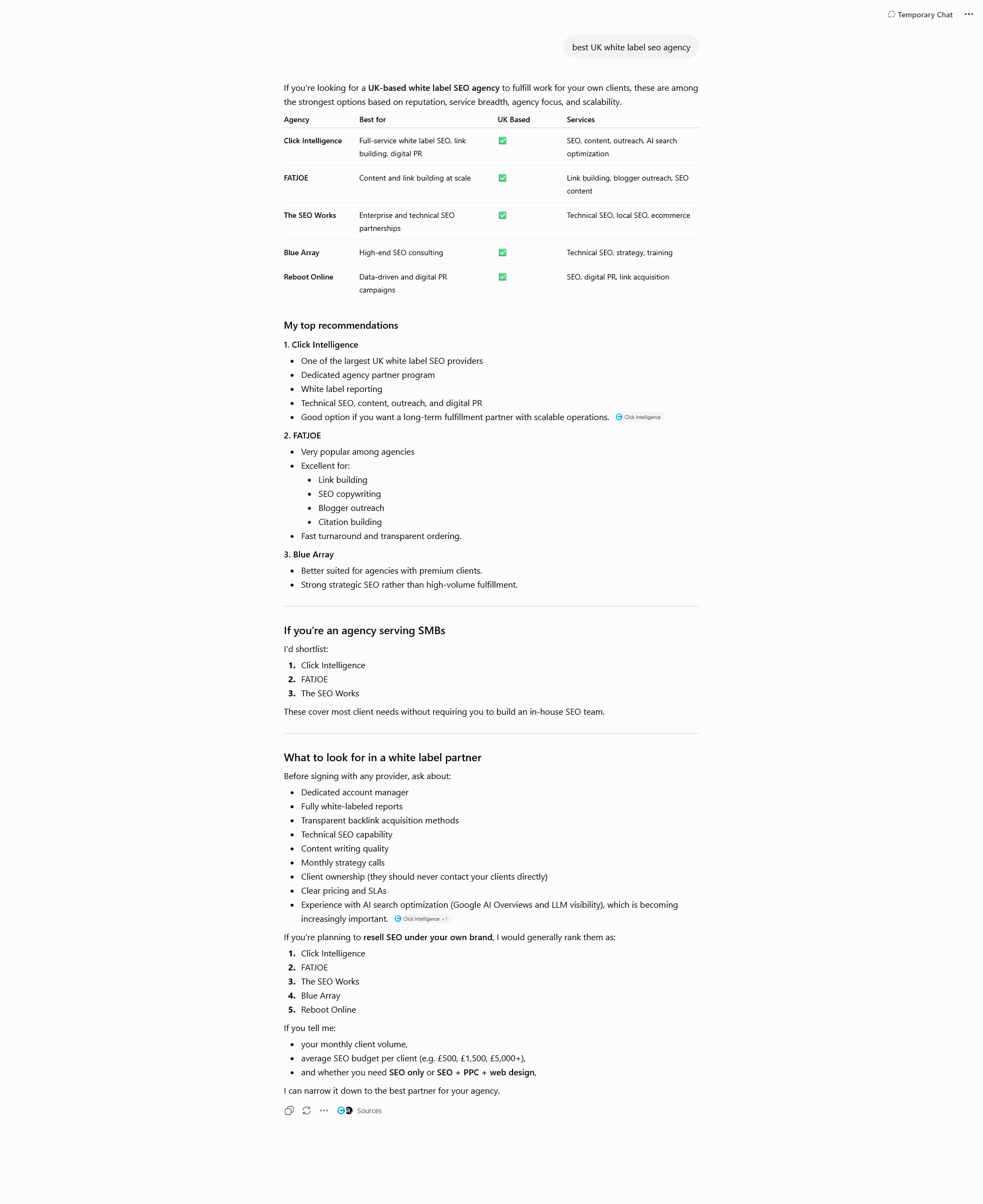
Our ChatGPT SEO test produced the most structured response, presenting a comparison table of recommended agencies, their strengths, and the types of businesses they best suited. It highlighted Click Intelligence as its top recommendation and followed this with practical advice on choosing a white label SEO partner, including questions agencies should ask before making a decision. Citations were displayed throughout the response, linking individual claims back to supporting sources.
Perplexity
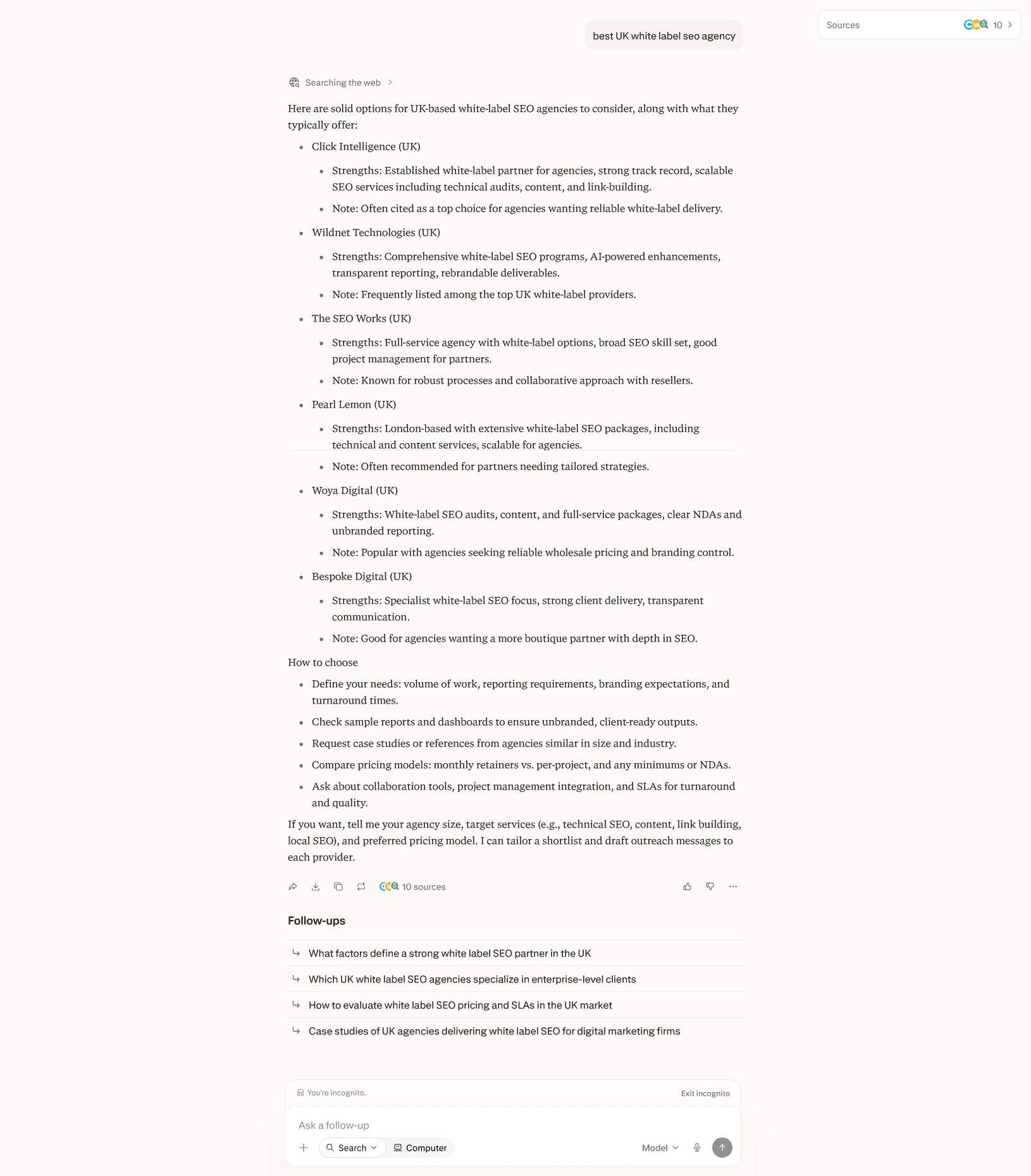
The results also highlighted the importance of Perplexity optimisation. Instead of ranking agencies in a table, it provided a shorter list of recommended providers before moving quickly into buying advice. It also cited sources throughout the response, with ten references supporting its recommendations. While Click Intelligence was included among the cited providers, the answer drew from a broader mix of agency websites and industry sources, placing greater emphasis on helping the user evaluate different options.
Google AI Overviews
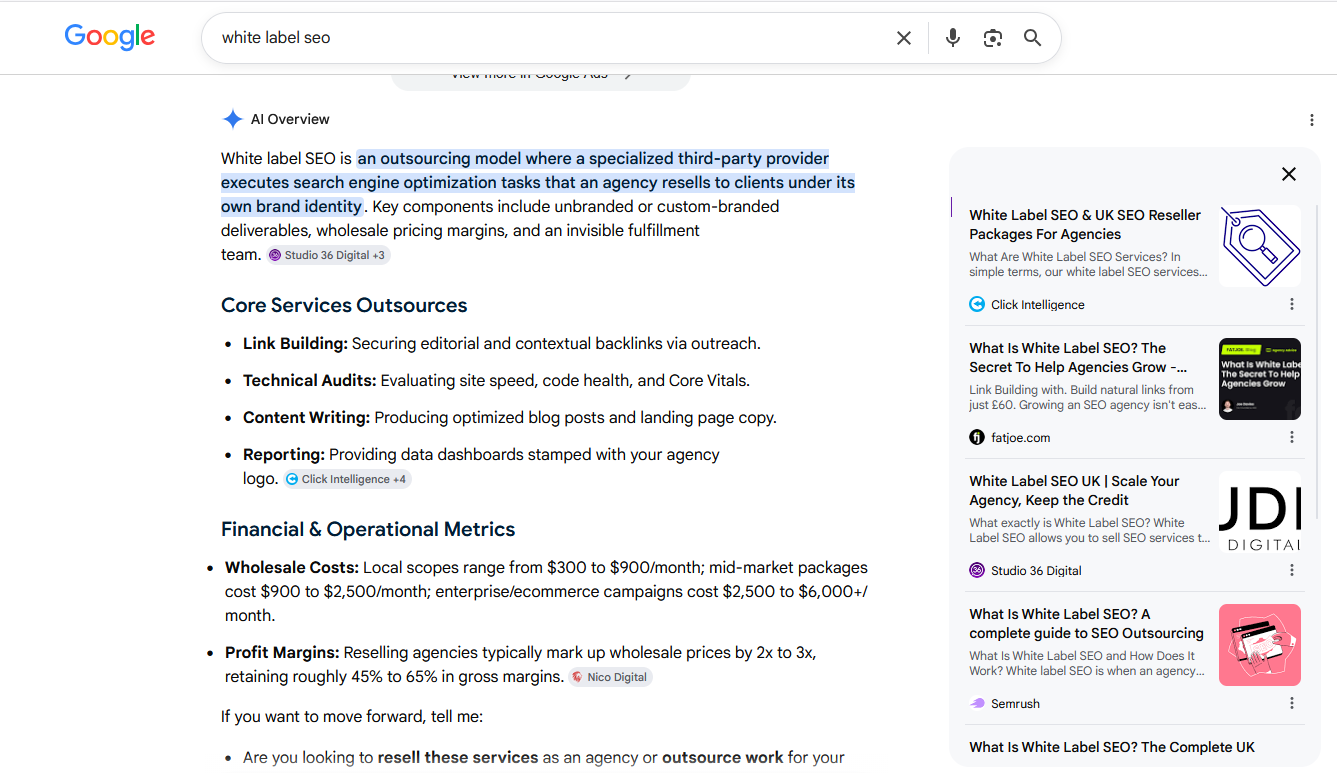
Unlike the other platforms, Google AI Overviews took an educational approach. Instead of recommending agencies, it explained what a white label SEO is, how the model works, and the services typically included. Citations were embedded throughout the summary, with relevant providers displayed beneath the AI-generated response, encouraging users to explore further.
What This Tells Us About GEO
Although all three platforms were responding to closely related searches, they produced noticeably different results. ChatGPT generated a detailed comparison with recommendations, Perplexity balanced recommendations with buying guidance, while Google AI Overviews focused on explaining the topic before directing users to supporting websites.
The takeaway is clear: GEO is platform-specific. Optimising your content for one AI search engine doesn’t guarantee the same level of visibility on another. Each platform selects, structures, and cites information differently, which is exactly why businesses need a broader GEO strategy that builds authority across multiple AI search experiences, rather than targeting a single platform all on its own.
Original GEO Research
Much of the conversation around generative engine optimisation services can be traced back to the original GEO: Generative Engine Optimization study by Aggarwal et al., published in 2023 by researchers from Princeton University, Georgia Tech, the Allen Institute for AI, and IIT Delhi. Widely regarded as the first major piece of GEO research, the paper introduced a framework for improving how content is surfaced within AI-generated responses, making it a landmark GEO study for businesses looking to understand generative search.
The researchers tested a range of optimisation techniques and found that adding credible sources, relevant quotations and supporting statistics consistently improved content visibility. In some cases, these changes delivered an AI visibility improvement of 30 to 40 per cent, although the results varied depending on the topic and the optimisation method used.
Like any academic study, the findings should be viewed in context. The research was carried out using a controlled benchmark called GEO-bench rather than live search platforms, and later researchers have noted that real-world AI search is considerably more complex and continues to evolve rapidly.
Rather than treating the study as a definitive rulebook, it is best viewed as the starting point for understanding how AI platforms evaluate and reference content. Its biggest contribution was demonstrating that content written with authority, evidence, and clear attribution is more likely to be surfaced in AI-generated answers.
How to Measure GEO Performance
One of the biggest differences when comparing KPIs for GEO vs SEO is how success is measured. Traditional SEO focuses on metrics such as keyword rankings, click-through rate, organic traffic, and conversions from search engine results. While these are still valuable, they don’t tell the full story when your goal is to appear in AI-generated answers.
Instead, GEO requires a broader set of performance indicators that reflect how your brand is being surfaced across AI search platforms. Instead of asking, “Where do I rank?”, the more important question becomes, “How often am I being referenced, and what impact does that visibility have?”
Some of the most valuable GEO metrics include:
- Citation frequency: How often your brand or content is referenced within AI-generated responses.
- Share of voice: How visible your business is compared with competitors across AI search platforms.
- AI-referred conversion quality: Whether visitors arriving through AI search are engaging with your website and completing valuable actions, rather than simply increasing traffic numbers.
These metrics provide a much clearer picture of how your content is performing in generative search, where visibility isn’t always tied to a traditional ranking position.
To help businesses measure this evolving search landscape, here at Click Intelligence, we’ve developed dedicated reporting tools within Click Insights, including the AI Overviews Tracker and LLM Visibility Tracker. Together, they help monitor AI citations, track visibility over time, and identify opportunities to improve your presence across generative search platforms.
For one SaaS client, we increased AI Overview appearances from just one to 448 within 12 months, alongside 206% year-on-year organic traffic growth. You can explore the full results in our SaaS SEO Reporting Platform case study, which shows how combining strong SEO foundations with a targeted GEO strategy can drive measurable business outcomes.
Do You Need GEO If You Already Have SEO?
In most cases, yes, you do. SEO and GEO work best together, rather than as separate strategies or as competing priorities.
A strong SEO strategy helps to give your website the foundations it needs to perform well in traditional search. Having high-quality content, technical optimisation, digital PR and topical authority all contribute to stronger visibility in search engines. These same strengths also increase how likely it is that your content will be recognised, referenced and cited by AI search platforms.
However, AI-generated search experiences introduce new opportunities that traditional SEO by itself doesn’t fully address. With more people turning to tools such as ChatGPT, Google AI Overviews and Perplexity for answers, businesses need to think far beyond rankings and consider exactly how their content is cited, summarised and recommended. That’s why an integrated SEO and GEO strategy is becoming increasingly important for brands that want to maximise their visibility across both traditional and AI-powered search.
This is where a GEO agency can help brands. Instead of just replacing your existing SEO efforts, GEO builds on them in order to strengthen your presence wherever people search for information. Whether you’re working with a generative engine optimisation agency or looking for a specialist GEO SEO agency, the goal should always be the same: creating a joined-up strategy that supports long-term visibility across every stage of the search journey.
If you’re looking to strengthen your presence across both channels, our Generative Engine Optimisation service combines proven SEO expertise with a forward-thinking GEO strategy, helping your business stay visible wherever your audience chooses to search.
FAQs
- What is GEO vs SEO in simple terms?
SEO improves your website’s visibility in traditional search engine results, while Generative Engine Optimisation (GEO) helps your content appear in AI-generated responses across platforms like ChatGPT, Google AI Overviews and Perplexity. Rather than replacing SEO, GEO builds on it to improve visibility wherever people search for information.
- Is GEO the same as AEO or LLMO?
Not exactly. GEO, AEO and LLMO overlap significantly and are often used interchangeably, but they have slightly different focuses. GEO is generally the broader term, while Answer Engine Optimisation (AEO) focuses on answer-based search experiences and LLM Optimisation (LLMO) focuses on improving visibility within AI chatbots. Learn more about our Answer Engine Optimisation and LLM Optimisation services.
- What are the KPIs for GEO vs SEO?
The KPIs for GEO vs SEO are different because they measure different types of search visibility. SEO focuses on rankings, click-through rate, organic traffic and conversions, while GEO is measured using citation frequency, share of voice and AI-referred conversion quality across AI-powered search platforms.
- Do I need both SEO and GEO?
Yes. SEO improves your visibility in traditional search engines, while GEO helps your content appear in AI-generated responses. Most businesses benefit from an integrated SEO and GEO strategy, as the two approaches work together rather than replacing one another.
- How is GEO measured differently from SEO?
Traditional SEO metrics include keyword rankings, click-through rate, and organic traffic. GEO uses AI visibility metrics such as citation frequency, share of voice, and AI-referred conversion quality to measure how often your content is surfaced and referenced by AI search platforms.
About the author
James Owen
Co-founder & Director
Since 2007, James has been at the forefront of the SEO world. During the early years of his career, James was the lead on many high-end projects for well-known travel, gaming, and retail brands, such as Jackpotjoy, Smyths Toys, eBay, Gumtree, Betway, and Expedia. However, this isn’t even touching the surface, and this list is continually growing.
Since opening Click Intelligence with Simon in 2013, James has been a crucial part of several elite SEO projects that have transformed businesses in a variety of sectors. His experience and knowledge haven’t just been passed down to clients either. James has also been a speaker at SEO and digital marketing conferences and events, such as Brighton SEO, guiding everyone involved in the industry.