LLM SEO is the digital marketing practice of optimising a website, its content, and brand presence so that large language models like ChatGPT can easily understand and interpret this, and surface that brand in their AI-generated answers, as a result.

With more people preferring to use ChatGPT, Perplexity, Claude, and Google AI Mode over traditional search engines, for brands eager to secure the valuable traffic at the other end, it’s time to embrace SEO for LLMs. If you are new to AI SEO, including LLMO (large language model optimisation), our guide explains exactly what this process is, how LLMs find and cite content, and the specific techniques that improve AI search visibility across ChatGPT, Gemini, and more LLMs.
Key Takeaways
- LLM SEO is the optimisation practice to get brands more AI visibility on LLMs like ChatGPT and Gemini.
- LLMs use the training data or live retrieval pathways to find content.
- For the most accurate AI-generated answers, LLMs rely on a combination of internal knowledge and fresh information, so updating content regularly and consistently matters.
- Measuring and tracking citations, brand visibility, and share of voice further optimise LLMO
- Not many brands have noticed the AI opportunity, so this gives major advantages for those that act now.
What Is LLM SEO?
LLM SEO refers to the practice of optimising content and websites to boost AI visibility. You may see the term LLMO floating around and think this is the same, but there are some subtle differences. LLMO (large language model optimisation) techniques tend to focus on what influences results away from the website, such as third-party mentions and citations, reviews, and structured data. When you use our LLM SEO services, our LLM SEO consultants use LLM SEO practices to make your content easy for AI to find and understand, and LLM optimisation to make your brand appear in the recommendations.
As you begin your search into LLM SEO vs SEO, terms such as GEO (generative engine optimisation) and AEO (answer engine optimisation) will also appear. These all have subtle differences worth noting, too. GEO is about optimising content so that it is more likely to be cited by generative AI systems, while AEO optimises for answer engines.
How LLMs Find and Use Your Content
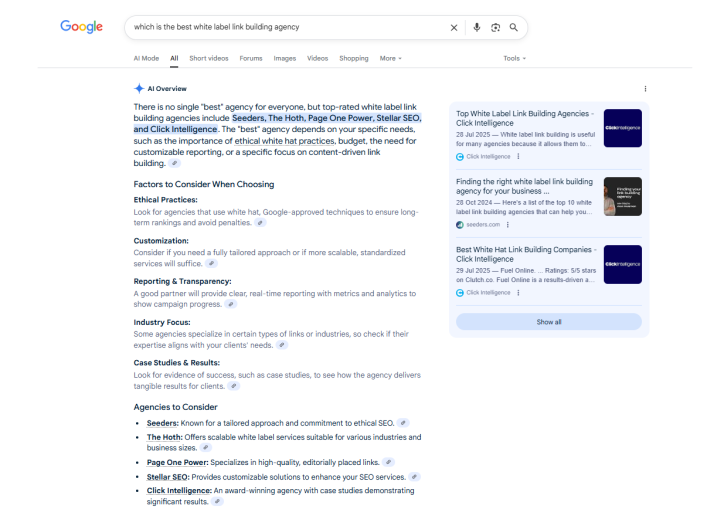
Before you start an LLM search optimisation campaign, you need to know how LLMs find content and subsequently how they use it. There are two main pathways that LLMs use to know about your brand:
- The Training Data (Parametric) Pathway
The training data pathway refers to the long-term knowledge an LLM has gained during training and stores in its parameters. During this process, many LLMs are trained on datasets, such as from Common Crawl. This non-profit organisation crawls the internet continuously and owns the largest open datasets of web pages. Before training, they heavily filter this data, typically removing the lowest-quality pages, duplicate content, and spam to give a snapshot of the web so that the LLMs don’t have to sift through unnecessary and potentially inaccurate information. LLM models then combine this dataset training with other sources, such as books, academic research, code, and licensed content.
While you can’t control exactly what becomes part of a model’s long-term knowledge, brands still want to know what they can do to increase their chances of becoming part of it over time. Many companies believe that posting one great blog post is enough to appear in AI models, but this isn’t how the training data pathway works. Rather than memorising your website, they learn patterns and relationships through vast amounts of information. When you appear frequently for the same topic, demonstrating yourself as an expert, it begins to associate this with your brand, and those associations become part of its parametric knowledge.
This is why the LLM training data pathway is considered a long-term compounding strategy. Every authoritative article you produce, industry mention and backlink you gain, expert contribution, and PR piece you publish contributes to your brand’s online presence. With time, these signals increase your chances of becoming part of the LLM’s long-term knowledge and appearing in their AI-generated answers.
- The Live Retrieval Pathway
The live retrieval pathway is the process of AI systems looking up relevant information in real time from web sources to form their answers. It doesn’t rely only on previous training or knowledge stored away. Why this is important is because the world is continually changing. New products, stock prices rising and falling, leadership changes, and breaking news are just some of the examples of this. It would take a lot to retrain LLMs every single day. To combat this ever-changing world, LLMs use retrieval-augmented generation (RAG). With this, AI looks up information first and then uses it to generate a better answer. Without RAG, AI systems are answering from memory that hasn’t been trained on the latest announcements.
One technique the live retrieval pathway uses to improve the experience further is fan-out queries. With this, rather than relying on a single search to generate their answers, they break the user’s question into several smaller questions, called sub-queries. These sub-queries explore different aspects of the topic, and this information is then combined into one answer.
For example, if a user types into ChatGPT or Gemini “What’s the best energy supplier in the UK at the moment?” this is considered to be quite a broad question. From this, they will break this down into the following sub-queries:
- Pricing with a query such as “Current UK energy tariffs and standing charges”, which looks into supplier tariff pages, Ofgem information, and comparison websites.
- Customer satisfaction, such as “Latest UK energy supplier customer satisfaction ratings”, turning to customer surveys and reviews.
- Renewable energy option prompts like “UK energy suppliers offering 100% renewable electricity”, using supplier websites themselves and industry comparisons.
They take all their findings from each of these queries to suggest who might be the best energy supplier as of right now. They are basing their answer on previous knowledge. They are using the most relevant, up-to-date information out there to give users the best experience.
Which Pathway Is Best?
Both pathways matter, but unfortunately, a lot of brands only pay attention to live retrieval. While it does bring benefits, if you focus on the live retrieval pathway, you can only optimise for today’s answers. When you bring in the training data pathway, you open yourself up to the opportunity of investing in tomorrow’s models. In short, you need both for the most success, and several best practices to follow.
Traditional SEO vs LLM SEO
A huge amount of focus seems to be on LLM SEO and getting visible on AI search, and this is causing many to believe that they can pull back on their traditional SEO. We do not recommend you do this. Both benefit you in different ways.
| Traditional SEO | LLM SEO | |
| Focus | Keywords and backlinks | Context, citations, credibility |
| Goal | Ranking in the SERPs | AI visibility and reference increase in LLM-generated answers |
| Reporting | Rankings and CTR | LLM visibility and citation frequency |
| Tactics | Metadata and link building | Structured data, entity signals and semantic depth |
| Platforms | ChatGPT, Gemini, Copilot |
It may first appear as though there is a battle of LLM SEO vs SEO and ranking vs citation, but LLM SEO doesn’t replace traditional SEO; it builds on it.
Best Practice 1: AI Crawler Access
AI crawlers are automated bots that browse the internet, collecting public data that they use for AI search, retrieval, and, in the future, data training. If you are familiar with SEO, they are similar to search engine crawlers, but there are some distinct differences. For example, unlike the Googlebot, many AI crawlers primarily rely on the raw HTML of a page and do not execute JavaScript. What this means for published content is that it needs to be accessible within the HTML, ideally through server-side rendering, not client-side rendering.
Always check that you aren’t inadvertently blocking AI crawlers, especially if you want to be discoverable by AI systems. Assess your robots.txt for AI to ensure that you permit the following AI crawlers:
- OAI-SearchBot
- ChatGPT-User
- PerplexityBot
- Google-Extended
- ClaudeBot
- Applebot-Extended
Don’t worry if you find any of these are blocked. Many sites have blocked AI crawlers without knowing they’ve done so, meaning you aren’t alone. It depends entirely on your configuration, and if you didn’t set yours up, there’s a chance your web developer has blocked these AI crawlers without intending to. For anyone using Cloudflare, be aware that it may be blocking certain AI crawlers by default. If Cloudflare AI bot blocking stops AI crawlers from being able to access your content, you are less likely to be retrieved or referenced, which is why this is always the first action worth taking.
Best Practice 2: Structure Content for LLMs
The recommended practice for how you structure content for LLMs is to have clear heading hierarchy (H1/H2/H3) followed by self-contained paragraphs that easily make sense when out of context. Where possible, aim to use lists and tables rather than dense prose because this makes your content much easier to identify, understand, and retrieve.
As you write, remember that while depth is important, where you position your most valuable content matters. The goal of any blog post, paragraph, or on-page article should be to have front-loaded content.
Readers and AI systems alike don’t want to have to dig through paragraph after paragraph to find what they need. If you can answer a question within the first 40-60 words, do so. There’s no stopping you from exploring the topic in depth further down, but ensure you focus on front-loaded answers so users get their answers quickly. AI systems can continue to retrieve and understand what you’ve included quickly, this way, too.
Best Practice 3: Schema markup
Adding LLM SEO schema (structured data) isn’t about making AI like your page. Structured data makes it much easier for AI systems to interpret pages. They don’t have to waste time trying to figure it out. When you have a page that genuinely contains FAQs, and you add FAQPage schema, this tells the machines this page contains frequently asked questions and their answers. There’s no longer any ambiguity because the schema markup has explicitly said what the page is. The types of schema markup you can include are:
- Article schema: This page is an article.
- HowTo schema: This page is a how-to article.
- Organisation schema: This describes a company.
- Person schema: This describes an individual.
- Product schema: This page is about a product.
- LocalBusiness schema: This is a business with a physical location.
- Review schema: This page contains genuine product or service reviews.
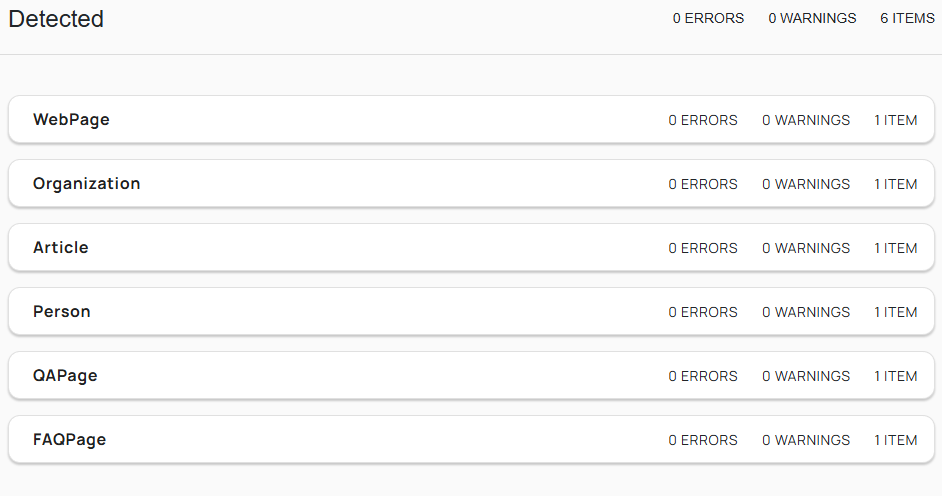
You should only ever add schema markup to reflect what is on the page. For example, don’t add how-to schema unless you have step-by-step instructions. If you don’t have genuine reviews on your page, don’t apply review schema. While nothing terrible will happen, this is still considered misleading, and your content may become ineligible for rich results, even if it is the best out there. Missed opportunities like these can make all the difference.
Best Practice 4: Original, human-authored content
For content to perform well, it must be original and human-written. Yes, AI can generate an article in seconds, but it will never perform as well as human-authored content, particularly when it is low-quality and mass-produced. Content of this quality lacks originality and experience, doesn’t add anything new to the web, instead repeating the same information already online, and can include factually incorrect information. Human-written content, on the other hand, expands the web’s knowledge with its expert opinions, original research, case studies, unique insights, data, and first-hand experience.
The biggest risk of more people turning to AI to produce their content rather than experts on the subject and qualified content writers is model collapse. If no new information is published, we risk a future in which AI models are trained on AI-generated content. Therefore, to avoid this, LLMs want genuinely new information, and this can be fulfilled by original content LLM SEO campaigns that take into consideration E-E-A-T requirements, credible sources, up-to-date and accurate information, clear structures, and relevance to the search intent.
Not sure whether your content is what LLMs are looking for? Take a few moments to assess your current page. Could a competitor easily replicate this content tomorrow? If yes, it is not distinctive enough. Elements like original research and data from surveys would mean that any competitor trying to compete with you has to delay their publication because they would have to gather their own data.
Best Practice 5: Freshness
The mistake many companies make is having experts write fantastic content, filled with original stats and unique insights, publishing it, and believing that is enough to keep AI visibility strong. They turn their attention to the next big piece and continue to build on this catalogue of in-depth content.
However, if you only ever focus on the next piece, always forgetting about what you’ve previously published, these may become more missed opportunities, damage your reputation, erode trust, affect your AI visibility and rankings, and allow competitors to outperform you. Facts may become outdated and inaccurate, internal and external links may break, references may not exist anymore, advice may not reflect the current best practices or industry standards, new technology might be here, and optimisation practices may have changed since publication.
If you want to retain the benefits of your content and avoid all this, you must schedule a quarterly refresh. By auditing and freshening up your content every three months, you can maintain the signal of content freshness AI search engines look for. For those particularly keen to boost visibility in LLMs, you must make this refresh a priority. As not everyone is in the habit of updating their old content and AI systems do not want to present outdated information in their answers, they prefer to turn to more recently published content. This is called recency bias. Even if your authoritative piece from 2022 is better, they are more likely to cite a blog post that has been published in the current year. Recency bias in AI citation is only a problem if you don’t update old content and keep it fresh.
When you’ve completed these updates, make sure to add dateModified to schema markup. However, do note that dateModified in schema must reflect genuine content updates, not just a timestamp change.
Best Practice 6: Optimise for Bing
Google may feel like it’s the buzzword when people talk about the internet, but did you know that ChatGPT’s live search actually primarily runs through Bing? You aren’t alone in not knowing, as very few SEO experts have spoken about this and some ignore it entirely. In fact, it’s considered to be one of the underused pieces of advice, and with little said on it, this means that even when businesses find out, they don’t immediately act on it as they should. They continue to optimise for Google, and while this may benefit your AI Overviews visibility, your exposure in ChatGPT search will struggle to surface.
The first step in conducting Bing SEO for ChatGPT is to set up Bing Webmaster Tools. This will take less than 10 minutes to do. Start by creating an account, verifying your site, and doing a sitemap submission. Once you’ve done this, you need to start monitoring your Bing rankings alongside Google. It’s been noted that pages that rank well in Bing tend to appear more in ChatGPT citations, so keeping an eye on your rankings is well worth your time.
Best Practice 7: Target fan-out queries
AI search engines don’t just take the question or prompt your customers are entering and find an answer for that. They turn this question into lots of related searches, called sub-queries.
For successful AI visibility retrieval for your brand, we need to use the fan-out queries strategy. With this, the idea is you have to anticipate the sub-queries your real audience might ask in conversational search, breaking your content into these smaller questions. Our example in the How LLMs Find Content section explores the type of query fan-out prompts that might come from the initial main prompt: What’s the best energy supplier in the UK at the moment? Include these as question-based headings in your content, keeping each section entirely focused on that sub-query in a self-contained paragraph.
To discover what your real sub-queries might be, use ChatGPT’s autocomplete in an incognito window to discover real sub-queries that your audience is likely to ask. Start typing in a prompt like “How does content freshness…” and it will suggest how you can finish this prompt, such as:
- …affect SEO?
- …impact AI search?
- …improve rankings?
You can take these prompts and turn them into question-based headings. Don’t rely solely on ChatGPT, but this can be a great way to get you started.
Best Practice 8: Build brand mentions beyond your own site
LLMs learn from the whole web, not just your own content, frequently using brand mentions as a strong signal, as these help them establish authority, identify entities, and connect information. Therefore, it’s time to look beyond your website and start earning more brand mentions. The goal should be to achieve brand mentions on some of these high-signal platforms:
- Hacker News
- GitHub
- Stack Overflow
- YouTube
- Industry forums
The practices our experts use to get third-party citations begin by finding content AI already cites for your target queries on forums and high-signal sites. As the topic is highly relevant, getting a mention within this can be extremely beneficial. To further expand the brand mentions AI search for, we build digital PR campaigns to get other people talking about your brand through newsworthy stories, expert commentary, and original research.
Best Practice 9: Grow branded search volume
Brand awareness matters for more than just your profit lines; it also signals to search engines and AI systems alike that your brand is relevant but also one to be trusted. Therefore, if you can increase your branded search volume, you could increase your LLM visibility. Branded searches won’t drastically improve overnight, but they can progress in the right direction with a consistent helping hand that is willing to put in the time and effort required. We recommend producing thought leadership content packed with original research and data to get people talking, remembering, and looking up your brand. Combine this with a consistent social presence and sponsoring podcasts and newsletters relevant to your brand. You should be able to make your name not just recognisable but widely discussed for all the right reasons.
Best Practice 10: Consider an llms.txt file
An llms.txt file is a companion to robots.txt that describes a site to AI systems, helping them understand the most important content. Out of all the practices for LLM SEO, take extra care with this. It is currently an emerging standard. No major LLM has confirmed they are using it, with Google being very honest to say that it does not use it, either. Only consider this as a low-effort signal that is worth adding but isn’t necessary. It’s not going to guarantee you visibility.
If you would like to implement this, use an llms.txt generator to create the AI crawler file rather than write it out manually.
Best Practice 11: Build topical authority with content clusters
The recommended practice for content writing is to answer the question directly first, ideally within the first 40-60 words. You then go on to provide supporting context and details after this. What happens with many is they only do half of this correctly. They may answer it directly, but they don’t follow up with the content that takes it from a thin page to a comprehensive one. When you have two competitors both with the same content subject matter, it is going to be the more comprehensive of the two that will beat the other.
Getting this type of content is made much easier when you go to LLM optimisation experts like us. We are highly skilled in being able to create high-end content, but we take it further than this. Whether you opt for our LLM or AEO service, we can create pillar and cluster models for clients in all industries.
The pillar and cluster model is a content strategy that organises your website to create one comprehensive page (called a pillar page) and support this with cluster pages. The pillar page is a broader guide that excels in authority, introducing all the major concepts of that subject matter, without the need to go into minute details everywhere. That is what your content cluster is for. Each cluster explores one aspect from the pillar topic in much greater detail. With a solid internal linking strategy, navigation between the pillar and the topical authority content clusters couldn’t be easier.
We will recommend this practice for all our AI SEO services, including GEO and AIO.
Best Practice 12: Don’t hide FAQs
Whenever you have an opportunity for FAQs, make sure this is completely visible content. In other words, do not hide any LLM SEO FAQs behind an accordion requiring a click. As standard for structured Q&A, you should aim to include 8-10 well-answered questions that demonstrate genuine expertise. Having 3-4 average answers on your page hidden is not enough to meet the AI signals.
How to Measure LLM SEO Performance
To determine which of the practices is bringing the best results, which needs further refinement, and what isn’t working for you, it’s time to measure LLM SEO performance. There are four key areas worth focusing on. These are:
- Share of voice: Share of voice measures how often your brand appears in AI-generated answers, when compared to your competitors. If a target user asks 10 questions relevant to your brand, and you show up six times, another competitor shows up twice, and another shows up four times, your share of voice is stronger. If you were only showing up twice, this shows your competition is building authority and brand awareness, and you are missing out on visibility in the conversations that really matter. Monitoring share of voice keeps you aware, helping you understand if AI platforms view your brand as an authority within the industry, and refines optimisation efforts to improve visibility even further.
- Citation tracking: Citation tracking is about measuring how often platforms such as AI Overviews, Perplexity, ChatGPT, and Bing Copilot use your content as a cited source. How often you are cited tells you a lot. For example, frequent citations suggest that AI systems view that content as trustworthy, relevant, and useful enough to support their answers. Fewer would suggest that your content doesn’t quite meet these expectations. Tracking doesn’t just give you numbers. It gives you insight and opportunities. You can see which content AI platforms are constantly referencing and what you need to aim for.
- Referral traffic from AI platforms: This monitors how many visitors arriving at your site are from AI platforms after interacting with their AI search. Remember, yes, visibility matters, but it doesn’t always create business value. What businesses want is proof that it is providing a good ROI by generating quality leads that increase sales. Monitoring your referral traffic and measuring the time this traffic spends on your pages, as well as your conversions, lead generation, and revenue, can help showcase whether AI traffic is delivering results.
- Topic-level inclusion vs competitors: This looks specifically into tracking which topics AI mentions your brand compared to your competitors. Tracking this enables gaps to be located and where you need to build authority into new, relevant subject areas.
While this may seem like a lot, when you use the right tool, it becomes a breeze. The Click Insights tool can cover all this and so much more, designed for all types of AI systems. Want to monitor your AI Overviews journey? Try out our AI Overviews Tracker. For LLM visibility tracking, we have the LLM Visibility Tracker available.
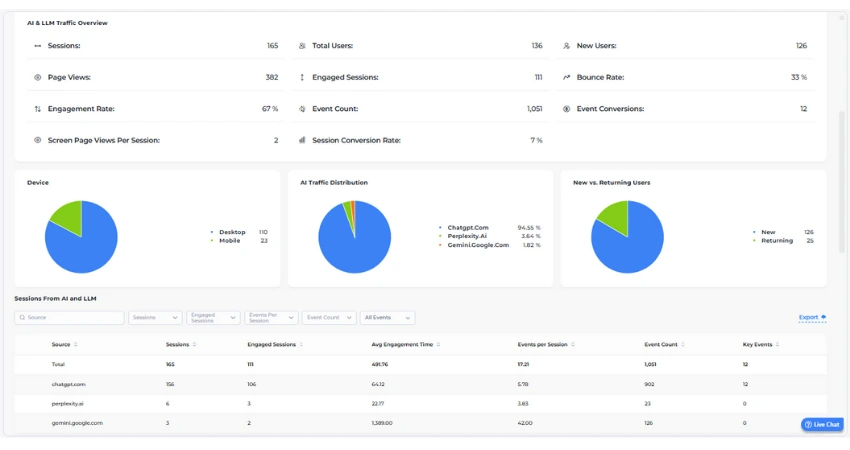
Using our Click Insights tool, we were able to measure and showcase to a SaaS client the difference their investment made over the course of a year. Their AI Overview appearances grew from 1 to 448 within 12 months, and they also saw a 206% year-on-year organic traffic growth. Without measuring these outcomes, it would have been difficult to demonstrate how much the campaigns contributed to this to justify the ROI or which strategies in particular delivered the greatest impact. We are all about ensuring our clients’ investment is being put to the best use, and robust measuring of this kind allows us to direct the campaign, reach informed decisions, and make adjustments along the way that allow successful results.
Want to read the whole story? Our complete SaaS case study is available to read right here.
Common LLM SEO Mistakes
It’s common to make LLM SEO mistakes along the way if you’re not an expert in the industry, but to help you avoid past mistakes countless businesses have made, check out our list below:
- Inadvertently and accidentally blocking AI crawlers due to website configuration and security setup.
- Using AI instead of human-written content, and lacking expert opinions, research, and first-hand experience.
- Ignoring Bing, which ultimately means ignoring ChatGPT, as this live search runs primarily through the search engine.
- Hiding content like FAQs behind JavaScript rendering.
- Building up a catalogue of stale content rather than refreshing it every three months to update out-of-date facts and improve quality and optimisation.
- Treating LLM SEO and traditional SEO as separate strategies when they share many of the same foundations.
- Expecting instant results with LLM SEO and stopping it before signals have had a proper chance to build, verify and spread, and results get a chance to shine.
- Only optimising owned content and not thinking about brand mentions and third-party citations on high-signal platforms like Reddit.
FAQ 1: What is LLM SEO?
LLM SEO is the AI visibility practice that helps businesses transform how often LLMs cite them. It slightly differs from LLMO ( large language model optimisation), which practices optimisation techniques for getting results beyond a website, like third-party citations.
FAQ 2: How is LLM SEO different from traditional SEO?
When comparing LLM SEO vs SEO, LLM SEO is about optimising for AI-generated answers. In contrast, traditional SEO focuses on optimising a website to improve search engine rankings and improve organic traffic from them. Strategies used in LLMO include brand mention campaigns, digital PR, original research and data studies, FAQ optimisation, and pillar and cluster strategies. Traditional SEO includes keyword research, technical SEO audits, link building, local SEO, content gap analysis, and mobile optimisation. There are some crossovers between the two. For instance, internal linking, content freshness, digital PR, technical SEO, schema markup, and content creation are common to find in both.
FAQ 3: How is LLM SEO different from GEO and AEO?
The LLM SEO vs GEO vs AEO debate creates confusion. Yes, the terms do overlap significantly, but there are some differences worth pointing out. LLMO is about optimising content to be understood and cited by LLMs; GEO services, short for generative engine optimisation directs campaigns is about optimising for AI-powered search engines that generate answers, while answer engine optimisation (AEO) services focus on optimising content to provide direct, concise answers.
FAQ 4: Do I need an LLM SEO consultant, or can I do this myself?
There are many LLMOs that a business can reasonably do in-house that bring great results, like improving existing content, answering questions directly, structuring content for retrieval, and publishing original expertise and data. On their own, these can be achievable. When combined, you may find you lack the time to do a thorough job that brings results. This is where bringing in an LLM SEO consultant can be useful. An LLM SEO consultant from an LLMO agency can add more value to your campaign than this too. With our LLM SEO services, we will be able to bring our experience, external perspective, and specialist resources, such as access to industry tools like Click Insights. Beyond this, we can identify the missed opportunities, providing strategic direction for your campaign, build an advanced content strategy, complete with pillar and cluster topics, and increase your brand’s visibility with digital PR.
FAQ 5: How long does LLM SEO take to show results?
LLM SEO isn’t going to transform your results overnight. A realistic LLM SEO results timeline often spans months and varies from company to company, with no two experiencing the same. It also depends on how the LLM your target audience uses discovers and receives information. Most modern LLMs use a combination of training data and live retrieval pathways. What this means for businesses is that they are likely to experience some faster results through live retrieval, particularly when they earn brand mentions on already-cited sources. However, the goal should always be to gain compounding results by building lasting authority. This can lead to higher returns on investment, faster growth in the future, stronger authority signals, and improved efficiency, as every new piece of content, citation, and brand mention is building on an established foundation. These long-term investments continue delivering value past their initial impact and help strengthen your presence long into the future. So, while results can take a while to present themselves, they won’t disappear and continue to leave their mark.
FAQ 6: What tools track LLM visibility?
You can use Click Insights to track all LLM visibility results right here, but there are alternative share of voice tools within the market, including Semrush AI Tracking, Ahrefs Brand Radar, and Profound. Each of these LLM visibility tools brings unique qualities, but for the best all-rounder AI tracking software, Click Insights delivers on all counts.
FAQ 7: Can small businesses benefit from LLM SEO?
Yes, absolutely, they can. Moving into the LLM SEO scene as early as possible is one of the best decisions you can make for your company, as most brands are not yet optimising. Moving now is a genuine advantage regardless of company size. Don’t let this early-mover advantage slip between your fingers and get your LLM SEO small business campaign started today.
About the author
James Owen
Co-founder & Director
Since 2007, James has been at the forefront of the SEO world. During the early years of his career, James was the lead on many high-end projects for well-known travel, gaming, and retail brands, such as Jackpotjoy, Smyths Toys, eBay, Gumtree, Betway, and Expedia. However, this isn’t even touching the surface, and this list is continually growing.
Since opening Click Intelligence with Simon in 2013, James has been a crucial part of several elite SEO projects that have transformed businesses in a variety of sectors. His experience and knowledge haven’t just been passed down to clients either. James has also been a speaker at SEO and digital marketing conferences and events, such as Brighton SEO, guiding everyone involved in the industry.