When conversations around AI search focus on results, they often skip over the work that made those results possible.
It’s easy to point to a graph showing huge growth or to highlight a headline figure, but that only tells part of it. The interesting part, and often the most useful part, is understanding what actually happened behind the scenes. Which foundations were put in place first? Which activities made the biggest difference? Which assumptions proved correct, and which ones took longer than expected to pay off?
This AI overview citations case study does exactly that. It is an in-depth review of a real campaign carried out by us at Click Intelligence for a SaaS SEO and AI search reporting brand. Over the course of twelve months, the campaign increased AI Overview appearances from just 1 citation to 448, while at the same time building a brand new domain to a recognised resource within one of the most competitive sectors in search.
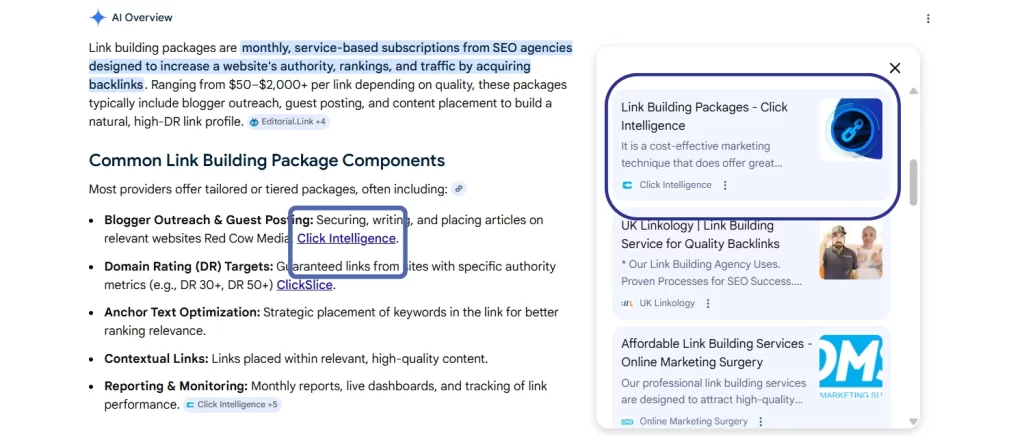
Alongside AI Overview visibility, the campaign also produced considerable improvements across organic traffic, keyword rankings, backlink authority, and overall search presence. Every result formed part of a much wider strategy that was designed to build trust with both traditional search engines and emerging AI-powered search experiences.
If you’d rather a high-level summary of the results, you can view the original SaaS SEO Reporting Platform case study. This article focuses on the method behind those numbers and explains what happened throughout the campaign rather than simply presenting the final outcome.
The Starting Point
Launching a new SaaS platform is never straightforward. Launching one within the SEO and AI search industry is even more challenging.
The client entered a market that was already dominated by established software providers with years of accumulated authority, thousands of backlinks, and extensive content libraries. Competing for visibility against brands with that level of history requires patience just as much as it does strategy.
Unlike many established software brands, this SaaS SEO case study began with a brand new domain that had to build trust from the ground up.
The domain had no meaningful backlink profile, no authority, and no non-branded keyword rankings. Organic visibility was essentially non-existent, which made every improvement something that had to be earned rather than inherited.
At the same time as this, AI search was beginning to change how exactly users discovered information. Visibility within AI Overviews and large language model-generated responses had become an increasingly important objective, particularly for software businesses operating in technical industries.
From the very start, the campaign had several clear objectives.
The first was to establish a technically sound website capable of supporting future growth. Alongside that, the team needed to increase visibility for commercially valuable SEO, SaaS, and AI-related keywords while building topical authority through high-quality content.
Authority also needed to be earned externally. Strategic Link Building and Digital PR formed an important part of the campaign. They helped strengthen trust signals that search engines and AI systems are increasingly relying on when determining which brands deserve visibility.
Ultimately, the goal was beyond just ranking for keywords. It aimed at creating a website that demonstrated expertise across every touchpoint, whether someone discovered the brand through Google Search, an AI Overview, or an AI-powered search assistant.
That challenge was reflected in the starting numbers. The campaign began with just one recorded AI Overview appearance, no meaningful keyword visibility, a Domain Rating of 0, and virtually no organic traffic. Twelve months later, this looked very different.
Why AI Overview Visibility Was Part of the Strategy From Day One
AI Overviews reward many of the same quality signals that support strong SEO. Clear information architecture, topical authority, trusted brand mentions, technically sound websites, and genuinely useful content all contribute towards greater visibility. This meant the campaign was never about chasing AI citations directly.
Instead, every decision was made with the understanding that advancing overall search quality would naturally strengthen the client’s chances of appearing across both traditional search results and AI-generated answers.
As the campaign developed, organic visibility continued to grow while AI Overview appearances followed the same rising trend, suggesting that investing in long-term authority delivered benefits across multiple search experiences rather than just one.
The Methodology, Phase by Phase
This LLM SEO case study demonstrates how technical SEO, content creation, and authority building can work together to improve visibility over time.
We needed to establish a brand new SaaS platform as a trusted source for SEO and AI search topics, all the while building enough authority to compete with businesses that had been investing in organic search for years.
That meant focusing on four core areas:
- Building a Technical Foundation
Before the site could compete, it needed the right foundations. Technical SEO improvements, on page optimisation, schema recommendations, and semantic enhancements were all used to make the website easier for search engines to crawl, understand, and index.
Rather than treating technical SEO as a one-off task, optimisation continued throughout the campaign as new content was added and the site expanded.
- Expanding Topical Authority Through Content
Over twelve months, 210 new landing pages were created to target additional keyword opportunities, support industry-specific topics, and improve AI search visibility. Alongside this, 57 SEO focused landing pages helped strengthen the site’s expertise around its core services.
The objective wasn’t simply to publish more content. Every page expanded the website’s coverage of SEO, SaaS, and AI SEO, which made it easier for search engines to understand the platform’s expertise.
- Strengthening Authority Beyond the Website
A strong website still needs external signals of trust.
Alongside content production, the Digital PR and Link Building campaign secured 516 referring domains. These backlinks and brand mentions helped increase the site’s authority, contributing to its growth from a Domain Rating of 0 to 59.
- Optimising for Traditional Search and AI Search Together
Instead of treating AI search as a separate project, the campaign combined it with the wider SEO strategy.
Semantic optimisation, content clustering, and structured data recommendations were all introduced to improve how information was understood by both traditional search engines and AI-powered search experiences.
Every improvement had the potential to strengthen visibility across multiple search environments, rather than focusing on one channel alone. For businesses wondering how to get cited in AI Overviews, this campaign reinforced that sustainable results come from combining technical SEO, high-quality content, and authority building rather than relying on one single tactic.
The Results
While the methodology behind any and every SEO campaign is important, results are what truly demonstrate whether the strategy was successful.
One of the most interesting aspects of this AI search visibility case study is that every major performance metric moved in the same direction, which suggested that the campaign’s different areas reinforced one another over time.
The campaign focused on building a website that both search engines and AI systems could trust. Over twelve months, that approach produced measurable growth across every major performance indicator, as shown below:
| Metric | March 2025 | March 2026 | Growth |
| AI Overview appearances | 1 | 448 | +447 appearances |
| Organic traffic | 10,890 | 33,393 | 206% year-on-year growth |
| Page 1 to 3 keyword positions | 96 | 866 | 802% uplift |
| Page 4 to 10 keyword positions | 253 | 935 | 269% growth |
| Domain Rating | 0 | 59 | New authority established |
| Referring domains | 0 | 516 | 516 referring domains acquired |
| New pages published | 0 | 210 | 210 new pages |
| Traffic generated by new pages | 0 | 14,591 monthly visits | New content driving growth |
| Keywords ranked by new pages | 0 | 842 | Significant topical expansion |
| Site wide monthly organic traffic | 38 | 8,108 | Strong growth from launch |
The increase from 1 to 448 AI Overview appearances is the main statistic, but it is alongside other considerable improvements across every traditional SEO metric. This matters because it suggests that AI visibility wasn’t created by targeting AI search by itself. It grew as a part of a wider strategy that focused on building authority, relevance, and trust.
One of the strongest indicators of that strategy was the content performance. Over the course of the campaign, 210 new landing pages were published in order to target additional keyword opportunities, support industry-specific topics, and to strengthen semantic coverage across the website. Collectively, all of those pages now generate 14,591 monthly organic visits while ranking for 842 targeted keywords.
This shows the actual value that publishing content with a clear purpose has, rather than simply increasing page count. Every single page helped to expand the website’s topical footprint, making it easier for both search engines and AI systems to understand the range of expertise the brand offered.
Starting from no meaningful non-branded rankings, the website got 146 keywords in positions 1 to 3 and 543 keywords in positions 4 to 10 within a year. This created a much stronger base for sustainable traffic growth, and put the brand in a strong position in an industry where established brands already held significant authority.
Throughout the campaign, 516 referring domains were secured through a combination of planned Link Building, Digital PR, and brand mention strategy. As those external trust signals increased, the site’s Domain Rating grew from 0 to 59, which provided further evidence that the website was becoming a recognised source within its sector.
Traffic growth coincided with stronger rankings. Stronger rankings were supported by increased authority. Greater authority helped improve visibility across AI search experiences. Rather than relying on one distinctive tactic, the campaign demonstrated how consistent improvements across multiple areas are able to reinforce one another over time.
What Specifically Moved the AI Overview Number?
There wasn’t a singular change that took AI Overview appearances from 1 to 448. Publishing 210 new pages expanded the site’s topical coverage, while semantic optimisation and content clustering helped search engines understand the relationship between those topics. At the same time, Digital PR and Link Building increased the site’s authority, supporting greater trust across both traditional search and AI-generated results.
The campaign also focused on improving AI search visibility from the outset, rather than treating it as an afterthought. Technical SEO, structured data recommendations, and high-quality content all worked together to make information easier for AI systems to interpret and reference.
While it’s impossible to attribute the growth to one activity alone, the results suggest that consistent investment across technical SEO, content, and authority building created the conditions needed for sustained AI Overview visibility.
There isn’t a definitive checklist for how to get cited in AI Overviews, and this campaign is a good example of why. Rather than one breakthrough moment, AI overview visibility increased steadily as the website became more comprehensive and easier for both search engines and AI systems to understand.
What We’d Do Differently
Looking back, one of the biggest lessons taken from this campaign is that building authority takes time, especially for a brand new domain.
Although the long-term results were strong, some things naturally took longer to influence performance than others. Content that was published early in the campaign often required several months before rankings began to improve consistently, while Digital PR efforts had more value as the website’s authority increased.
With hindsight, we would look for opportunities to accelerate topical expansion even earlier. Publishing high-quality content at a faster pace during the opening stages may have shortened the time that was needed to gain authority across key SaaS, SEO, and AI search topics.
Additionally, we would continue investing in AI search monitoring from the very beginning of future campaigns. Having more detailed historical data makes it easier to understand how visibility changes alongside campaign activity.
Stable growth came from consistently improving technical foundations, producing valuable content, earning trusted links, and improving the strategy over time. Those fundamentals remain just as important for AI search as they do for traditional SEO.
Takeaways for Other Brands
- The first is that strong SEO and strong AI search visibility go together.
As AI Overviews become more common, it’s easy to think they require a completely new strategy. In our experience, that wasn’t the case. The biggest improvements came from doing the fundamentals exceptionally well.
- Another important takeaway is to think in topics rather than individual keywords.
Early SEO strategies often focused on ranking one page for one search term. Today’s search is much more complicated. Search engines and AI systems are looking for evidence that a website understands an entire subject, and not just isolated queries.
That was one of the reasons behind creating 210 new pages during this campaign. It wasn’t about publishing content for the sake of increasing page count. Each page answered a specific question or expanded on a related topic.
- Patience is another lesson that’s very easy to overlook.
Visibility didn’t suddenly jump after a single technical update or just one successful Digital PR campaign. Growth came from months of consistent improvements, with different parts of the strategy supporting one another as the website became more established.
For businesses launching a new website, that should be encouraging rather than discouraging. Building authority takes time, especially when it comes to competitive industries. The important thing is to focus on sustainable progress rather than chasing quick wins that rarely last.
- It’s also worth remembering that authority isn’t built only through your website.
The growth in referring domains played an important role in strengthening the overall credibility. Earning mentions from trusted, relevant websites helps reinforce the expertise you’re demonstrating through your own content. That combination of strong on site content and external validation is becoming more and more important as AI systems decide which sources they want to reference.
- Finally, don’t treat AI search as an afterthought.
While traditional rankings remain incredibly important, they are not the be-all and end-all. AI Overviews, AI assistants, and large language models are introducing new ways for users to discover brands and information.
Monitoring those appearances alongside your existing SEO performance gives a much more complete understanding of your visibility. It also helps you identify opportunities that might otherwise go unnoticed.
If you’d like to explore the wider strategy behind AI search optimisation, our LLM SEO: The Complete Guide covers the principles, best practices, and long-term approach in greater detail without repeating the lessons from this campaign.
How We Tracked This Campaign
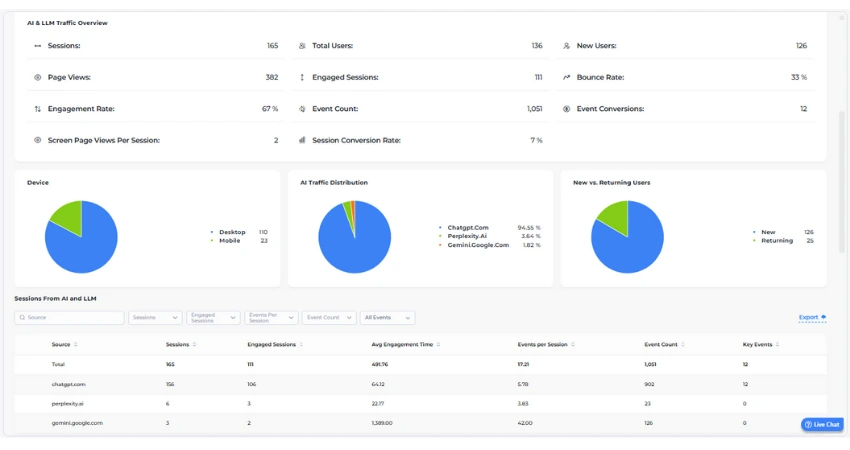
One of the biggest challenges with AI search is measurement, because, unlike traditional rankings, AI-generated answers can change frequently, and visibility isn’t always easy to monitor without the right tools. That’s why every figure used throughout this article comes from tracked campaign data rather than estimates or anecdotal observations.
The increase from 1 to 448 AI Overview appearances was measured using Click Insights and the AI Overviews Tracker, allowing the team to monitor changes over time and understand how the client’s visibility evolved throughout the campaign.
Alongside AI search data, the campaign also tracked traditional SEO metrics including organic traffic, keyword rankings, backlink growth, domain rating, and the performance of newly created landing pages. Looking at these metrics together provided a far clearer picture than relying on any single number in isolation.
Author
James Owen
Co-founder and Director, Click Intelligence
James Owen is the Co-founder and Director of Click Intelligence, where he helps businesses improve their online visibility through SEO, Digital PR, Link Building, and content marketing. With years of experience delivering search strategies across a wide range of industries, James has worked with businesses of all sizes, from ambitious start ups to established global brands. He is particularly focused on helping organisations adapt to the changing search landscape, combining proven SEO techniques with emerging AI search strategies to deliver sustainable, long term growth.