
Google AI Overviews were introduced in 2024 and have changed the face of search ever since. In fact, 48% of searches now trigger an AI Overviews response. Search users no longer have to scroll through results to find answers; instead, AI Overviews provides an AI-generated answer at the top of results without users even having to click. So, how do you make sure it’s your content being referenced in AI Overviews? Appear in Google’s top 10, right? Not exactly.

Research by Ahrefs shows this is changing. In 2025, it analysed citations and found that 76% of the pages cited in Overviews also ranked in Google’s top 10. Fast forward to 2026, and that percentage has dropped to 38%. So, if you want to know how to rank in AI Overviews, it isn’t as simple as appearing in the top results in traditional search.
Of course, traditional organic visibility is still important, but Google’s AI-generated answers are drawing on a wider pool of sources than ever before, not just the results that are deemed the most relevant. AI Overview optimisation (AIO) needs to take into account authority, topical relevance, content structure, how Google chooses sources, as well as traditional SEO best practices.
This guide will tell you everything you need to know about ranking in AI Overviews and what makes certain pages stand out to the search engine giant. We’ve also got another detailed guide you can check out on AI Overviews Optimisation specifically once you’ve read this one.
Contents
- Key Takeaways
- What Are Google AI Overviews?
- How Google Selects Sources: The Grounding Process
- AI Overviews vs Featured Snippets
- The Types of AI Overview Positioning
- Content Strategies for AI Overview Inclusion
- The Role of Structured Data
- Real Results in AI Overview Visibility
- How to Measure AI Overview Visibility
- Common AI Overview Optimisation Mistakes
- Frequently Asked Questions
Key Takeaways
- AI Overviews are AI-generated summaries that reference information from multiple webpages.
- Google uses the grounding process to retrieve relevant information from its Search Index before generating an answer.
- Ahrefs found the percentage of AI Overviews citations coming from top 10 results fell from 76% in 2025 to 38% in 2026.
- Content structure with direct answers, clear sections, and wide topic coverage that shows off trust and expertise improves chances of citation in AI Overviews.
- AI Overview optimisation is changing search quickly, and to be successful, you need to actively measure your visibility and take a proactive approach to content improvements.
What Are Google AI Overviews?
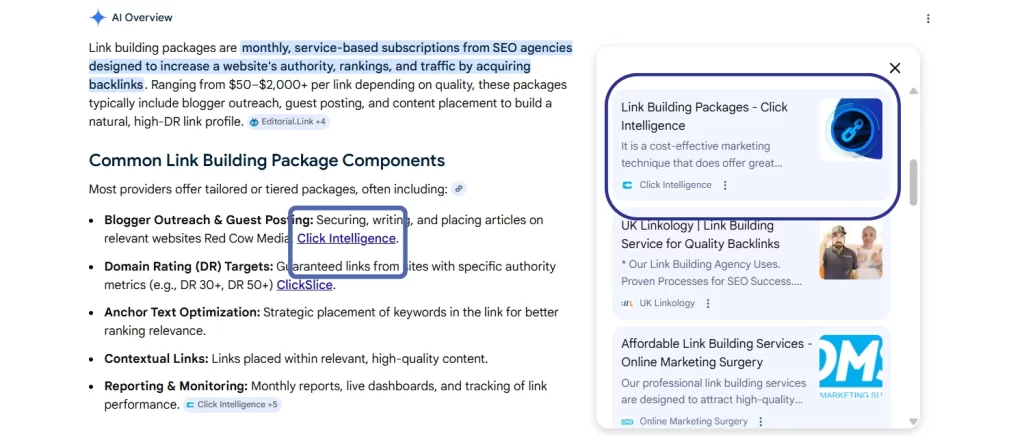
Google AI Overviews, previously known as Search Generative Experience (SGE), are AI-generated summaries that appear at the top of some search results. They help users get answers to their queries quickly by summarising multiple sources and providing links to these websites for additional reading. Google shows AI Overviews when it determines that an AI summary gives the user more value than conventional search result lists.
For businesses wanting to learn how to rank in AI Overviews, you need to understand that AI Overviews aren’t just another organic result. Instead, multiple webpages can be summarised to contribute to a generated response and get a citation for being included.
AI Overviews optimisation is related to a wider group of AI SEO best practices that include Generative Engine Optimisation (GEO) and Answer Engine Optimisation (AEO). They concentrate on visibility across generative search and making information as easy for answer systems to surface and interpret as possible, respectively. AIO is Google-specific and refers to techniques that make sure your content is selected and cited in its overview results, not other AI-driven searches like ChatGPT or Perplexity.
How Google Selects Sources: The Grounding Process
Optimising for AI Overviews is tricky without knowing how Google finds and chooses the content it’s going to summarise. Google uses grounding to retrieve and examine relevant content, generate a response, and provide clickable reference links to the original source to support its answer.
For successful AI Overview optimisation, it can be helpful to know how the grounding process works, roughly following these 5 steps:
- Retrieval
To be able to provide an answer, Google needs to have information to work with first. It takes candidate pages from its organic search index to do this. So, technical SEO and making sure pages are able to be crawled and indexed is vital to being a contender for AI Overviews inclusion. Pages that don’t rank organically are rarely selected for AI Overviews. Think of ranking as an entry requirement rather than a guarantee of actually being featured in AI Overviews. Ahrefs‘ research further backs this up, as 76% of pages AI cited in 2025 appeared in the top 10 rankings, with this number dropping to 38% in 2026. So pages don’t necessarily need to rank highly to be selected for AI inclusion; they just need to be indexed.
- Query Fan-Out
Query fan-out is a process that AI models, including Google, use to turn a single query into lots of related searches before generating an answer. It does this behind the scenes to give more context to understand the user’s intent, context, and any follow-up needs. Think of it like “fanning out” from a central point to gather information to provide a well-rounded answer. So, pages that don’t rank highly for the exact search phrase could still earn visibility in AI Overviews.
- Evaluation
Next, Google evaluates the source material it’s chosen for quality, relevance, and authority so it can give an answer. It likes to give well-rounded answers so it doesn’t get the information from just one source. Instead, it might take different important aspects from multiple pieces and blend them together to create a response. So, it’s important to keep your content clear to be picked up.
- Synthesis
When it’s decided on the source selection it will use in its response, Google uses a synthesis model to generate an answer. It does this by drawing on the most relevant and authoritative sources that it initially chose.
- Citation
Finally, Google links to the sources it’s summarised within its response. This allows users to click through to find out more.
AI Overviews vs Featured Snippets
Featured snippets and AI Overviews can both appear high in Google results, but they work differently from each other.
We’ve put together this table breaking the differences down:
| Featured Snippets | AI Overviews | |
| Sources Used | Use just one single source. | Use multiple sources, sometimes as many as 8. |
| Answer Generation | Extracts information verbatim from an existing webpage. | Uses synthesis to generate a more broad response from a range of sources. |
| Queries Covered | Narrow queries that require definitions, lists, and concise factual answers. | Wider queries that benefit from several bits of information to provide a well-rounded answer. |
| Competition | Normally, 1 dominant source is featured in the snippet. | Several websites can be cited in AI Overviews. |
Based on this, there is more opportunity for ranking in AI Overviews as they use multiple sources to generate an answer for users as opposed to Featured Snippets’ 1. Optimisation for Featured Snippets used to focus on directly answering just one query. AI Overviews optimisation is broader than this and takes into account supporting information Google needs to generate a well-rounded answer.
AI Overviews also offer citation fluidity, as it won’t always cite the same websites for similar queries, and it might retrieve various information for many queries and interpret it differently. This means you have more opportunity to become one of the trusted sources Google chooses to cite in AI Overviews.
The Types of AI Overview Positioning
Not every AI Overview reference looks the same. There are 4 main types of positioning that are useful to know about when learning how to rank in Google AI Overviews.
- Carousel Links
Sometimes AI Overviews show sources through carousel links. Appearing in the top 3 sources implies that your relevance to the answer is more important than sources positioned beyond this. It also gives the most visibility. Clear, useful content can help you appear here as Google can easily match it to queries and interpret it for responses.
- Article Links
Article links show up alongside certain statements that AI Overviews generates within its response. Content that clearly targets subtopics can perform well here thanks to Google only needing to extract a small passage for part of its response.
- Product or Business Recommendations
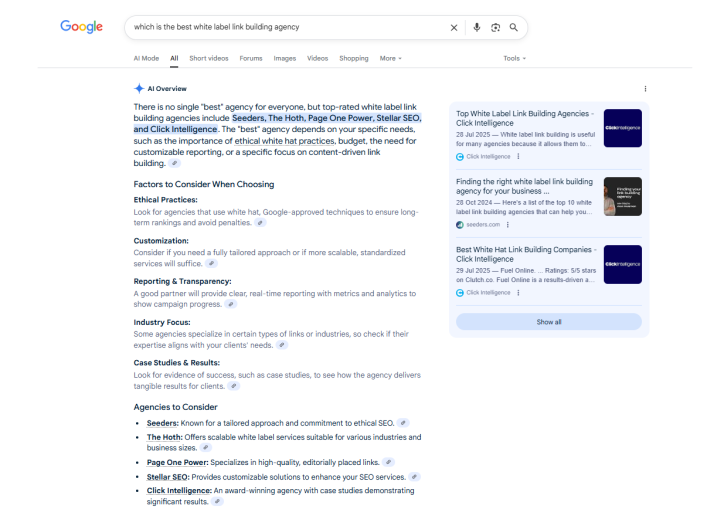
Commercially driven searches can result in AI Overviews recommending products, businesses, or service providers to users. Having clear and in-depth product and service descriptions that also answer common customer pain points can improve your visibility for this type of result.
- Branded Searches and Alternatives
AI Overviews will often help users compare branded alternatives and additional options. This is where having strong brand authority can benefit you; think third-party mentions, comparison lists, and reviews to grow that all-important authority.
Content Strategies for AI Overview Inclusion
Google has stated that there’s no guaranteed way to be included in AI Overviews. However, there are some content best practices you can follow to optimise for AI Overviews inclusion.
Comprehensive Topical Coverage
AI Overviews take from sources that show off an in-depth understanding of a topic. Thin content that only just scratches the surface of a subject is rarely cited. However, if your content demonstrates real topical depth and authority with detailed explanations, data, examples, and different angles covered, this shows off your expertise. This feeds into Google’s E-E-A-T principles too. It is content that does this that is more likely to be surfaced by AI Overviews.
Now, depth is important, yes, but it doesn’t mean that long content is automatically better. Content that is complete and offers a well-rounded answer is better. For example, if you own a chain of bridal shops, a concise 2000-word guide that covers every aspect relating to different wedding dress styles will perform better in AI Overviews than a 6000-word guide that waffles, is poorly structured, and unclear.
Clear, Structured Information Architecture
The way you structure your content makes it easier for AI Overviews to understand.
If you can:
- Use description or questions in headings.
- Use clear H2s and H3s to differentiate topics and subtopics.
- Give a direct answer.
- Then support your answer with evidence.
- Give examples and next steps.
For best results, answer the question each section poses in the first 40 to 60 words before going into more detail later. Just don’t make it confusing or difficult for Google or people to find the answers that they need. Always be direct.
Authoritative Evidence-Based Claims
Evidence-based content gives users and Google more of a reason to trust what you are saying. This is because it demonstrates authority and trust. Avoid making bold claims without being able to back them up and instead support what you write with:
- First-hand experience
- Original research
- Case study evidence
- Named experts
- Industry data
- References to other research
Doing this will make sure that your content stands out against the other more generic content.
Content Freshness
For businesses wanting to know how to rank for AI Overviews, they need to keep their content up to date. That’s because Google’s grounding process favours content that is fresh and relevant. If your content isn’t evergreen, then you should have a system in place for reviewing and updating it.
When checking your content, always make sure that any statistics, product information, prices, laws, product features, research, and best practices you’ve mentioned still hold true. If they don’t, update them and treat this as an ongoing process as opposed to a one-and-done job.
To show users and AI Overviews your content is up to date, it’s a good idea to include a “Last Reviewed” date (a bit like the one we have at the top of this guide).
The Role of Structured Data
Structured data, or schema markup, can help support AI Overviews inclusion as it helps Google’s systems understand what your content is about. Implementing it correctly can improve the likelihood of citations, but it’s not a shortcut. Your content still needs to tick all the right boxes and follow best practices for optimising content for Google AI Overviews.
Where relevant, implement the following structured data across your pages:
FAQPage Schema
FAQPage schema reinforces questions and answers across your pages. This can make structured FAQs content easier for AI Overviews to interpret, especially when they reflect real user searches and the answers given are concise and accurate.
HowTo Schema
For queries that are asking how to do things, HowTo schema can help you reinforce a sequence of steps that AI Overviews can easily reference. This is particularly important for capturing visibility for searches that are asking for clear instructions to follow, as it gives AI clear content to pull from.
Organisation and Entity Schema
Organisation schema is an entity-focused markup that helps reinforce information about your business and helps AI understand how it fits into the wider world. Using this schema can help build entity trust, which is an important consideration when AI is evaluating content for summary.
Real Results in AI Overview Visibility
Don’t just take our word for how important AI Overviews optimisation is. Look at our stats instead!
When a global SaaS company came to us for our wider AI SEO services, we developed a bespoke campaign for them that brought a huge boost to their AI visibility results:
- AI Overview appearances grew from 1 to 448 appearances in 12 months.
- 206 year-on-year organic traffic growth.
- 210 new pages created to boost AI search visibility.
Read the full case study here.
How To Measure AI Overview Visibility
You can’t expect to know how to improve visibility in Google AI Overviews without measuring your current positioning. Tracking AI Overviews visibility is a little more complicated than organic rankings, but there are ways to do it.
Google Search Console (GSC) Data
GSC reports some AI Overview data like impressions and clicks from citations. While the data isn’t super detailed yet, it can be used to help signal how often your pages are appearing in AI Overviews and the traffic that they bring to your website. Track this over time to see how your efforts are impacting impressions and clicks.
Systematic Manual SERP Testing
With manual testing, you can see how you appear in AI Overviews for the most important search phrases for your brand. It’s a good idea to create a fixed set of queries and make note of:
- If an AI Overview appears for it.
- Whether your brand is cited.
- Which URL gets the citation.
- Where the citation appears.
- Which of your competitors are appearing.
- What information Google takes from each source.
Doing this gives you solid data to keep track of and allows you to see how different nuances in queries impact results.
Third-Party Tracking Tools
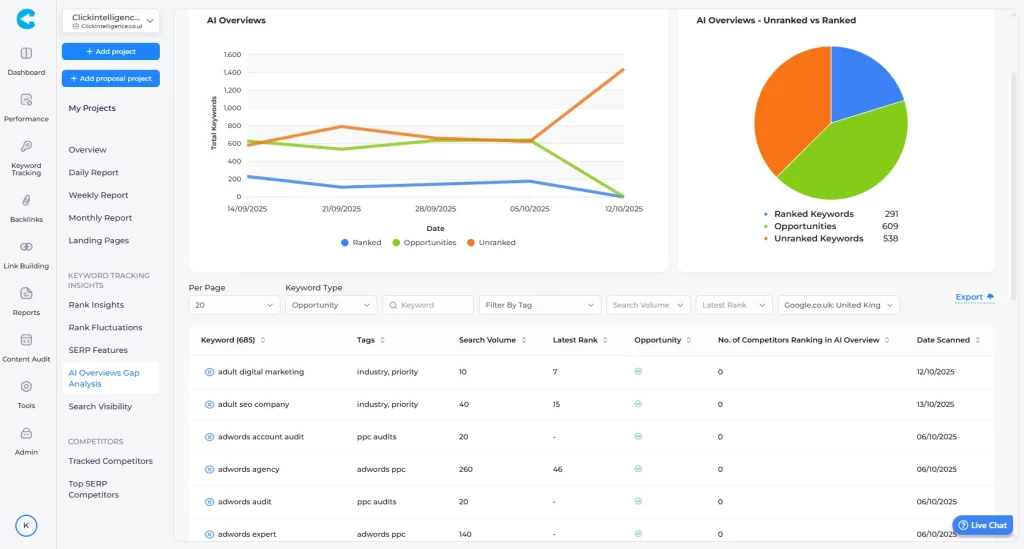
Using tools to measure your performance in AI Overviews is a smart choice. They can help you spot where you have gained visibility and where you need to focus your efforts next. You can also track keywords for source citations across AI Overviews. As AI Overviews can vary based on the user’s query and context, it can be tricky to track them, but the Click Insights AI Overviews Tracker makes it easy.
Competitive Citation Analysis
Tracking which competitors are being cited in Google AI Overviews when you aren’t can help you find gaps that you should be targeting with your content. This is a proactive way of monitoring what others are doing, learning from them, and improving your own content strategy.
Always look at:
- Which websites are cited repeatedly.
- The information that Google takes from them.
- The subtopics that your competitors cover well.
- What stands out about your competitors’ content (for example, expertise, evidence, original data).
Common AI Overview Optimisation Mistakes
Knowing how to rank in Google AI Overviews is one thing, but to be truly successful, you need to know which common mistakes to avoid. To make it easy for you, we’ve run through them below:
- Ignoring SEO Basics: Web pages need to be able to be crawled and indexed to be eligible for AI Overview inclusion. If there are technical problems holding your website back, it’ll be hard to get AI citations no matter how much effort you are putting into AIO.
- Writing Formulaically Just For Inclusion: Direct answers are helpful, but if your content is just based on short blocks of text with little context, it won’t be helpful to AI or search users. Your content needs to be written for humans first and then structured in a way that makes it easy for AI to cite. Depth, authority, and expertise are major signals that you need to demonstrate in your writing. AI can then pick and choose what it wants to include.
- Not Keeping Content Fresh: AI Overviews prefer information that is up to date, especially if your content is about topics that change over time. Outdated content that references old data or methods will be deprioritised in favour of up-to-date sources. Updating content freshness regularly will keep your brand relevant for AI Overviews inclusion.
- Publishing Thin Content On Important Subjects: If you’re writing a 500-word blog post on a complicated topic that your competitors have informative 5,000-word guides on, then you won’t be cited in results. AI Overviews love context because they need enough material to draw their summaries from. However, there’s no point adding thousands of words extra if they don’t actually add value to the piece. Avoid repetition and generic content as this doesn’t demonstrate your expertise.
- Skipping Structured Data: Schema markup, or structured data, makes it easier for AI Overviews to understand your content and summarise it. AI may not be able to reliably surface content on pages that don’t have structured data.
- Treating AI Overviews Optimisation as a One-Off: AIO isn’t a one-and-done job. It requires continual effort to keep up with Google system changes, industry topics, and competitor content updates. Measure your progress, analyse it, optimise, monitor, and measure again to stay up to speed.
Frequently Asked Questions
FAQ 1: How Do I Rank in Google’s AI Overviews?
To boost your chances of featuring in AI Overviews, you need to have the SEO foundations covered and make sure that your pages can be crawled and indexed. It’s also important to make you write clearly and directly, show off your expertise, and back up any claims with evidence. Covering subtopics in detail is also crucial for AI Overview optimisation. How to rank in AI Overviews is all about becoming a genuinely useful source for Google’s retrieval and grounding systems instead of simply stuffing in keywords.
FAQ 2: Do I Need to Rank Organically to Appear in AI Overviews?
Your organic rankings aren’t as important as you might think to appear in AI Overviews. Your pages need to be indexed to be eligible for inclusion, but you don’t actually need to rank highly. According to Ahrefs, just 38% of cited web pages appeared in Google’s top 10 ranked results. When you optimise for AI Overviews, strengthening your wider topic relevance and visibility is crucial because your related content could get picked up.
FAQ 3: What’s The Difference Between AI Overviews and Featured Snippets?
As a rule, featured snippets take information from 1 main source, whereas AI Overviews use information from lots of sources to provide a broader, more well-rounded answer. It then provides links to all of the content it’s summarised. There is more opportunity for ranking in AI Overviews this way because of the wider approach Google takes.
FAQ 4: How Long Does AI Overview Optimisation Take to Show Results?
There is no fixed AIO timeline for results. Making structural improvements to how content is displayed on a web page that already has good search visibility and authority might result in a quick AI Overviews payoff. On the other hand, building a new website or improving poor-performing pages might lead to a longer results timeline because you need to develop authority, trust, and topical expertise first. That’s why the most effective how to rank for AI Overviews strategies mix quick wins and long-term techniques for sustained growth.
FAQ 5: What is AIO?
AIO stands for AI Overviews optimisation. It is used to describe the techniques that are used to improve a website’s visibility and citations in Google’s AI Overviews. It is also sometimes referred to as Google AIO.
About the author
James Owen
Co-founder & Director
Since 2007, James has been at the forefront of the SEO world. During the early years of his career, James was the lead on many high-end projects for well-known travel, gaming, and retail brands, such as Jackpotjoy, Smyths Toys, eBay, Gumtree, Betway, and Expedia. However, this isn’t even touching the surface, and this list is continually growing.
Since opening Click Intelligence with Simon in 2013, James has been a crucial part of several elite SEO projects that have transformed businesses in a variety of sectors. His experience and knowledge haven’t just been passed down to clients either. James has also been a speaker at SEO and digital marketing conferences and events, such as Brighton SEO, guiding everyone involved in the industry.