Did you know that AI SEO has 2 meanings? It can refer to using AI tools for SEO to streamline workflows and improve traditional rankings; the second meaning refers to optimising websites and content so they are visible across AI-driven search. So, when asking ‘what is AI SEO?’, the answer can vary depending on the context.
This guide focuses on the second meaning of AI SEO, which is carrying out AI search engine optimisation techniques to improve a brand’s visibility across Google AI Overviews, AI Mode, Bing Copilot, ChatGPT, and Perplexity. AI search optimisation helps AI systems find your content, interpret it, and use it in its responses. This might involve you earning a citation or making sure that your products and services are accurately represented.
AI search optimisation builds on a lot of traditional SEO best practices, but the aim isn’t rankings; it’s visibility across AI search responses. As experts in all things AI SEO, we’ve put together this helpful guide on what it is and the steps your business can take to improve its performance.
Contents
- Key Takeaways
- What Is AI SEO?
- How AI SEO Relates to GEO, AEO, LLMO and AIO
- Why AI SEO Matters Now
- Real Results in AI SEO
- How to Do AI SEO
- Practitioner Perspective
- Common AI SEO Mistakes
- How to Measure AI SEO Success
- Frequently Asked Questions
Key Takeaways
- AI SEO has 2 meanings: using AI tools to help with SEO-related tasks and optimising a website and content for visibility in AI search and AI-generated answers.
- GEO, AEO, and LLMO overlap, but each one concentrates on a different aspect of AI search visibility.
- Having solid technical foundations, positioning yourself as an authority figure, and strong, useful content are essential to growing AI visibility.
- Clear and well-structured content makes it easier for AI systems to understand information and summarise it.
- AI search is constantly changing, so brands that invest in AI SEO early can stay ahead of the curve.
What Is AI SEO?
AI SEO is the process of improving how easily a brand is discovered, understood, and represented across AI-driven search.
AI search engine optimisation builds on a lot of traditional SEO best practices. To stand a chance of appearing in AI search results, you still need to have a technically sound website, helpful content, credibility, strong authority, and a website structure that makes sense. However, instead of ranking highly, AI SEO is all about making it easy for AI systems to retrieve relevant information and portray it accurately in responses.
AI optimisation makes sure that your content can be:
- Discovered and retrieved for relevant user queries.
- Clearly understood.
- Extracted as direct passages of text.
- Accurately summarised.
- Referenced or cited in an AI-generated response.
- Obviously linked to a company, person, service, or product.
There are different types of AI platforms; these are the main ones and what they do:
- Google AI Overviews: generates summary answers in Google search results.
- Google AI Mode: gives search users a conversational experience where users can ask follow-up and longer questions.
- Bing Copilot: mixes classic web search with AI-generated responses.
- Perplexity: generates conversational answers with links to sources.
- ChatGPT: does a combination of the above and is a popular choice for browsing the web and citing information from external sources.
These AI search engines and features don’t all retrieve and cite information in the same way. Still, they all rate the same important qualities in content and websites like strong technical aspects, clear explanations, topical relevance, consistent information, credible sources, and reviews. For more on setting your website up for wider generative search, check out our Generative Engine Optimisation service.
How AI SEO Relates To GEO, AEO, LLMO, and AIO
When it comes to wider AI SEO optimisation, there are lots of abbreviations that crop up:
- GEO (generative engine optimisation)
- AEO (answer engine optimisation)
- LLMO (large language model (LLM) optimisation)
- AIO (AI Overviews optimisation)
Sometimes they’re used interchangeably, and some people define them differently. To help you understand them, it’s best to think of AI SEO as the broader strategy for improving visibility across different AI-driven search experiences. At the same time, the individual terms relate to specific areas inside that strategy.
Traditional SEO techniques are a bit like the building blocks that all AI SEO tactics are built from. To learn more about their differences and similarities, take a read of our helpful GEO vs SEO guide.
Here’s a little explainer of what each term means and how it relates to AI SEO:
Generative Engine Optimisation
GEO is all about improving how often and accurately brands are mentioned in AI-generated answers. It applies to search engines that work by combining information from lots of different sources like ChatGPT, Perplexity, Gemini, Google AI Mode, and AI Overviews. Generative engine optimisation focuses on building entity authority and quality content that can be easily cited.
Answer Engine Optimisation
Answer engine optimisation, also known as AEO, is about making it easier for AI search systems to find and extract clear answers in response to user queries. Concise content, question-based headings, structured data, logical formatting, and clear paragraphs that make sense on their own are important elements for strong AEO.
LLM Optimisation
Large language model optimisation is all about growing visibility in LLM search. LLM optimisation increases the chances of a brand being mentioned, recommended, and described properly by the likes of ChatGPT, Gemini, and Perplexity when a user asks it a question or to compare options.
AI Overviews Optimisation
As the name implies, AI Overviews optimisation is about making sure that content and brand information is cited in Google’s AI Overviews for certain queries.
Why AI SEO Matters Now
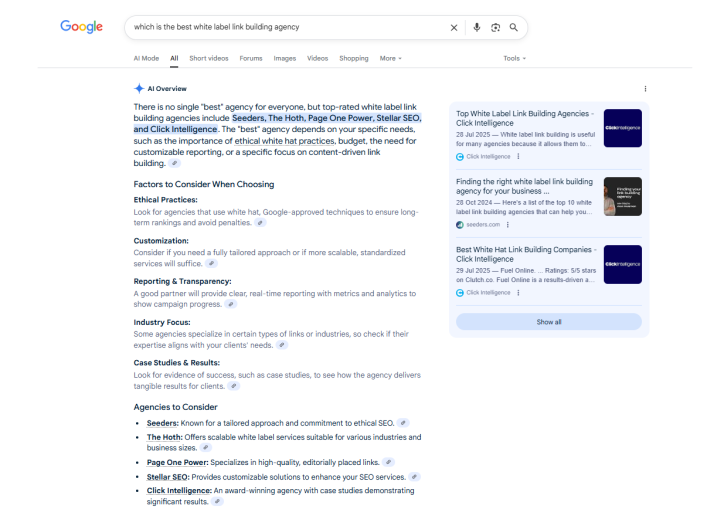
Search, and how people use it, is changing in a big way. Thanks to LLMs and Google’s AI Overviews growth and AI Mode, search users can get fast answers to their questions without scrolling through reams of search results or clicking on a single link.
The rise of zero-click searches has coincided with a shift towards a more conversational search experience. Users now prefer to ask detailed questions instead of using short phrases. They also ask follow-up questions to refine results further or get a comparison of more options.
Zero-click search is becoming the norm for users. In fact, research by SparkToro showed that 68.01% of US Google searches ended without a click in the first 4 months of 2026. This doesn’t spell disaster for businesses that previously relied on clicks, though. Instead, it’s opening up new ways for them to grow brand visibility and reach customers with properly executed AI search engine optimisation strategies. With clear content, growing entity recognition, and demonstrating trusted expertise and experience, brands can make real gains in AI search.
Real Results in AI SEO
Don’t just take our word for how important AI SEO is. Take a look at our proven stats instead!
A global SaaS company came to us for our bespoke AI SEO services, and we developed them a unique strategy and campaign that brought them a massive boost to their AI visibility results:
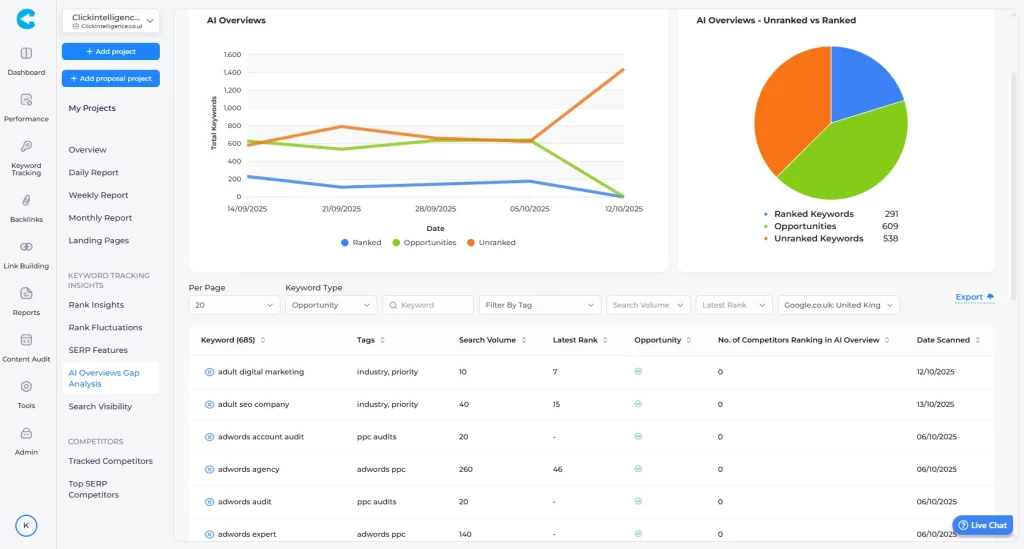
- AI Overview appearances grew from 1 to 448 appearances in 12 months.
- 206% year-on-year organic traffic growth.
- 210 new pages created to boost AI search visibility.
We tracked their progress with the Click Insights AI Overviews Tracker, which makes measuring AI Overviews visibility easy.
You can read the full case study here.
How To Do AI SEO: Core Principles
There is no single AI for SEO technique that can guarantee your brand’s inclusion in an AI-generated answer. Instead, AI SEO optimisation is most effective when you concentrate on the 6 core principles below.
- Entities Need To Be Clear and Consistent
In AI SEO, entities are a recognisable person, business, product, service, location, or idea. AI models need to be able to understand your content and also what the words mean in a wider context. Entity clarity allows AI systems to connect businesses with their services, products, expertise, staff, and locations so that they can recommend or cite you in responses.
If you have inconsistent information across your website or on third-party mentions, then it can make retrieval more difficult for AI search engines and features, which could result in them skipping past you in favour of your competitors. For example, if you describe yourself as a web design agency on one page, a software company on another, and a digital marketing business somewhere else, AI won’t know what to associate your business with.
Action To Take
Make sure that all of your company and product names and descriptions are accurate across your entire website. It can be a good idea to have a central ‘About Us’ page that has information about your company, services, products, location, and who works there. Use this as a benchmark to check all other internal and external mentions of your business. Implementing structured data can help reinforce your business information but only if it actually reflects the content on the page.
- Structure Content So It Can Be Easily Extracted
Generative AI search engines prefer content that’s precise, well-structured, and easy to interpret. Having self-contained paragraphs that communicate your points clearly, clean formatting, and strong semantic structuring boosts the chances that AI models will use your content in summaries and answers.
Keeping your content succinct is key, but that doesn’t mean that it should feel fragmented. Only it should be organised in a way that is easy for users and AI models to understand.
If you can, it’s helpful to include the following, where applicable, when writing and structuring your content:
- Descriptive headings
- Direct opening sentences
- Short paragraphs that explain things clearly
- Definitions
- Question and answer sections
- Comparison tables
- Numbered lists or steps
- Bullet points
- Clear, relevant examples and use cases
Action To Take
Look at important service and product pages and check every heading. Then, look at the first two sentences and ask yourself if they answer the heading directly. If the sentences are vague or unclear, rewrite them. For example, a section headed “What Is Web Design?” should start with a self-contained definition first before going into further detail below. This structure makes it easier for AI models to extract passages from your content for use in responses.
- Show Topical Depth
AI search engines love content that shows off real understanding through contextual explanations and comprehensive coverage of a topic, including definitions, step-by-steps, FAQs, processes, comparisons, costs, risks, examples, alternatives, etc. Of course, you may not be able to do that with just one piece of content, as it would simply be too long.
Instead, a strong AI SEO content strategy should revolve around connected pillar content and content covering related subtopics. Try to avoid repetition where possible so that each piece of content has a clear purpose within the wider subject area. Doing this will put you in a stronger position for increased AI visibility and inclusion.
Action To Take
It can be helpful to think about the customer journey when mapping out your content strategy. Using a bridal boutique as an example, content covering the below would help demonstrate your topical knowledge and increase the chances of AI inclusion:
- Wedding dress styles
- When to start wedding dress shopping
- What to expect at your first bridal appointment
- How much wedding dresses cost
- How to choose a dress that fits your venue and season
- A guide to wedding dress sizes
- FAQs about wedding dress alterations
- Bridal styling and accessories
- The order process
Always make sure these pages link together logically and to other relevant pages on your website, including your booking page.
- Show Real Expertise with Evidence
Generative AI already has access to huge amounts of general information. If your content repeats what’s already available, it’s unlikely that you’ll stand out to be included in AI results. One way to stand out is to demonstrate your expertise. Of course, showing topical depth does help with this, but original evidence takes it a step further. Always make sure that this is clearly attributed.
- Case studies
- Proprietary data
- Expert commentary
- Product testing
- Customer research
- Clear processes
- Original imagery including infographics
- Detailed examples
- First-hand observations
Action To Take
If you can, try to add one piece of clear evidence to every important piece of guide content. This could be something as simple as a case study, like we’ve done above, or a quote from an expert within your company. This also improves entity recognition and helps AI systems build trust in you.
- Make Sure You Have Strong Technical Foundations
Your website’s technical health is vital for AI search engines to access, parse, and correctly interpret your content. Without strong technical SEO and good crawlability, you will miss out on AI visibility.
Important areas to improve are:
- Indexability
- Internal linking
- XML sitemaps
- Canonical tags
- Mobile friendliness
- Page loading speeds
- Core Web Vitals
- Structured data or schema markup
Action To Take
A technical audit can help uncover any problems with your website that are holding you back from reaching your full potential in AI results. You could have the most informative and engaging content in the world, but it won’t be discovered by AI search if your technical SEO is poor. So, fixing these problems is vital.
- Measure Visibility Holistically
Holistic visibility measurement means looking at your performance across traditional search, AI-generated answers, brand mentions, and citations rather than traditional rankings alone. Thanks to AI, the customer journey looks different than it used to. A customer might find your brand via ChatGPT, and then search for it separately, look at comparison guides, and convert into a paying customer days later.
AI visibility may not result in an immediate click for your site. Still, by taking a broader, holistic approach that takes into account the below, you can get a truer picture of your visibility:
- Organic rankings
- AI answer inclusion
- AI Overviews appearances
- Branded search demand
- LLM mentions
- Third-party citations
- Assisted conversions
- Conversion quality
- Direct visits
- Referral traffic
Action To Take
Make sure that your reporting takes into account all of the above and look for patterns that might suggest your AI search visibility is growing. For example, an increase in AI citations might also lead to more branded searches or assisted conversions even when direct referral traffic from AI systems is low.
Common AI SEO Mistakes
To truly increase your chances of being referenced and cited in AI search results, you need to know which mistakes to avoid. We’ve laid out the common pitfalls below to help you avoid any confusion:
Treating AI SEO and Traditional SEO Separately
AI SEO isn’t totally separate from traditional SEO. AI search engine systems rely on accessible, relevant, and authoritative content just like traditional search engines do. Treating it as something separate and ignoring traditional SEO basics can hinder your AI visibility and make it harder for AI models to interpret your content.
Over-focusing on Keywords Instead of Clarity and Structure
AI systems depend on semantic understanding rather than keywords. Long, unstructured paragraphs, unclear explanations, and repetition of keywords without proper context can make it harder for AI search to interpret, extract, and cite content.
Ignoring Entity Signals
Having inconsistent brand names, products, services, descriptions, topics, or anything else can weaken entity signals and make it harder for AI to find your brand and represent it accurately. All details need to be consistent and clearly defined across your website and external content.
Only Optimising For Rankings
Pages can rank well but still fall short of AI inclusion. AI SEO looks for authority, clarity, and extractability in terms of clear structure. So without these boxes ticked, you might rank well, but you won’t be included in AI responses.
Forgetting About The Basics of Technical SEO
Slow, poorly structured pages can impact your AI SEO visibility just as much as they can your regular SEO. User experience, crawlability, and indexability are massively important for AI visibility.
Publishing Generic Content
Content that repeats the information that’s already out there will not capture AI’s attention. Equally, pushing this sort of content out at scale will not result in stronger topical authority. You need to give AI systems a reason to pick your brand’s content, so be sure to demonstrate your experience and expertise to stand out from the competition.
Not Updating Content Regularly
AI search engines move quickly. If your pages aren’t kept up to date, then your content can lose context, accuracy, or relevance, which makes it more difficult for you to be surfaced and referenced in AI results. To stay ahead of artificial intelligence in SEO, it’s best to schedule regular content reviews for content that is not evergreen.
Not Checking Schema Markup
Make sure all schema markup actually matches up to the content on the page. Incorrect structured data can damage your AI visibility.
How To Measure AI SEO Success
Visibility in AI search is measured differently than in traditional SEO. Yes, traditional metrics like rankings, organic traffic, and click-through rate (CTR) are still important, but they don’t give you the full picture when it comes to AI search performance.
As AI offers a different search experience to users, visibility in it doesn’t always equal more clicks. For example, an AI-generated response might mention a brand without the user immediately visiting the website, or it might cite a page for a passage that they don’t click on. However, both of these things help build brand awareness and can have a positive impact on branded searches and direct visits to your site.
There are lots of things to consider when measuring how successful SEO AI is:
Inclusion in AI-generated Answers
Keep an eye on whether your brand, products, service, or other website is appearing in relevant responses on AI Overviews, ChatGPT, Perplexity, and other conversational search platforms. Even if these mentions don’t result in an immediate click, they help grow brand awareness and influence user decisions later in the customer journey.
Citation Tracking
Tracking citations shows you which pages are being used as sources in AI-generated responses. If your pages are being cited, great! Citation tracking can also help you see which content is performing well, how your competitors are doing, the format of content AI loves, and any gaps in your authority that you should fill.
Brand or Product Mention Frequency
How often your brand or products are featured in AI responses can give you a good indication of how effective your strategy is. Be sure to check the sentiment around your mentions too.
Passage-Level Extractability
AI likes to pull concise, self-contained statements. When pages are clearly structured, your content passages are more likely to be extracted in AI-generated responses. Signs that your content is properly AI optimised include noticing your content getting quoted more, specific paragraphs being extracted repeatedly, and structured content like how-to guides, step-by-steps, and lists being shown in AI summaries more often.
Accuracy of Representation in AI Results
It’s not uncommon for AI models to misinterpret information, so it’s important that you consistently check how your brand is being represented across AI search. Look out for factual correctness, how accurate comparisons are, and how AI summaries align with your content. When you are being represented in a consistently accurate way, it’s a sign that you have strong AI SEO.
AI Influenced Traffic and Conversions
AI visibility won’t always translate into a direct click to your website. When it does, you need to make sure you’re tracking AI-referred conversions. Monitor users that are coming from AI search, traffic patterns, how they behave on your site once they get there, and which stage of the customer journey your content supports. Increased AI visibility can also lead to more branded searches, direct traffic, and assisted conversions as users might not choose to continue browsing via AI.
Share of Voice
Share of voice compares your brand mentions and citations versus your competitors across the same set of prompts. It can show you how your relative visibility is improving and who is the most prominent for certain topics.
Signs Your AI Visibility Is Improving
Progress in AI search can be difficult to track, but there are some signs you can look out for that show your authority is improving over time:
- Better inclusion in AI answers
- Accurate representation in responses
- Fast adoption of updated or new pages by AI models
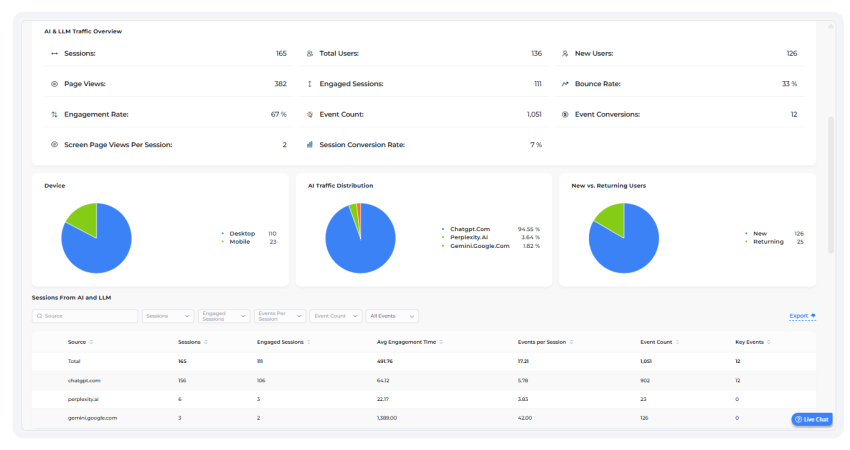
Click Insights is the go-to solution for measuring AI SEO success. It monitors brand mentions, citations, competitor performance, AI Overviews visibility, and more. The LLM Visibility Tracker feature gives deep insight into how brands are discovered and represented across LLMs and offers real-time data and analytics to inform the next steps of your strategy.
Frequently Asked Questions
FAQ 1: What is AI SEO?
AI search engine optimisation is the process of boosting a brand’s visibility across AI-powered search experiences. It helps the likes of ChatGPT, Perplexity, Google AI Overviews, and AI Mode find, extract, and reference your content.
FAQ 2: Does AI SEO Mean Using AI Tools, Or Optimising For AI Search?
AI SEO has 2 meanings. It can mean using AI tools for SEO tasks or optimising a website for inclusion in AI-generated results. This guide refers to AI search optimisation for increased visibility across AI search engines and features rather than using AI for SEO to streamline tasks and workflows.
FAQ 3: What’s The Difference Between AI SEO And GEO, AEO Or LLMO?
AI SEO optimisation is a broader strategy for growing visibility across AI search. Generative engine optimisation (GEO) focuses on being included in AI-generated responses, answer engine optimisation (AEO) is all about direct answer extraction in AI search, and LLM optimisation looks at your visibility in large language models.
FAQ 4: Do I Need an AI SEO Agency, Or Can I Do This Myself?
AI SEO requires specialist knowledge and ongoing effort to see results. There are lots of aspects to it, including technical SEO, content writing, authority building, and more. This can be a lot to deal with when you also have a business to run. That’s why turning to a specialist agency like ours with expertise in AI SEO is a smart choice. Check out our AI SEO services to see how we can help take your brand’s visibility to the next level.
FAQ 5: Will AI SEO Replace Traditional SEO?
No, artificial intelligence in SEO has changed how information gets retrieved and presented in search, but traditional SEO techniques act as the building blocks to strong visibility in AI search. Think of AI SEO as an extension of regular SEO rather than a replacement for it.
About the author
James Owen
Co-founder & Director
Since 2007, James has been at the forefront of the SEO world. During the early years of his career, James was the lead on many high-end projects for well-known travel, gaming, and retail brands, such as Jackpotjoy, Smyths Toys, eBay, Gumtree, Betway, and Expedia. However, this isn’t even touching the surface, and this list is continually growing.
Since opening Click Intelligence with Simon in 2013, James has been a crucial part of several elite SEO projects that have transformed businesses in a variety of sectors. His experience and knowledge haven’t just been passed down to clients either. James has also been a speaker at SEO and digital marketing conferences and events, such as Brighton SEO, guiding everyone involved in the industry.