
How to Approach SEO for Specialist Markets
There’s plenty of scope when creating SEO campaigns. Each industry that turns to experts for…


The amount you invest in your link buildingLink building is a process of acquiring links pointing to your website. These links are obtained by creating content, participating in social media or commenting on other blogs. budget should be based on the realistic impact that improved organic visibility could have on your business. The right SEO link building budget will vary from one business to another: for example, a local business focusing on a small number of high-intent searches as compared to a national brand competing against dozens of valuable commercial terms.
So, how much does link building cost, and more importantly, how much should your business invest?
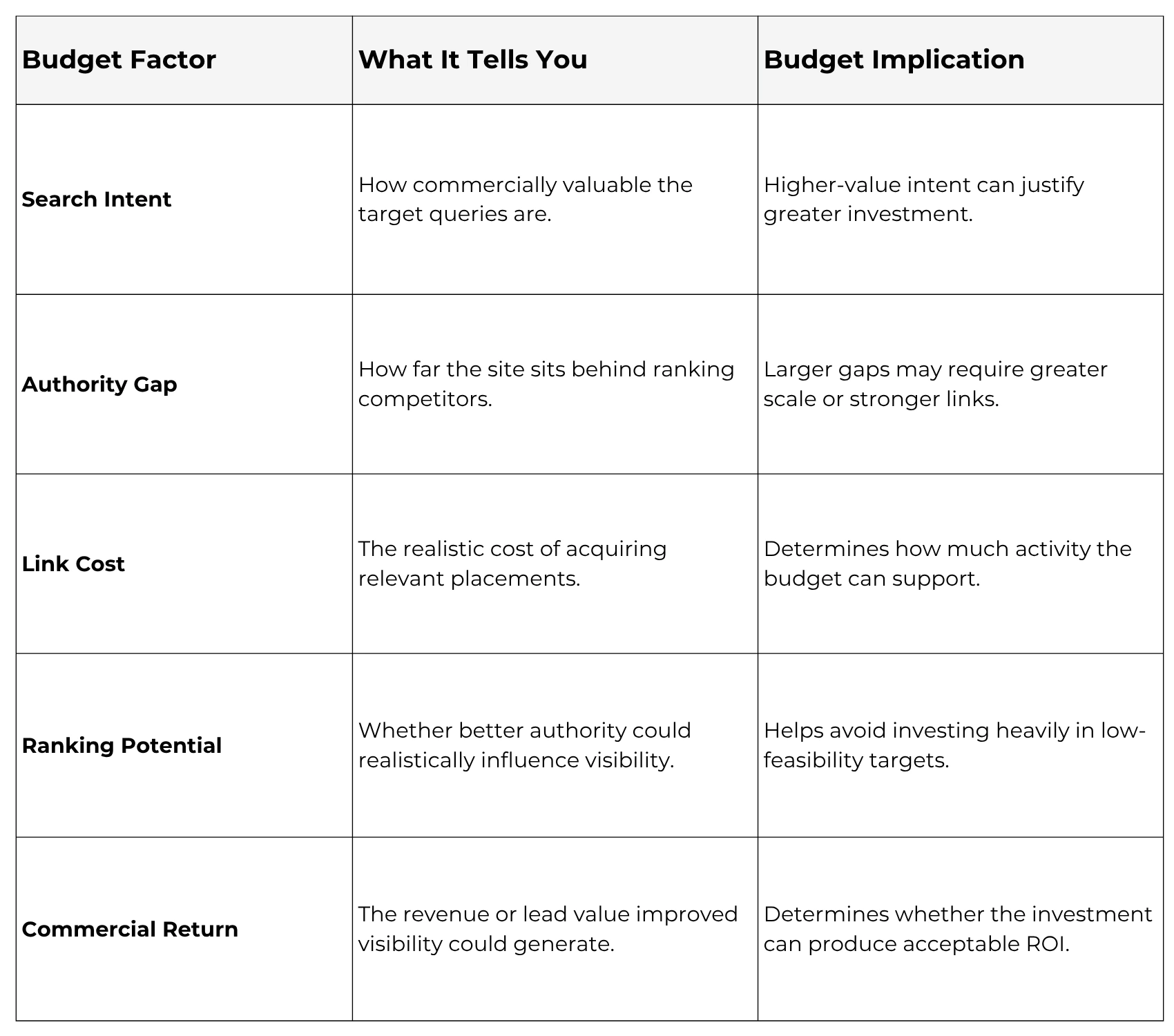
A link building budget should reflect the commercial value of the search opportunity, the competitive authority gap, and the level of investment needed to influence rankings.
Before thinking about link building pricing, you need to figure out what it is exactly that you want to achieve.
For example, if one keywordKeywords are the words and phrases that potential customers might search for to find your business. gets 5,000 searches a month but mainly draws in people who want information, while another gets only 100 searches yet those searches are from people who are specifically looking for the exact service that your business offers, then the second term could end up being far more valuable.
The amount of search volume by itself doesn’t show you what an organic opportunity is worth.
A useful starting point is:
Search demand × intent × conversionA conversion is a desirable result on a website that leads to an action such as completing an order, filling out a form, or simply clicking on a link. potential × commercial value
Start with search demand but also take search intent into account. You should think about whether someone is researching a topic, comparing different providers, or is actually looking to make a purchase. Then look at conversion potential. By using historical analytics and conversion data, you can determine how effectively relevant organic visitors become leads or result in purchases.
Just because a keyword is valuable doesn’t mean it is a sensible one to target. The ranking potential of a keyword is affected by content quality, technical performance, the level of competition in the search results page, and the authority that the site currently has.
You can then use your larger SEO budget on those opportunities in which gaining more authority is likely to lead to a commercial result, rather than just on keywords that have impressive search-volume figures.
To know what SEO link building costs, you need to understand the sites and pages that are already taking up the most space in the search results you want to enter.
Start by looking at the strength of ranking domains and the backlink profiles of the individual pages competing for your target terms. How many referring domains have they attracted? Are those linksHyperlinks, also known as links, are the connection points on a webpage that take you to other webpages. relevant to the subject? Do they come from credible publishers? These are questions that help to show the authority gap between your site and the competition.
Your existing position is important though, too. A newer website competing against authoritative brands could require a longer campaign and a substantially greater link building investment.
Tools can provide useful metrics for assessing backlink profiles, but these should support rather than replace manual analysis. Our backlink checker tool can help you investigate backlink data when assessing your current position and the competitive landscape.
The right link building budget sits where ranking opportunity, required investment, and potential commercial return intersect.
The value of a backlink depends on more than its price, because relevance, authority, placement, and the page receiving the link all influence its potential return.
Looking just for the lowest cost of backlinks can therefore be a false economy. A cheap placement is not necessarily cost-effective, just as an expensive link is not automatically valuable. There are several characteristics worth assessing together.
Website authority provides useful context, but metrics such as Domain Rating (DR) should not become the only measure of quality. Topical and editorial relevance are important too. A link should make sense in relation to the publisher, the surrounding content, and the destination page.
Organic trafficOrganic search traffic (sometimes called natural or unpaid search) is the traffic that's driven to a website because of unpaid placement on a search engine results page. can offer another indication of a site’s health and visibility, while the position of the link within the content deserves attention too. Links to supporting content can also contribute to authority when they form part of a properly planned link building strategy.
The distinction is essentially between cost per link and value per link.
Blogger outreach services can support relevant editorial placements, while Digital PR could be used to earn broader coverage and brand mentions. These approaches can have different costs, outputs, and strategic roles, so they should not be treated as interchangeable products priced purely on a per-link basis. Google’s link spam policies are an important reference when looking at link acquisition practices, alongside Google guidance on links.
Your budget determines more than just the type of links you can get. It also affects how big a link building campaign can be.
Scale should reflect the number of target pages and keyword clusters involved, competitor authority, the strength of the existing backlink profile, geographic reach, industry difficulty, and the timescale available.
For example, a campaign focused on one high-value group of keywords can put resources into a clear opportunity. A bigger strategy might cover several products or services, each competing with different sites and needing its own content and authority.
If you spread your budget over too many URLs, each page might not get enough support to make a real impact. Focusing your investment on key commercial pages or related groups can make it easier to see if building authority is helping performance.
For brands that would rather coordinate these elements within one strategy, our Managed SEO services can combine authority building with the wider work required to improve organic performance.
Link building ROI should ultimately be measured against organic visibility, conversions, and commercial value rather than the number of backlinks acquired.
A campaign might hit its target number of placements but still not deliver a good return. On the other hand, a few well-chosen links can boost performance on pages that bring in real leads or sales.
Measurement should therefore follow the commercial journey:
Link building investment → improved visibility → qualified organic traffic → conversions → revenue
Begin by focusing on the pages and keyword groups your campaign targets. Track their rankings and organic impressions to see if visibility is improving. Then, look at organic clicks and non-branded traffic to check if more people are visiting your site.
Next, track landing page conversions, qualified leads, and revenue where you can. Remember, assisted conversions also count, since organic search isn’t always the last step before someone becomes a customer.
If better organic visibility brings in more customers, compare the cost of getting them to your link building investment and any other SEO costs. This gives you a clearer picture of your organic ROI than just looking at the average price per backlink.
Many things affect rankings, like content updates, technical fixes, search engine changes, and what competitors do. So, it’s not accurate to credit every ranking change to a single new backlink.
Timing is another thing to consider. Links can build authority over time, and SEO results often add up as your campaign goes on. A link you get this month doesn’t have to bring an instant conversion to be valuable.
That’s why you should look at trends over time and compare them to your original campaign goals. Is the authority gap closing? Are your key pages getting more visibility? Is qualified organic traffic going up? Most importantly, is that traffic leading to results that matter for your business?
These are the questions that provide a much stronger basis for deciding whether to maintain, increase, or reconsider an SEO link building budget.
Opportunity → intent → competition → cost → scale → return
Find out what stronger organic visibility could be worth. Then understand how competitive the opportunity is, how much authority may realistically be required, and what acquiring appropriate links is likely to cost. From there, decide what scale of activity makes sense and measure the resulting performance against commercial outcomes.
This also lets us ask the question “how much does link building cost?” The price of an individual placement tells you very little about what an effective campaign should cost overall.
The same goes for comparing backlink costs. Paying less for each link doesn’t really save money if those links don’t help you get the visibility you need to attract the right customers.
In the end, a link building budget should be based on what the organic opportunity is worth and what level of authority is realistically required to compete, rather than choosing an arbitrary number of links each month.
Our link building services can provide the authority-building element of the strategy. Where link acquisition needs to sit alongside content, technical SEO, and wider optimisation, Managed SEO services provide a broader approach.
No matter which approach you choose, the goal is to invest based on the value of the opportunity, build authority where it can really make a difference, and measure success by business results, and not just by the number of links in a monthly report.

There’s plenty of scope when creating SEO campaigns. Each industry that turns to experts for…

PR has long supported brands in building authority and spreading awareness, but PR distribution has…

Download our free Millionaires SEO Guide Today!
Link Building or Managed SEO which is right for me?
The amount you invest in your link building budget should be based on the realistic…

Search engines aren't the only automated systems accessing, interpreting, and making sense of content found…
There's plenty of scope when creating SEO campaigns. Each industry that turns to experts for…
PR has long supported brands in building authority and spreading awareness, but PR distribution has…

Some backlinks can help a key service page gain authority, while others help to strengthen…

SEO can be complicated. It’s constantly changing and is not a one-and-done job. That’s something…

AI has become part of how people research and look for products, as well as…

Growing an SEO agency takes a lot of hard work. You've got to keep up…
If you are looking to increase your traffic, sales & leads, let's have a chat!

The team will usually respond within 1 hour.