Why Listicles Matter for AI Search, LLM Discovery, and SEO Visibility
If you look back at films from the 80s, filmmakers created visions of flying cars…

The phrase “content is king” was so commonplace for years that many businesses and web owners took this as gospel for seeing great SEO advances. While content very much deserves such recognition, the problem with that phrase is that many have viewed it as though any content brings rewards. This is not the case at all. The content that is king is high-quality, valuable, and factually accurate, and this is where many have gone wrong.
There is a thin line between perfection and error when it comes to content, and if you have found yourself on the latter end with content debt that has left you lost, there is hope. Fortunately, modern SEO strategies, like content consolidation, can help you manage this content debt and get you back on the path to success. Join us as we explore everything you should know about this strategy.
When companies started hearing whispers of the wins they could gain from producing content, they jumped on board straightaway. Soon enough, everyone was doing it. However, not many people considered what years of publishing lower-quality content and creating pages that cover similar topics or intent would cause them.
In trying to produce as much content as possible, maintain trust with an audience, and expand reach, blogs might have gradually overlapped, or they may have created duplicate landing pages. While audiences sometimes like having familiarity and have been known to absorb information more easily when it’s connected to concepts they know well, this doesn’t work in favour of SEO and AI SEO.
The same applies when you are so focused on continually putting out new content. Your existing work may now have outdated advice within it, and resources may no longer have a clear role in what they do exactly. All of this has left many with huge volumes of content debt, and problems like this can have big consequences for businesses aiming to reach new heights with not only their SEO but also their AI search efforts, meaning content consolidation has never been more important.
You might not think much about having a couple of blog posts that both have “how to find the right SEO agency” as an H2 heading, for example. However, this overlap can cause issues with search intent. Now search engines will try to match your pages to a particular search intent, and because you have multiple options, you run the risk of the algorithms struggling to pick, instead landing you with lower rankings or delivering the wrong one to users. An informational blog is no good for users who were searching with commercial intent in mind, and vice versa. This effectively means that for both search engines and AI systems, you are competing against yourself, and halving your chances of being cited immediately or ranking well for both pages.
Overlapping content affects more than search intent. It may also:
This is why content consolidation is so important. Content consolidation helps search engines and AI systems understand which pages best represent your expertise by reducing unnecessary overlap and creating clearer, more authoritative sources of information.
There is a very simple way to discover how to start on content consolidation for AI SEO and uncover which pages might be overlapping or have outdated content, and that is through a content audit. During this audit, experts will look into the:
If a page ticks these boxes across the board, it’s safe to assume it’s good to keep. However, for the pieces that don’t deliver and are showing signs of lost traction, outdated information, or demonstrate a lack of topical relevance, these are clear signs that consolidation is required.
But what happens when keywords overlap? You’ve started doing your audit and found some pages immediately for consolidation, but then you come across several blogs that contain the same keywordKeywords are the words and phrases that potential customers might search for to find your business.. It can certainly be confusing regarding how to choose which page to keep when consolidating content where it concerns keyword use. In times when there is keyword overlap across several pages, this does not always mean these pages should be merged. As search engines and AI systems focus more on search intent, when you have 2 pages with the same keywords but different search intent behind them, these are perfectly fine to have across different pages. Still not sure? Why not reach out to our SEO Consultancy team to get some more clarity?
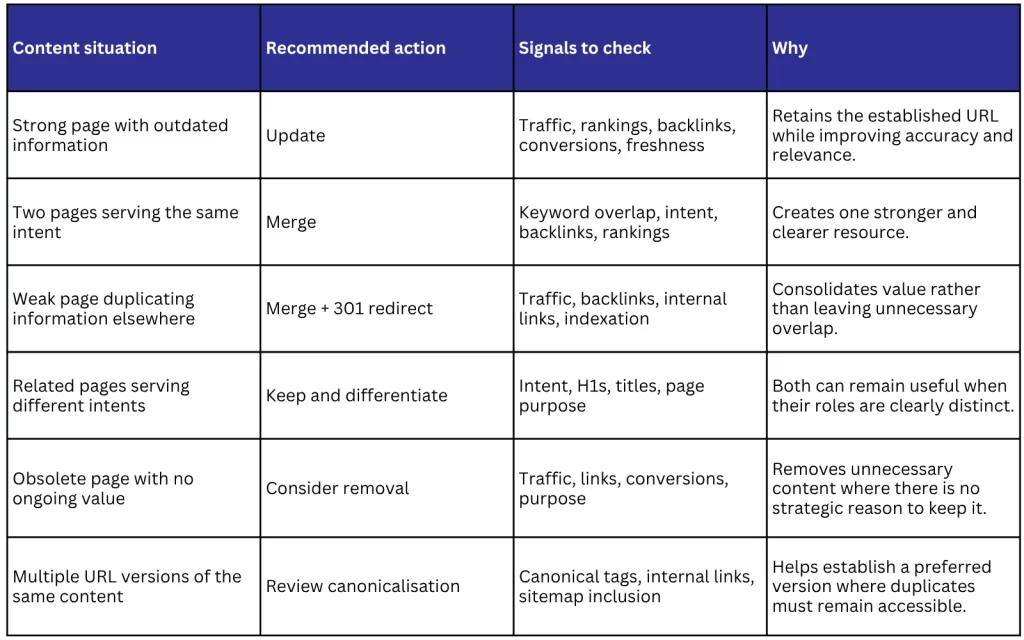
Once you’ve completed your audit, now is the time for content pruning. This is a process where you decide whether to keep, update, merge, or remove a page. The keep is often an easy decision. These will be pages that offer the most value to you, from good traffic to quality backlinks, excellent rankings, great topical authority, and conversions that speak for themselves. When a page demonstrates such value, keeping it is the right move. If there are pages that are related, the goal should be to differentiate them. So long as their roles are distinct enough, they can remain valuable to you. If these pages are not distinct enough and serve the exact same intent and one page is weaker than the other, merging the content pieces to create a stronger and clearer resource is recommended.
The biggest question as you look at how to consolidate website content is: should old blog posts be deleted or updated? The answer entirely depends on what signals that page is giving. For example, if one page has quality backlinks to it with decent traffic, you can retain the already established URL but update the content for accuracy and relevance. On the other hand, if you have an obsolete page with no ongoing value, with limited to no traffic, poor rankings, low AI visibility, minimal conversions, keeping such a piece becomes unnecessary.
As you spend your time consolidating your content for SEO and AI SEO, to ensure these are not fleeting improvements as your website continues to grow, you must put in place a dependable content strategy that allows you to keep content planning and ownership clear over time. This way, as you produce more content, you won’t be back to stage one within a matter of months, needing to redo everything.
As part of your content strategy, you need to:
As part of your content strategy, you will also need to edit the content you deemed worthy of keeping but requires updating. Part of this update should consider how to optimize existing content for AI search. What this involves is:
If you aren’t sure how to fulfill all of this, turn to our Content Marketing services and allow our experts to get your content where it needs to be to stand a chance of getting AI visibility. For all future content, you must follow the same practices.
The mistake many website owners make is thinking that publishing more content will fix their visibility issues on both traditional search and AI search. More content will not necessarily change this, however. In many cases, it is what you already have that can make the difference. Content consolidation can take your outdated, overlapping content and turn it into clearer, more useful pages that harness stronger search intent and internal signals. When applied as part of a wider SEO and AI SEO strategy formed by experts like us, you can not only transform existing content and help it perform better, but you can aid all future content, too, and may see some exciting metrics come your way. Explore our SEO and AI SEO services today to get started.
What is Content Consolidation in SEO?
Content consolidation is an SEO strategy that audits a website’s content to highlight which pages overlap, cover similar topics or intent, are thin, or are duplicates, and can be combined into stronger URLs as a result.
How Do I Know Which Page to Keep When Consolidating Content?
During assessments of pages, look into rankings, backlinks, traffic, conversions, freshness, completeness, and URL quality. When these perform highly across the board, or as close to it as possible, these are pages worth keeping. For pages that perform moderately, you may consider keeping them but completing some necessary updates.
Should Old Blog Posts be Deleted or Updated?
Any page that is strong in terms of traffic, rankings, backlinks, and conversions may need updating if it contains outdated information, so you are also nailing freshness signals. If you have 2 pages that serve the same intent, merging is the sensible move here, but a weak page that is publishing duplicate information from elsewhere may benefit from a merge and 301 redirect301 redirects are permanent, so they only need to be set up once. They can signal to search engines that a page has been permanently moved or removed, which can help boost website traffic in the process.. Times when updating, merging or redirecting is not possible, such as when you have an obsolete page with no value, removing it is the most appropriate action you can take.
How Can I Optimise Existing Content for AI Search?
Start by thinking about the structure of your content, introducing clear standalone paragraphs throughout, which contain internal linking, broken up by scannable sections (tables, bullet points). Clear intent and topical depth must also be achieved with every piece of content. This is a great way to demonstrate expertise with accurate and consistent brand/entity information.
Can Content Consolidation Improve SEO Rankings?
Starting with content consolidation removes overlap and strengthens a primary resource. It should be viewed as a one-stop solution for seeing ranking improvements. While it may bring about positive performance metrics, it still depends on many factors.

If you look back at films from the 80s, filmmakers created visions of flying cars…

Search engines aren’t the only automated systems accessing, interpreting, and making sense of content found…

Budgeting for SEO is a terrifying prospect. There are so many elements in play, and seemingly endless considerations, rendering it…

Google's Core Web Vitals reports how a page performs, and here's our checklist to improving page experience this 2022!

In recent years, the coronavirus pandemic and war in Ukraine have taken a significant toll on the world's finances. Add…

Domain Rating (DR) is one of the most talked about SEO metrics. It’s used to…

A well-written press release is one of the most impactful ways to secure quality media…
If you look back at films from the 80s, filmmakers created visions of flying cars…
The phrase “content is king” was so commonplace for years that many businesses and web…

The amount you invest in your link building budget should be based on the realistic…
Search engines aren't the only automated systems accessing, interpreting, and making sense of content found…

There's plenty of scope when creating SEO campaigns. Each industry that turns to experts for…

PR has long supported brands in building authority and spreading awareness, but PR distribution has…
If you are looking to increase your traffic, sales & leads, let's have a chat!

The team will usually respond within 1 hour.
