
Why Listicles Matter for AI Search, LLM Discovery, and SEO Visibility
If you look back at films from the 80s, filmmakers created visions of flying cars…


A well-written press release is one of the most impactful ways to secure quality media coverage in digital PR. As well as announcing important company news and industry findings, if you get the writing of a press release right, you can win valuable media coverage that grows your brand’s credibility, earns you powerful backlinks, and can help you improve your visibility in traditional and AI search results.
Although the rewards sound appealing, the truth is that the journalists you send your press releases to are super busy. They don’t have the time to read every boring email that lands in their inbox, so you need to know how to write a press release that first grabs their attention and secondly, leads to that all-important publication.
To be successful, you need to be able to write a concise press release that resonates with the media and the intended audience. Here’s how to get it right.
First up, you need to ask yourself what the angle is. Your press release needs to be newsworthy even to stand a chance of piquing a journalist’s interest. Think about what you’re telling the world:
It doesn’t have to be mind-blowing enough to hold the front page, as long as it’s something new that’s what’s important. Instead of just advertising your business, your press release needs to bring news value to the table.
As we’re a digital marketing agency, it also needs to be SEO friendly and work with your wider digital PR efforts. Be clear on the pages you want to link to within your press release to give readers more information and context.
Think about what you want the press release to achieve in terms of SEO:
Want to know how to write a press release for SEO that gets results? Part of the answer to that question is that it’s all in the structure.
Journalists need to be able to get the gist of your story in seconds, starting with the headline. Your headline needs to instantly tell them what it’s about without confusion. Ideally, it should be descriptive and mention your company, data, product, or event wherever relevant. It needs to be direct without promotional or vague language, and shouldn’t be more than around 15 words in length.
Press releases should follow an inverted pyramid structure. All the important information is at the top, and the less crucial details follow lower down. Doing this means readers can get a grasp of the story before losing interest.
With this in mind, your opening paragraph needs to include all the most newsworthy elements. Think of the 5 Ws when writing:
Then, the rest of your press release should add body and context to the story. Don’t forget to include extra details to make it more engaging and useful:
Your press release shouldn’t be too long. Aiming for 300 to 400 words is the sweet spot. You can link back to relevant pages on your website to provide more context and detail. Also, as this is a press release for SEO, weaving in some natural keywords is a good move.
We’ve put together this helpful table you can use as a checklist when structuring your next press release:
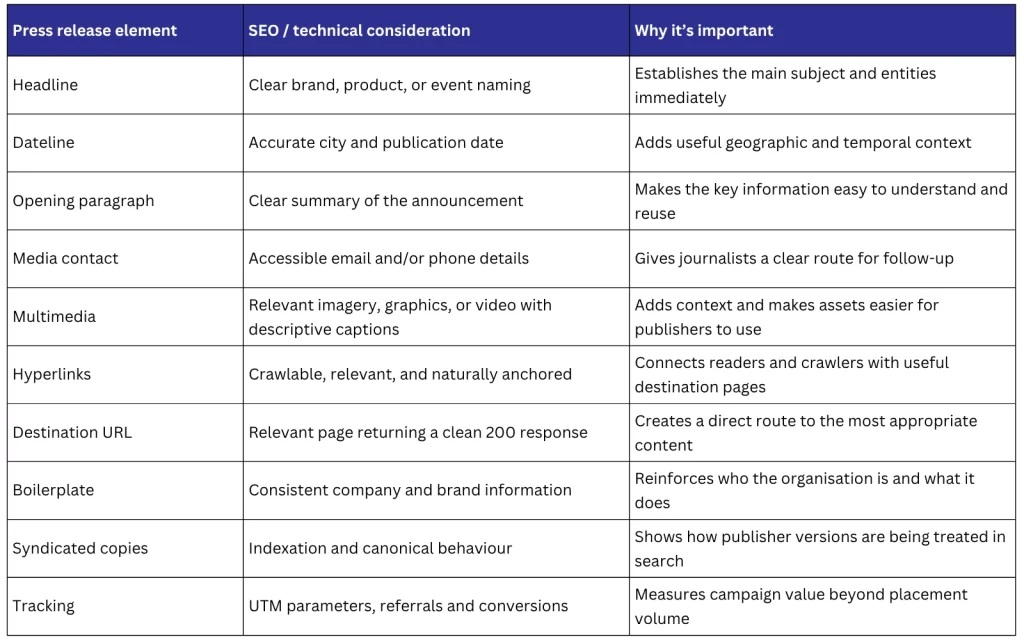
Check out Business Wire’s press release resources for more information.
We’ve covered structure, but what else makes a press release effective for both PR and search visibility? Links do. In fact, they’re a press release SEO non-negotiable. That said, you should always make sure that the links you include have a real purpose.
For example, if you’re writing a press release about a new service, then linking to that service page can give readers somewhere to find out more. If you’re announcing more general company news or original research, then a link to your homepage might be more suitable.
There are some rules you should follow when adding links to your press release; they are:
Google has published advice on link best practices if you want to find out more.
By making press release distribution part of your Digital PR and wider Link Building strategy, you can gain valuable backlinks from trusted publications as well as continue growing your long-term authority.
When your press release is finished, you need to think about distributing it. First, you need to publish it on your website so Google can index it. You can even use NewsArticle schema to help search engine crawlers understand that it is news you’ve published. Once you’ve done this, it’s time to syndicate it.
Press release syndication for SEO involves sending your story out to the media. There are specialist media outreach syndication services you can use to get your press release out there. There, it gets sent directly to blogs and news sites that publish your story. So literally thousands of sites could end up publishing your press release. However, not every story that gets published will have a positive impact on your SEO.
Search engines may class syndicated content as duplicated content and choose only one URL to index. This is called canonicalisation. You can read more about it in Google’s guide.
Instead of trying to get your story published in loads of mediocre publications, aim for a few quality, industry-relevant publications. You don’t have to aim for the hard-hitting national and international publications either; it’s more important that the publications are relevant to your industry. It is these types of links that will really benefit your backlink profile and increase credibility.
Once published, you want to make sure that new links are being crawled and indexed by Google, as this is what will pass valuable link equity on to you. Also pay attention to how these placements are benefiting you by looking at visibility and referral traffic metrics.
Measure the Full Value of Press Release Distribution
There are some important metrics you should track to get an idea of how successful your press release distribution has been:
Paying attention to these metrics will help you see what impact your press releases are having on your wider online visibility.
AI is changing almost every aspect of search. As more people turn to it over the likes of Google, your business needs to think about how your brand is seen and represented in AI-powered search. Digital PR and press releases for AI visibility are one of the best ways to improve brand discovery and enforce entity recognition in this type of search. It also helps organic search by growing your credibility.
When a trusted third-party media website publishes a story about your brand, it increases the amount of information that is out there about your business, products, and services. To reap the maximum benefits from this, you should make sure that:
A press release that gets results combines genuine news value with clear entity information, crawlable links, and distribution across relevant publisher websites. This helps to support PR, organic search, and wider AI discovery. However, writing your press release is just one aspect of press release performance and won’t guarantee results on its own.
The best press releases are:
Get them right, and you’ll enjoy wider organic and AI SEO visibility. If you want to get your brand noticed, then our Press Release Distribution Service is here to help you take your digital PR efforts to the next level.
How Do You Write A Press Release For SEO?
If you want to know how to write a press release for SEO, then you need to first have a strong news angle, headline, and opening paragraph. Clear brand information that helps entity recognition and crawlable links to your target landing pages are also essential.
Should You Include Backlinks In A Press Release?
Absolutely, yes. Including relevant backlinks in your press release can help readers find further useful information, increase your referral traffic, and help pages get found by search engines. Always make sure that the anchor text is descriptive of the page the link is leading to.
How Does Press Release Syndication Work For SEO?
Press release syndication sends your story to multiple publisher websites. You need to keep an eye on indexing, backlinks, and referral traffic to measure how successful it has been.
Should A Press Release Link To The Homepage Or A Landing Page?
Deciding whether to link your press release to your homepage or landing page all boils down to what’s relevant and makes sense in the context. If you are promoting a new product you are launching, then it makes sense to link to that product’s landing page. On the other hand, if your news is more general, linking to the homepage would make more sense.
Can Press Releases Support AI Search Visibility?
Yes, they can, and that’s one of the main reasons why you should include press releases in your digital marketing strategy. Published press releases increase the amount of reliable information that is on the internet about your brand, which can help strengthen entity recognition signals that AI models rely on. This can lead to more visibility in AI search.

If you look back at films from the 80s, filmmakers created visions of flying cars…

When your target customer heads to Google to search for a product or service, or…

Google's Core Web Vitals reports how a page performs, and here's our checklist to improving page experience this 2022!

Here is how to find the perfect link building partner, download today!

Download our free Millionaires SEO Guide Today!

Domain Rating (DR) is one of the most talked about SEO metrics. It’s used to…
A well-written press release is one of the most impactful ways to secure quality media…
If you look back at films from the 80s, filmmakers created visions of flying cars…

The phrase “content is king” was so commonplace for years that many businesses and web…

The amount you invest in your link building budget should be based on the realistic…

Search engines aren't the only automated systems accessing, interpreting, and making sense of content found…

There's plenty of scope when creating SEO campaigns. Each industry that turns to experts for…

PR has long supported brands in building authority and spreading awareness, but PR distribution has…
If you are looking to increase your traffic, sales & leads, let's have a chat!

The team will usually respond within 1 hour.
