
How Can Brands Compete in ChatGPT Without Paying for Ads?
AI has become part of how people research and look for products, as well as…


Instead of scrolling through pages and pages of endless search results, more people are now turning to AI-powered tools for a quick and personalised answer. This means it’s no longer enough to simply just rank well in search engines. AI systems also want to understand what your business actually stands for and whether it’s a trusted source or not on a particular subject.
Put simpler, topic association is the strength of the connection between your brand and the subjects that you want to be known for. The clearer and more consistent these connections are across trusted sources, the easier it becomes for AI tools to recognise when your business is relevant.
In this guide, we’ll explore what topic association really means, why it’s becoming so important for AI SEO, and how tactics like press release distribution and community mentions can help build stronger connections that improve your visibility in AI search.
Rather than making a judgement based on a single blog post or service page, AI looks for repeated signs that your business is connected to a particular subject. The more often those signals appear in relevant, trustworthy places, the stronger that association becomes.
Think of it like this: if a cybersecurity company regularly publishes practical security advice, earns media coverage on emerging cyber threats and takes part in industry discussions, AI will naturally start to link that brand with cybersecurity.
This is where ideas like topical relevance, brand-topic relationships, co-occurrence and brand entity signals come into it all. AI pays attention to how often your brand appears alongside the topics you want to be associated with, the language used around those mentions, and whether those connections are backed up by sources that are credible.
The result is a clearer understanding of your expertise, which makes it easier for AI to recognise when your business is a relevant recommendation for users searching within your niche.
When someone asks an AI tool for a recommendation, it is trying to identify the brands that make the most sense for the question being asked. To do that, it needs to have confidence that your business actually belongs within a particular category and has the expertise to help.
In simple terms, AI wants to know:
The answers come from repeated evidence rather than a single source. Your website plays an important part, but so do trusted third-party signals, such as media coverage, industry discussions, and other credible mentions.
This has a direct impact on AI search visibility. The clearer that your brand-topic relationships are, the more likely it is that your business is to appear in relevant recommendation prompts. Not only this, but it also strengthens AI’s category understanding and expertise recognition, making it easier for your brand to be surfaced at the right moment.
Without strong topic association, even a well-optimised website may struggle to appear in AI-generated recommendations because the AI lacks enough confidence to connect your brand with the topics users are searching for.
Google has also highlighted that strong SEO fundamentals continue to play an important role in improving visibility within AI-powered search experiences.
It’s easy to think of press releases as a way to generate linksHyperlinks, also known as links, are the connection points on a webpage that take you to other webpages. or announce company updates, but their value goes much further than that. A well-planned press release distribution strategy helps to reinforce the topics you want your brand to be associated with, creating a stronger and more consistent picture for AI to understand.
Every relevant release adds another layer of context. Over time, these repeated signals help build:
For example, regularly sharing original research, company news, strategic partnerships or product launches within your area of expertise shows that your brand is actively contributing to the conversation. Rather than appearing as a one-off mention, your business becomes repeatedly linked to the same subject matter across multiple trusted sources.
If you’re looking to strengthen these signals, our press release distribution services can help ensure your news reaches relevant publications that support your wider topic association strategy.
Some of the strongest signals are created through conversations where people are asking questions, sharing experiences and recommending solutions. This is where community mentions make a real difference.
Whether they appear in forums, industry communities, Q&A platforms or professional discussions, these mentions provide AI with authentic evidence that your brand is relevant to a particular topic. Instead of promotional messaging, AI sees your business being discussed naturally by people with an actual interest in the subject.
These conversations are particularly valuable because they often reflect the language real customers use when describing their challenges. As your brand is repeatedly mentioned alongside the same topics, products or services, AI can build stronger brand-topic relationships based on authentic context rather than isolated marketing claims.
A dedicated community mentions service can help your brand earn meaningful visibility in the places where your audience is already having relevant conversations, strengthening your presence across the wider web.
When it comes to building topic association, trying to be known for everything is not the best approach. The goal is to create a strong, consistent connection with the topics that matter most to your business.
A good place to start is by identifying the areas that naturally align with your brand, including:
As you narrow your focus, it helps to ask a few simple questions:
Once you’ve chosen your priority topics, consistency becomes key. The same themes should run through your website, blog content, PR activity and external mentions, reinforcing the same message wherever your brand appears. When these channels work together instead of sending mixed signals, AI gains a much clearer understanding of your expertise.
Building strong topic association comes from creating a clear strategy and making sure every piece of content, mention, and announcement supports the same core themes.
A simple way to plan this is by mapping your priority topics alongside the signals you’re creating both on your own website and across the wider web.
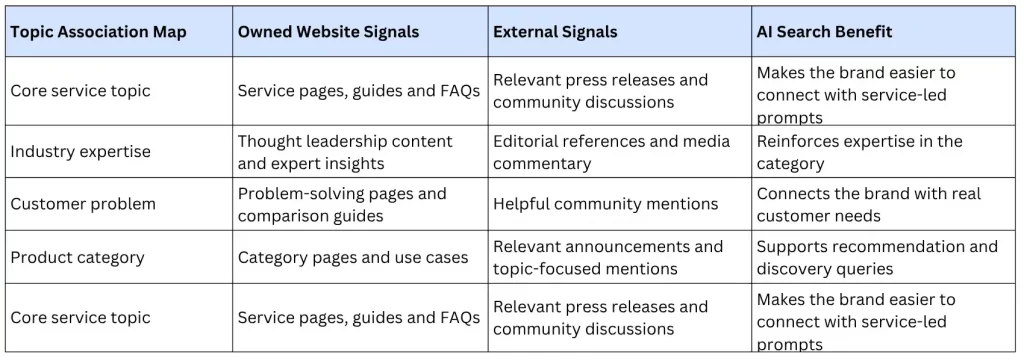
The strongest brand-topic relationships are built when these messages stay consistent across every channel. If your website says one thing but your external presence tells a different story, AI has a much harder time understanding where your expertise truly lies.
To keep your strategy on track, it’s worth reviewing your progress regularly.
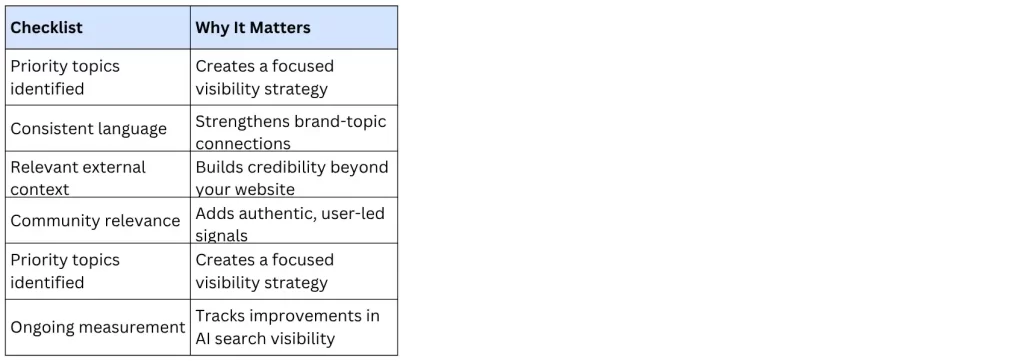
Google has emphasised that good SEO practices continue to support visibility in AI search, making consistency more valuable than ever. Finally, don’t forget to measure what’s working. Keep an eye on how your brand appears in AI search prompts, whether you’re being cited by AI tools, the quality of recommendations your business receives and how often your brand is mentioned alongside your chosen topics.
By combining AI SEO services, press release distribution services, and a dedicated community mentions service, here at Click Intelligence, we help brands strengthen their brand-topic relationships from every angle. Your content is optimised to clearly communicate your expertise, while carefully planned PR and community activity reinforce those same messages across trusted third-party sources.
Just as importantly, these efforts are measured over time. By monitoring changes in AI-generated recommendations, citationsA citation is a mention of your company, product, or service in an online publication. Citations increase the ranking of your site on search engines and overall AI search visibility, it’s possible to see how your brand’s associations are developing and where further opportunities exist.
AI recommends the brands it understands. Building strong topic association helps create that understanding by consistently connecting your business with the subjects, services and customer problems you want to be known for.
When your website, media coverage and community mentions all reinforce the same message, AI gains greater confidence in your expertise and relevance. Those consistent signals make it easier for your brand to appear in recommendations today while strengthening your AI search visibility for the future.
If you’re ready to build a long-term strategy that helps AI recognise your expertise, the team at Click Intelligence can help you develop meaningful topic associations that support sustainable growth and long-term visibility.

Comments are closed.
AI has become part of how people research and look for products, as well as…

When your target customer heads to Google to search for a product or service, or…
Link Building or Managed SEO which is right for me?

Are you struggling to think about what to write about for your content marketing efforts? It’s not an uncommon situation–particularly…
If Google's latest Web Core Vitals update has caused havoc to your SEO results, find your solution in our latest in-depth ebook.

Some backlinks can help a key service page gain authority, while others help to strengthen…

SEO can be complicated. It’s constantly changing and is not a one-and-done job. That’s something…
AI has become part of how people research and look for products, as well as…

Growing an SEO agency takes a lot of hard work. You've got to keep up…

Google announced it was rolling out a further spam update on August 18, 2026. It…
Instead of scrolling through pages and pages of endless search results, more people are now…
When your target customer heads to Google to search for a product or service, or…

Artificial intelligence (AI) is changing the way that people are searching for information. Tools like…
If you are looking to increase your traffic, sales & leads, let's have a chat!

The team will usually respond within 1 hour.

[…] is also where topic association becomes useful. Building links and mentions around related subjects can reinforce the areas your brand is […]