
How Can Brands Compete in ChatGPT Without Paying for Ads?
AI has become part of how people research and look for products, as well as…


ChatGPT is an incredibly versatile bit of technology. You can use it to craft a professional cover letter. Developers may produce a piece of code for their video game project. It can even plan out a weekly menu for those on a vegan diet.
However, is ChatGPT any good for keyword researchKeyword research helps websites unearth the best keywords to drive traffic and visibility. This research is supported by a number of powerful web-based tools, the best of which we’ve listed here.?
In short: Yes. Yes, it is – as long as you understand its limitations. KeywordKeywords are the words and phrases that potential customers might search for to find your business. research with ChatGPT offers a lot of value, allowing you to perform tasks like highlight popular keywords, uncover new ideas for blog content, and much more.
While you shouldn’t consider it a replacement for professional SEO services or your current keyword strategy, ChatGPT can complement this area of your digital marketing efforts. Let us show you how.
Since its launch at the end of 2022, ChatGPT has evolved in every conceivable way. For marketers, it has become a Swiss army knife that can complete a wide range of tasks within a matter of seconds. That includes keyword research.
So, when it comes to keyword research with ChatGPT, what is it capable of doing? We thought it would be best to ask the AI tool directly. Here’s a summary of what it said:
It all sounds great, right? Yet keyword research with ChatGPT isn’t quite the full package. The aforementioned insights are only based on general knowledge and available data. It’s not pulling more precise, actionable data – the type you’d receive when utilising specialist keyword research tools like Google Keyword Planner, Ahrefs, and SEMrush.
For instance, when researching a keyword, ChatGPT is now capable of obtaining up-to-date insights on current trends and insights. That includes keywords trending on Google and other search engines. However, it doesn’t have access to numerous all-important keyword metrics such as keyword difficulty and search volume.
It can estimate, but it can’t validate.
Now, don’t let that make you completely discount ChatGPT as a new weapon in your keyword arsenal. It’s not going to be the basis for an enterprise SEO campaign or performing in-depth technical SEO audits, but this powerful tool can still offer a big helping hand.
As noted above, ChatGPT is better at certain keyword tasks than others. Here are the functions we recommend incorporating into your SEO strategy.
When searching for keyword ideas, ChatGPT is an excellent resource. You can find unique – and often untapped – keywords that are relevant to your audience. Along with being useful for targeting the right customers, these keywords can have little in the way of competition.
This free run is different compared to using, say, SEMrush or another traditional keyword research tool. Go this route, and you’re often fighting against numerous competitors all challenging to rank for the same recommended keywords.
Here’s a little example of how to brainstorm ideas for an SEO management agency:
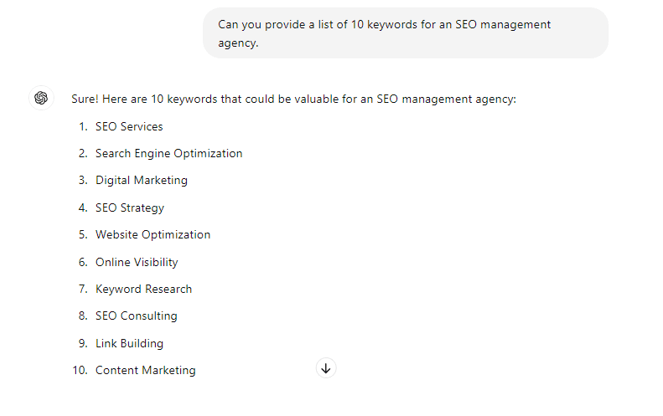
So, we get a list of ten keywords. Nothing too remarkable, I’m sure you’d agree. However, the magic of ChatGPT is when you dig a little deeper to unearth the gold. Let us take one of the recommended keywords, SEO consulting, and go that step further:
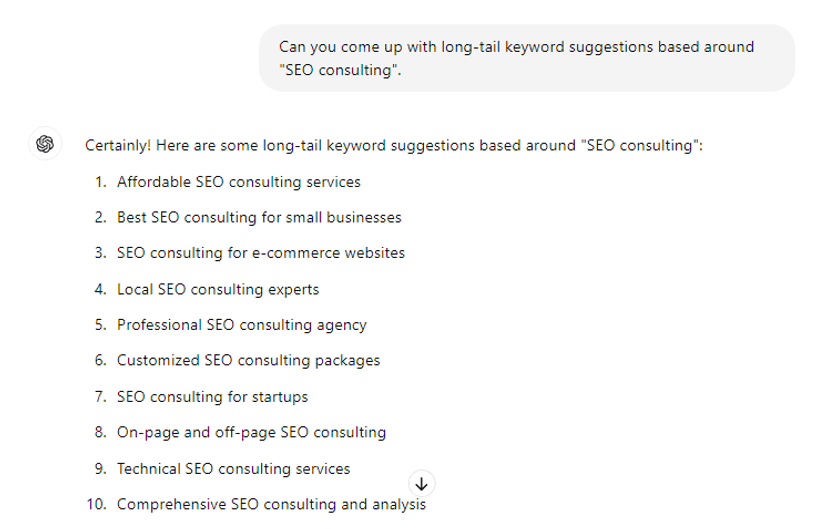
Side note: we might even add some of these to our SEO consultancy page!
It shows that, with just a couple of quick prompts, you can receive a healthy list of keywords to target. You can then take it further for even more specific, unique search terms. There are also other ways, from generating a list of questions to the Alphabet Soup Method, to gain keyword ideas from ChatGPT. Creative prompts are rewarded.
As part of our managed SEO services, we know the importance of knowing the search intent behind keywords. We also know that it’s not always easy to identify this intent. A keyword can appear leaving you wondering what the heck a user was trying to find with their search query.
Fortunately, ChatGPT makes it effortless to classify and categorise your keywords.
Remember that list of long-tail keywords we requested based around SEO consulting? Well, we asked ChatGPT to sort these out for us:
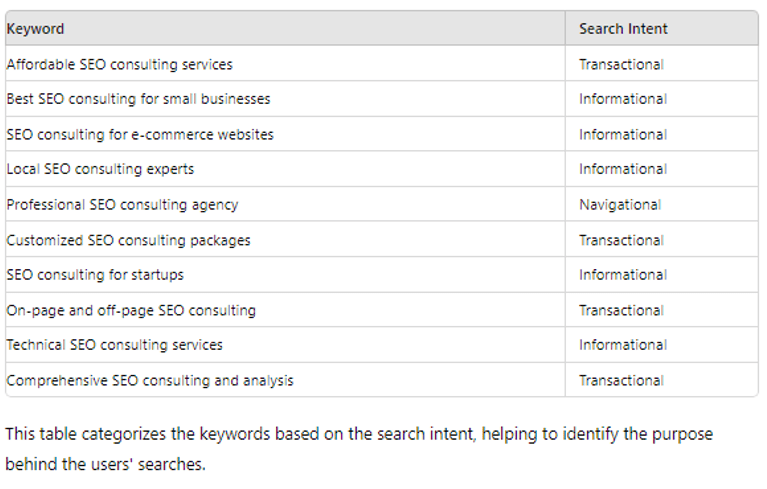
Just like that, we know the search intent behind each keyword. ChatGPT effectively guides us on where to place these keywords within the search funnel. Of course, you can also get this tool to categorise keywords in other ways.
You already know your competitors are a great source for learning about keywords to target. The issue is that trying to pinpoint specific keywords can be tricky, particularly when going with the manual approach. With ChatGPT, you can simply feed it a portion of text, and it can analyse what keywords were used.
As highlighted, ChatGPT can help with your keyword research efforts in numerous ways. That said, it’s not a comprehensive, all-in-one solution. For example, you would not use it for an in-depth audit of your website’s keywords. That requires a professional SEO audit to analyse performance and see where keyword improvements can be made.
Nevertheless, if you have been avoiding ChatGPT for whatever reason, now is the time to start embracing it – and not just for keywords, but many other elements of SEO. Our SEO reporting software Click Insights can help you track Google SERP AI overviews.

AI has become part of how people research and look for products, as well as…

Instead of scrolling through pages and pages of endless search results, more people are now…

Are you struggling to think about what to write about for your content marketing efforts? It’s not an uncommon situation–particularly…

Without the correct tactics, your website doesn’t have a chance of appearing prominently on search engine results pages. Because if…

The search engine landscape is constantly changing; search in 2022 is no exception. New trends and algorithm updates occur all the time in the search engine world.

Some backlinks can help a key service page gain authority, while others help to strengthen…

SEO can be complicated. It’s constantly changing and is not a one-and-done job. That’s something…
AI has become part of how people research and look for products, as well as…

Growing an SEO agency takes a lot of hard work. You've got to keep up…

Google announced it was rolling out a further spam update on August 18, 2026. It…
Instead of scrolling through pages and pages of endless search results, more people are now…

When your target customer heads to Google to search for a product or service, or…

Artificial intelligence (AI) is changing the way that people are searching for information. Tools like…
If you are looking to increase your traffic, sales & leads, let's have a chat!

The team will usually respond within 1 hour.

Comments (1)