3 Reasons to Use Press Release Distribution for SEO and AI Search Visibility
PR has long supported brands in building authority and spreading awareness, but PR distribution has…


An assortment of ingredients are required to cook up those all-important sales. One of the most important is undoubtedly the product description. Getting a potential customer onto your page is one thing, but a lot of convincing is required before they’ll part with their hard-earned cash.
The issue is that writing persuasive product descriptions is not an easy task.
A little knowledge, however, goes a long way to solving this problem. The following guide will detail how to craft product descriptions which sell.
A product description is copy you utilise to describe your product in detail. The main purpose of product descriptions is simple: convince customers what you’re offering is worth purchasing.
This is done by supplying them with a collection of important information about said product. This will cover its features, key details and specifications, and the benefits it ultimately provides.
When putting together a product description, here are the three main questions you need to answer:
What is gained by the customer from buying your product?
Which problems are solved with your product?
Why is your product better than comparable options on the market?
A product description should be the perfect supporting partner to your product images. The latter goes some way to enticing buyers, but the description is often necessary to get those sales over the line as it increases trust in the product.
Compelling copy is a crucial part of any product description. That much is obvious. However, you also cannot overlook the importance of incorporating SEO elements into these descriptions.
When these elements are missing, you have a problem: your products will not show up in search results. While you can attract visitors via other means, there’s no doubting the power of attracting organic trafficOrganic search traffic (sometimes called natural or unpaid search) is the traffic that's driven to a website because of unpaid placement on a search engine results page. through search engines like Google.
So, what SEO elements are required for product descriptions?
If you have ever produced content with SEO in mind before, you’ll have a fair idea about what needs to be incorporated.
Keywords are essential. Make no mistake. You want your products to be found via relevant search terms, and the implementation of keywords is vital in securing that goal. Of course, these have to be added naturally – the last thing you want is to be penalised by Google due to keyword stuffingKeyword stuffing is a technique that attempts to give pages higher rankings in search engine result pages by inserting the same keywords over and over again..
In this day and age, SEO efforts are rewarded when you opt for detailed descriptions. This is no time to go with a bare-bones approach. You want to pack in as much relevant, informative content as possible. This also makes it easier to insert those aforementioned keywords. Just remember not to add fluff for the sake of pumping up your word count!
Having up-to-date content is another important component of SEO. Admittedly, most product descriptions won’t deviate much over time. Yet if there is a change to price, quantity, features, etc., this must be reflected.
A product description, when well-crafted, is one that effortlessly supports your sales funnel. Even with just a small slice of creativity, this can make a large difference to the compelling nature of your product pages. The result: you give your conversionA conversion is a desirable result on a website that leads to an action such as completing an order, filling out a form, or simply clicking on a link. numbers a healthy boost.
With that said, there are various steps you can take to generate the perfect product description. Here are some top tips to consider:
Before you begin putting words down on the page, there’s an important initial step you need to make. You have to place a strong focus on your target audience.
If you produce a generic description aimed at buyers from all backgrounds, this isn’t going to deliver results. It will just be a fluff piece that fails to address anyone.
When you have your audience in mind, this gives you the platform to create product descriptions that are both direct and personal. You understand what questions to answer. You know how to write a description that is more like a conversation than a sales pitch. You realise which language and words resonate best with your ideal customer.
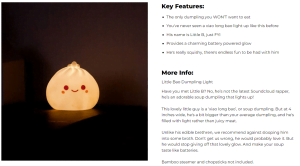
Injecting personality into your content is recommended. Okay, certain product descriptions are not exactly a canvas for creativity (think medicinal items and car parts) but if there is space to sprinkle in some humour and uniqueness to your descriptions, take the opportunity to do so. To see this in full action, let’s take a look at a product description from Firebox:
Description automatically generated with medium confidence
Firebox is a retailer that sells itself as a place to “shop for the unusual”. Due to this, it shouldn’t come as a surprise they go with descriptions that are more unconventional than the norm.
Now you don’t necessarily have to go ‘all-in’ quite like Firebox does, but there’s no harm in taking inspiration from their approach. Creative writing can go a long way to capturing the attention of your audience and getting them hooked from the first word to the last. The longer they stick around, the more chance a visitor will be transformed into a customer.
Ultimately, ecommerce product descriptions don’t have to be boring. Make them unique like your business is.
As mentioned, you want to keep users hooked and ready to consume every word of your product description. This greatly increases the chances they will be convinced by your words, leading to them buying what you have for sale.
An effective way of doing this is to opt for a storytelling approach.
In the same way as the previous point about personality, there are many paths you can venture down when crafting a story.
You can explain how your business came to sell the product. You might decide to detail the general story of your business. You may even go with a quirky narrative about how to use your product. Play around with a few options to see what suits your business and that particular product.
Are you selling products you have made on your own? In this case, it’s easy to get a little overexcited and go in-depth with those product specs and features. This isn’t necessarily a bad thing – there is certainly a place for this type of information within your product description.
However, the average customer isn’t going to be as excited as you about these specs and features. In fact, they’ll generally see them as boring and mundane.
Instead of flooding your description with these aspects – you can put them towards the bottom of the page or behind a selection input – you should focus on the benefits. Primarily, customers want to understand what they will get from buying one of your products.
With a description of your benefits, you can cover the pain points that customers have, aka the reasons why they’ll be looking at your products in the first place.
A detailed description is certainly recommended. Not only is it beneficial for SEO purposes, but it’s also necessary to capture those undecided customers.
With that said, it is also recommended you choose to summarise the main product benefits with a quick bullet-point list. Some potential customers are not interested in wading through a sea of words. They just want to know what the product offers – no fuss, no drama.
Of course, a summary of a product’s benefits is also a great starting point for those that consume every word. It gives them what is essentially a preview, and the rest of the description can expand on the points you have highlighted.
As you may gather, this bullet-point list should appear towards the top of the product page. Ideally, it will appear directly below the “Add to cart” button. You could also go with a short introductory paragraph before these highlights are listed.
There’s another reason why to go with this list: making your product description scannable.
Aside from bullet points that are easy to scan, there are other methods to improve the scannable nature of your descriptions. Aspects include eye-catching headlines and subheadings, ample white space, and high-quality images.
If you sell products online for a living, you already know the importance of social proof, as it is a way to build trust with your audience. If they can see that past customers were delighted with your products, they are going to be more confident to commit to buying what you’re advertising.
This is why it’s vital you incorporate customer reviews – when possible – within your product descriptions.
These reviews are an excellent way to sell your products, and you don’t have to come up with fancy descriptions on your own. The problem is actually getting people to leave these reviews.
Fortunately, there are various methods to entice reviews. A simple yet effective way is to send a follow-up email to remind customers to leave a review, detailing how much it will help your business. You could also provide a reward of some kind – such as entry into a competition – when they post a review. The addition of this could see your product descriptions boosting sales.

PR has long supported brands in building authority and spreading awareness, but PR distribution has…

When your target customer heads to Google to search for a product or service, or…

Budgeting for SEO is a terrifying prospect. There are so many elements in play, and seemingly endless considerations, rendering it…
We’re going to take a look at how you can turn your eCommerce dream into a reality.

If Google's latest Core Web Vitals update has caused havoc to your SEO results, find your solution in our latest in-depth eBook.

The amount you invest in your link building budget should be based on the realistic…

Search engines aren't the only automated systems accessing, interpreting, and making sense of content found…

There's plenty of scope when creating SEO campaigns. Each industry that turns to experts for…
PR has long supported brands in building authority and spreading awareness, but PR distribution has…
Towards the end of September, on the 24th, Google released the second spam update in…

Some backlinks can help a key service page gain authority, while others help to strengthen…

SEO can be complicated. It’s constantly changing and is not a one-and-done job. That’s something…

AI has become part of how people research and look for products, as well as…
If you are looking to increase your traffic, sales & leads, let's have a chat!

The team will usually respond within 1 hour.