
3 Reasons to Use Press Release Distribution for SEO and AI Search Visibility
PR has long supported brands in building authority and spreading awareness, but PR distribution has…


So, SEO forums and Twitter have been full of chatter about the helpful content update, and as of Thursday, 25th of August, confirmation hit that rollout had begun…
But what does this update mean, and what changes may we see? Here at Click Intelligence, our Marketing Manager Mary has caught up with Head of SEO David Farmer and SEO Team Lead James King to get their expert insight.
JAMES:
The helpful content update’s objective is to devalue content that has been written for search engines and reward content that has been written with a ‘user first’ approach.
From what I’ve read on SEO Round Table, Google says it’s not a core update.
Google has always wanted content to be unique. This isn’t new. The helpful content update is an extension of the 2019 EAT (Expertise, Authoritativeness, Trustworthiness).
My favourite analogy for explaining Google is that it’s like the world’s best journalist looking for fresh content all the time, but it wants that content to be of the highest quality.
DAVID:
I agree; this has been in the works for years. Everything I’ve read on the helpful content update suggests if your site is going to be affected, it may well be a site-wide issue. Potentially a penalty, though it’s too early to tell yet, and this does depend on rollout.
JAMES: When we do our keyword researchKeyword research helps websites unearth the best keywords to drive traffic and visibility. This research is supported by a number of powerful web-based tools, the best of which we’ve listed here., we focus on questions people are asking and writing. Relevant, well-researched content that provides detailed answers to these queries is what they want. It’s about knowing your audiences really well and giving them the answers they want.
For example, one of our clients specialises in hair transplants. If you’re potentially interested in this service, there will be a lot of questions you want to ask. What’s the process? How long does it take? Is it painful? How much does it cost? Are results guaranteed? And loads more. Google’s job is to provide the best answers for these queries, and as it gets more sophisticated, it’s better able to realign the user query with the best answer. So it’s a combination of knowing the questions your audience wants answers to and providing the information in a way that provides insights and considers data.
In May, Google rolled out a core update, and we saw a spike in the number of FAQ snippets featured. This jumped from 22% to 27%! It shows the questions are becoming a bigger focus.
David: Make the content read naturally. Let’s say you offer wedding cakes in Cheltenham, avoid writing content like this:
For the best wedding cakes in Cheltenham, look no further. We offer a range of bespoke wedding cakes perfect for weddings in Cheltenham. Wedding cakes in Cheltenham offer class and provide the best quality ingredients, perfect for your Cheltenham wedding.
This example is extreme, but you get the point. It’s clear that it has been written to try to rank for a keywordKeywords are the words and phrases that potential customers might search for to find your business., not to give the user the best experience possible.
Instead, try: Are you looking for a wedding cake that looks as good as it tastes? Here at ImaginaryBakery, we’ve made dream cakes for over 200 weddings this year alone! Based in Cheltenham, we use the best locally sourced ingredients from our partner ImaginaryFarmShop. Our Head Baker has over 25 years of experience in crafting cakes for a range of celebrations, and will work with you to deliver a delicious wedding cake that perfectly compliments your theme.
See the difference? You should be proud to put the content as part of the user journey. You should be providing information that helps people make informed decisions.
James: Anyone that isn’t following the rules of not writing decent content!
David: It’s too early to tell for sure. However, I do worry that a lot of SMEs could be at risk because they could be doing these SEO techniques from 2 or 3 years ago in order to stand a chance against bigger enterprises.
Big corporations, however, won’t need to worry as it’s unlikely they’ll have utilised this content because they’ll have stronger brand awareness supporting them.
David: It’s just too early to say, it’s a 2-week rollout, and we’re keeping tabs on changes. As time passes, we’ll make sure to give feedback on our findings.
James: We’re monitoring results now, of course, but next week is reporting week, which will give us an indication of the early signs of this change.
David: When they give it an animal name, THEN we know it’s as big as Penguin!!
James: Yes – when it’s the pelican update, we’ll wonder this.
David: Or parrot… yikes.
In all seriousness, we just don’t know; it’s too early to say. Google will keep people guessing.
James: For Google, PPC is their main revenue generator. With SEO, they just want it to be as user-friendly as possible, so they will keep making tweaks to deliver this. We’ll be keeping a close eye on what unfolds.
James: Go back and read Google’s user guidelines – they’ve even brought out an edition that particularly focuses on this update and covers what creators should know. Spend some time digesting this, and you shouldn’t go too far wrong.
David: Question the content you have – SHOULD this be on your website? What is the relevance of your blog content to your sector? Review content and make sure it’s adding value.
If you have a high volume of content that perhaps shouldn’t be there, have a chat with us to review it. Don’t go trashing loads of content if you think it’s risky. Come and speak to us, and we’ll do a quick scan for you.
James: We’re being protective by making sure we understand what’s happening. If and/or when we see any changes, that’s when we’ll drill down and investigate.
David: At the moment, we can’t fully tell where we are until the rollout is complete. We’ll be checking for low-quality content that might be hiding deep within sites, and we’ll be looking at EAT
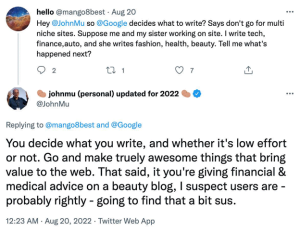
Just make sure you’re qualified to talk about the content. I’ve seen a great Tweet this week that shows exactly what I mean:
David: So, I’m really interested to see how this update will affect the use of AI content. Are you using extensive automation to produce lots of content? If so, definitely think about how you’re using it.
Don’t get me wrong, automation software can create great content super quickly! But with any super efficient tool, it can be taken advantage of. I wonder if Google is clamping down on this in part. We’ll be monitoring, but it’s too early to say for sure.
That said, whatever way you create your content, it’s worth questioning if you’re producing content that you shouldn’t be ranking for?
I think Google is realigning the internet with how it should be. That’s the goal of this helpful content update. It’s about limiting faff at the top of the search engine results pages (SERPs). For example, think about a baby night light. Imagine parents are searching for ‘best baby night light.’ Everyone assumes that the top search result is the most relevant; that’s why the click-through rate is the highest. You’ll likely get results from a retailer or a blog… but something that is more relevant, perhaps an academic research paper into what kind of light provides the best sleep for babies, might be a little further down. This update will help ensure that high-quality content researched by those most qualified will be at the top and that users will be happy.
So, ask yourself, does your content leave users to feel like they’ll need to keep searching for more answers? If your blog posts tend to be 300 – 500 words, it’s certainly worth asking if users will need to look at other sites for more information.
Think about the structure of the content. If you have 10 short blog posts that each answer one question but are on the same topic, could this be condensed into a single post? Again, don’t make any panic changes but definitely feel very welcome to ask us to cast our eyes over your content!
James: Something to look out for is if you’ve got a site that is one niche, but you start spinning content for sectors, this perhaps could be frowned upon. This may make things hard for targeted niche bloggers who are looking to expand. To use the classic, loved phrase in SEO, ‘it depends.’ To echo David, we’re here if you want to talk more about your SEO.
Thank you so much to David and James for your time! We’ll catch up with them in a month’s time to learn more about the rollout’s impact and what changes have been seen.
Until then, we offer free consultations, so please feel welcome to talk SEO with us at a time that works for you!

PR has long supported brands in building authority and spreading awareness, but PR distribution has…

When your target customer heads to Google to search for a product or service, or…

While the fundamentals of SEO remain the same no matter the size of your business, if you are an enterprise…
Ah, 2021 – the year of volatile Google algorithm updates that shook marketers from within and left website owners scratching…

Seasonality can have a huge effect on the success of your business. It is imperative to have a strong digital marketing campaign during periods of high consumer demand.

The amount you invest in your link building budget should be based on the realistic…

Search engines aren't the only automated systems accessing, interpreting, and making sense of content found…

There's plenty of scope when creating SEO campaigns. Each industry that turns to experts for…
PR has long supported brands in building authority and spreading awareness, but PR distribution has…

Towards the end of September, on the 24th, Google released the second spam update in…

Some backlinks can help a key service page gain authority, while others help to strengthen…

SEO can be complicated. It’s constantly changing and is not a one-and-done job. That’s something…

AI has become part of how people research and look for products, as well as…
If you are looking to increase your traffic, sales & leads, let's have a chat!

The team will usually respond within 1 hour.

Comments (3)