
When it comes to the right student recruitment strategy, forming an education SEO campaign for your university couldn’t be recommended more. With this, you have several options. You can hire your own SEO team and conduct your university SEO strategy in-house – often the preferred choice for smaller academic facilities with lower budgets wanting applicant acquisition. Or, you can outsource the work to a reliable university SEO agency. Outsourcing your SEO is the route we will always recommend to businesses across all industries and sizes, particularly those looking to start an SEO strategy for universities and boost their postgraduate recruitment figures. Why?
Your industry is one of the most competitive out there, with many institutions fishing from the same giant pond year after year, with poor results, but this isn’t the only challenge with university digital marketing. Student expectations have changed, funding pressures are constantly arising, and brand scrutiny is at an all-time high. Your digital visibility, therefore, and how it presents itself, couldn’t be more important. It’s not just SEO you need to be factoring in, either, anymore. AI search for universities is now a core component of effective higher education marketing that you must act on sooner rather than later when in such a competitive industry. If you want to increase applications and enrolments, you need advanced SEO and AI SEO strategies built by experts who can guide you through this from start to finish.

Why Universities Need a Tailored SEO & AI Search Strategy
Experts in education SEO strategy will implore you to invest in tailored SEO over anything else, not because they want you to spend more money with them, but because it is the only way you will be able to overcome the unique challenges your university faces with digital marketing. The best ranking spots are competitive, and the student search journey is long; one of the longest customer journeys to exist in SEO, in fact, made up of several stages. The initial research and awareness stage of the journey might happen anywhere from 12-24 months before (sometimes even further back). They will then go through the consideration stage, followed by decision, application, enrolment, and beyond.
A tailored SEO strategy for universities considers each of these stages throughout your campaign and ensures that your search intents align. During the early stages of research, you need to focus on informational intent. Still, as students narrow down their options, you need to lean into commercial investigation intent, ranking for terms like “best universities for nursing in the UK”. Then, when students are ready to take action, you double down on transactional intent.
University competition is tougher than ever before, so like SEO, experts recommend you approach AI search strategy for universities in a similar tailored way. AI search is becoming increasingly popular by the day, particularly among prospective students. Being able to ask as many questions as possible, all in one place, with limited back-and-forth, helps up-and-coming students speed up their research stage while still oozing confidence in their decision. Any complex questions they have can be answered in a way they understand, whether it is about which course they need, how funding works, or how late admissions work. It provides the best way to compare options conversationally. However, by using AI Search Overviews, for example, they may never click on your website. What this means for you is that while ranking is still important, it’s not the only goal to achieve. You also want to build trust and authority and apply E-E-A-T in higher-education content so you can show up in these AI Overviews.
Our Expert University SEO & AI Services
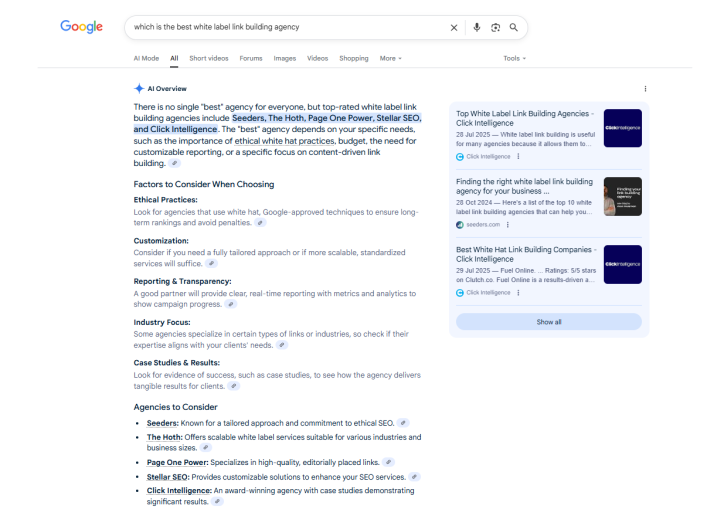
Our university AI SEO agency gives you everything you need to create a tailored SEO and AI search campaign, which includes technical SEO, link building, content marketing, PPC, reporting, and ROI tracking. We also offer digital PR for universities for authority building. Having a higher education SEO agency that offers such a wide range of enterprise SEO services for universities ensures that every aspect of your digital strategy is aligned to improve visibility, attract prospective students, and maximise applications. If you aren’t going to a university UK SEO agency, you risk your competitors pipping you to the post for higher rankings and AI visibility.
How We Build Your University SEO & AI Strategy
The university SEO strategy process we follow has been developed through years of experience and results. Our step-by-step framework consists of:
Step 1: It starts with research and competitor analysis before moving into a technical SEO audit, which reveals how well your website is functioning.
Step 2: Once this is complete, we will conduct keyword clustering and search intent mapping to develop a detailed content strategy that supports your authority-building efforts.
Step 3: Our experts follow this up by implementing CRO and optimisation tactics.
Step 4: We provide details on how it all has gone in a tidy report.
We also run an AI search optimisation strategy that includes technical SEO, entity optimisation, fresh, high-quality authoritative content, digital PR, AI visibility measurement, and structured data.
SEO Strategy for Universities
The best SEO strategy for universities will cover every single SEO avenue, from international campaigns to Core Web Vitals. However, knowing what’s included in an SEO campaign is one thing. Understanding how each element contributes to your university’s growth is another. Take the example of technical SEO for universities. While it often works behind the scenes, it actually provides you with the foundation for the strongest search performance you could want through aspects like crawl optimisation, structured data implementation, indexation optimisation, and schema markup for courses.
Beyond technical SEO, a successful strategy also includes logical internal linking, AI-friendly content formatting, and optimised content for AI search visibility.
This is what else you can expect in the top strategies for higher education:
Keyword Research for Universities
As we move away from the technical elements of your website and towards content, we embark on finding out the most relevant university SEO keywords. Keyword research for universities will look at both the international student search (e.g., “universities in London” and “MBA in the UK”) and local terms searched by prospective students near you (like “Universities near me” and “University of Bristol open day”. These keywords allow you to target students who may not know what they want to study but do know they want to live in a particular location. If you are in the right place at the right time, your enrolments could shoot up.
As you will want to target prospective students who know which courses they want to take, course-level keyword targeting is critical. At this point, they may be searching more course comparison queries, so researching these and creating content relevant to them could be what drives students to your university over a competitor. Note: these keywords will have high intent because at this point the searcher is actively comparing universities. Looking beyond this, undergraduate keywords and postgraduate keyword targeting that includes qualification types, study, or career goals broadens search visibility and connects with users who have more specific intentions.
Informational keywords should form a core part of your keyword strategy. These keywords attract prospective students during the earliest stages of their research journey, as they start researching questions like:
- How many UCAS points do I need?
- How does Clearing work?
- What is university accommodation like?
As more prospective students turn to AI-powered search, you will need to target long-tail keywords, as these will match the conversational search behaviour and hone in on the search intent.
Keyword Mapping for University Websites
It’s no good collecting these keywords and then throwing them randomly across your website. You do this, and you risk cannibalisation, in which you compete against yourself for rankings. This is where keyword mapping for universities comes in. We first cluster keywords, grouping related keywords by topic and search intent.
For example, if you are a university of law, we might cluster together: law degree, LLB, undergraduate law degree, study law, law courses. Each cluster is assigned to a page, whether for your course, faculty, blogs, or landing pages. In doing so, you are creating content silos and SEO page hierarchy. One of the biggest benefits of keyword mapping is that it helps you figure out your internal linking strategy.
Content Strategy for Universities
Developing your keyword mapping will be critical to your university content strategy. Rather than creating content and adding keywords into it after creation, you map out what pages will target each specific search intent before any writing begins. Once you have done this, you can start creating pillar content. These pages cover a broad topic within a particular subject, serving as a central hub with internal links to relevant pages for more information. Why we make this a part of content marketing for universities is simple. It signals topic authority. We determine pillar pages during the keyword mapping stage. Take our previous example for a university of law. This cluster of keywords will be assigned to the pillar topic “law degrees”.
The internal links you include in your pillar pieces will not only help users navigate your website but also help Google understand the internal relationships, allowing it to more easily identify that you are an authority on the subject. These linked-out pages are called topic clusters. Each pillar piece will link out to a variety of topic clusters, and they will always link back to the original pillar piece.
As an example, your law degrees pillar page might link out to student guides including:
- Types of Law Degrees
- Careers with a Law Degree
- Undergraduate Law Courses
- Postgraduate Law Courses
- Becoming a Solicitor
With each page, you can further create topic clusters. For instance, the types of law degrees page can form topic clusters of its own, such as LLB law courses, LLM law courses, and conversion courses. As pieces come to life, we won’t just be looking to create E-E-A-T standard content. We will also be recommending that you follow an AI-optimised structure. This will involve using a clear, descriptive heading hierarchy, writing short, focused paragraphs, breaking up content with lists and tables, and including FAQs.
FAQs don’t just help provide quick answers to your prospective students without having to hunt through in-depth content, and they are more valuable than just an opportunity to target long-tail keywords. If you apply FAQ schema markup to them, you stand a chance at appearing in AI search results because they are formatted in a way that AI systems prefer. They are clear, concise, and direct.
SEO Auditing for Universities
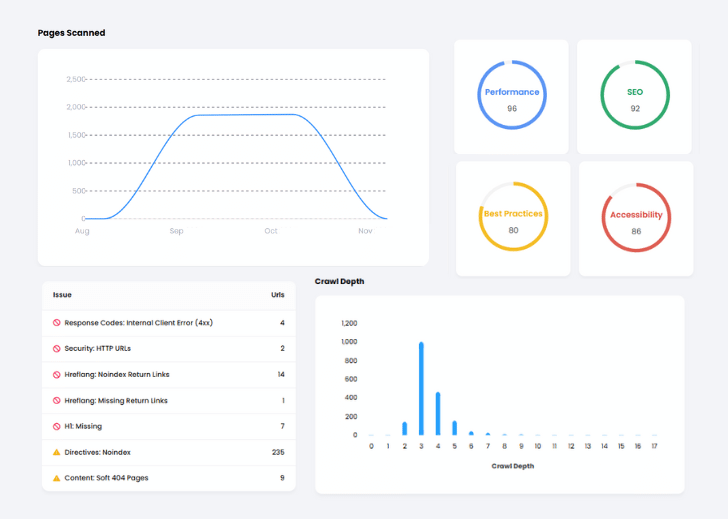
A functioning, visible website couldn’t be more important if you want to boost enrolment numbers. Carrying out a university SEO audit is the way to guarantee that your website itself isn’t impairing your results. What you can expect from an SEO audit for higher education is as follows:
- Technical: If you have crawl errors, broken links, or indexation issues, we will pick up on them during our technical SEO audit.
- Backlink: A backlink analysis will look at your profile to see the variety of links you have, whether any are too low-quality and dragging you down, and opportunities your competitors may have missed.
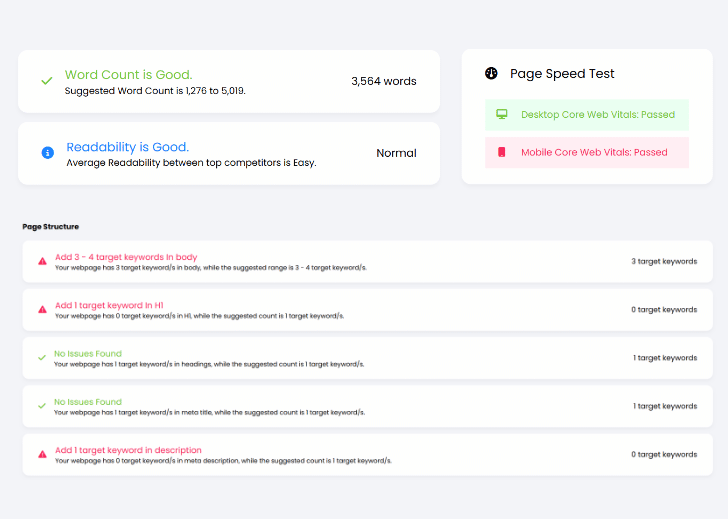
- On-page: From your title tags, meta descriptions, and keyword targeting to search intent alignment, we look at every inch of your on-page content to uncover any problems.
- Content: While we review your content during the on-page assessment, a content audit is the only way to confirm all the details, such as whether it is outdated, retains sufficient topical authority, is well-formatted for AI, or has gaps.
- Local: Your location pages, keyword targeting, NAP consistency, and Google Business Profile will be reviewed to identify areas for improvement.
- AI visibility audit process with competitor gap analysis: To get LLM optimisation right, you need to know where your current content is missing the mark. For instance, are you using structured data or correctly applying entity optimisation? Our analysis uncovers this.
It is always beneficial to have a non-biased third party conduct your SEO audit, as this provides the most honest opinion.
SEO Audit Checklist for Universities
If you want to prep yourself on how much work will likely need to be done to your website, make yourself familiar with our SEO audit checklist, so you can pore over your website for yourself to see what could be holding your university back from ranking higher or boosting enrolments.
Our university SEO checklist:
Technical
- Page speed audit
- Crawlability and indexability
- XML sitemaps
- txt
- Broken links
- Redirects
- Canonical tags
- Duplicate content issues
- Core Web Vitals
- Mobile-first indexing
- Structured data/schema markup
- HTTPS security
On-Page
- Title tags
- Meta descriptions
- Heading structure (H1s, H2s, H3s)
- Keyword targeting
- Content quality
- Search intent alignment
- Internal linking
- Image optimisation
- URL structure
- Page speed optimisation
Local
- Local citations
- Location pages
- NAP Consistency
- Google Business Profile
Authority and AI readiness.
- E-E-A-T signals
- Schema validation
- Conversational search opportunities
- Content depth
- Entity optimisation
You get an SEO audit as part of our managed SEO package, so don’t worry if you don’t feel like you’ve covered yours in enough detail.
Google Ranking Factors for Universities
Your ranking is based on a number of factors that Google has taken into consideration. For example, they explore your authority. Websites with stronger brand authority are considered more trustworthy and will therefore rank higher than those with question marks hovering over them. While Google says domain authority does not directly impact rankings, getting quality backlinks and improving your content quality will boost this and encourage more partnerships, which can further bolster your trust. The bonus of focusing on backlinks and content is that they are two factors Google assesses. If your backlinks are poor quality and/or your content is equally low in quality, your rankings will reflect that. If you are not hitting those expertise signals in your content, the results will show in your ranking position, too. Google ranking factors for universities also include engagement metrics, such as dwell time on a page and trust signals.
Local SEO for Universities
A lot of prospective students aren’t set on which course they want to study when they leave school, and many are more interested in living in a new, exciting location like London, Manchester, or somewhere overseas. While this means your target audience can be expanded beyond your immediate area, local SEO shouldn’t be forgotten. Local SEO for universities is one of the best strategies for boosting enrolment and website traffic. As standard, you should expect the following to be included in your local SEO campaign:
- Optimise Google Business Profiles
Once you’ve claimed and verified your profile on your Google Business Profile, optimisation can begin. Updating your name, address, and phone number (ensuring NAP consistency), and following up with blog content optimisation and accurate descriptions of your business, videos, images, and Q&As will boost your local SEO.
- Create campus pages
If you have multiple locations under your university name, you will need to build individual campus location pages. Each page must have unique content. You cannot simply find and replace location names in any keywords. Instead, it should contain specifics on campus-specific courses and facilities, the local area, maps and directions, and transportation information. What can further improve a local page is having unique testimonials for each page.
- Reviews
If you would like to boost local search visibility, particularly in the map results, review management is essential. Seeing positive experiences by real students can build trust with prospective students and influence click-through rates. Any negative reviews should be responded to rather than deleted, as this is your opportunity to show your university is willing to make changes and act on students’ experiences to improve in the future. Management also involves encouraging reviews at the right times. After an open day or graduation, encourage as many people as possible to leave their thoughts on your website or on Google itself.
Link Building for Universities
Getting high-authority backlinks will be the ultimate goal when you start up your SEO campaign. Of those quality links, some should be coming from .ac.uk websites. Even though you may be one of those ac.uk links in your own right, securing academic partnerships with other universities can be a big boon. You can link to them, and vice versa, which will boost your authority, trust, and credibility. Link building for universities succeeds only when your profile is diverse. Yes, getting ac.uk links is great, but having a range of scholarship links, editorial, digital PR, brand mentions, resource page, and local links is even better. Blogger outreach services and digital PR campaigns are by far the best way to build up a variety of links like this.
University SEO Content Writing
Whether you are planning conversion-focused course pages, enrolment-driven content, or landing page optimisation, having your keywords is only the beginning of the creation stage. If you want your content to rank well and prove useful to prospective students and current students alike, whoever is writing your guides, landing pages, or web copy must apply content best practices. The first is aligning your style with the intent. If you are producing conversion copywriting, persuasive messaging and language will be necessary. Other essential university SEO content writing guidelines should include AI-friendly formatting, FAQs, internal linking, readability, E-E-A-T, and semantic optimisation.
Conversion Rate Optimisation (CRO) for Universities
When an audit gets underway, it will highlight many technical areas for improvement. Still, it won’t uncover what is preventing your visitors from completing desired actions, such as filling in application forms. This is where CRO for universities comes in. A CRO audit will identify the issues your visitors face that are holding them back from committing to study with you. You may find that your CTAs (Calls to action) are not convincing enough or too difficult to find on each page. Enquiry forms may be too long or confusing; you may have slow-loading pages or poor mobile usability, which can cause frustration. If you are lacking trust signals in the form of reviews and testimonials, graduate results, or accreditations, again, you will lose prospective students along the customer journey. No matter what stage they are at, if you aren’t setting the right tone, you will struggle to retain the trust ever again.
Fortunately, conversion optimisation for higher education can transform outcomes. With UX improvements, A/B testing on CTAs and forms, optimised landing pages, improved page speed, and strengthened trust signals, you can start converting prospective students.
Measuring Success: KPIs for University SEO
From measuring organic growth to tracking conversions and monitoring AI visibility metrics, university SEO KPIs should always align with your marketing objectives. If you want to see a surge in interest in your university during application time, you could choose to track open day bookings and applications. If you want to spread awareness of your institution, tracking rankings and traffic makes sense. Don’t forget AI visibility when you measure university SEO success. AI search can deliver remarkable results for universities, helping higher education platforms reach prospective students at the earliest stages of their research journey.
SEO Reporting & Tracking (Click Insights)
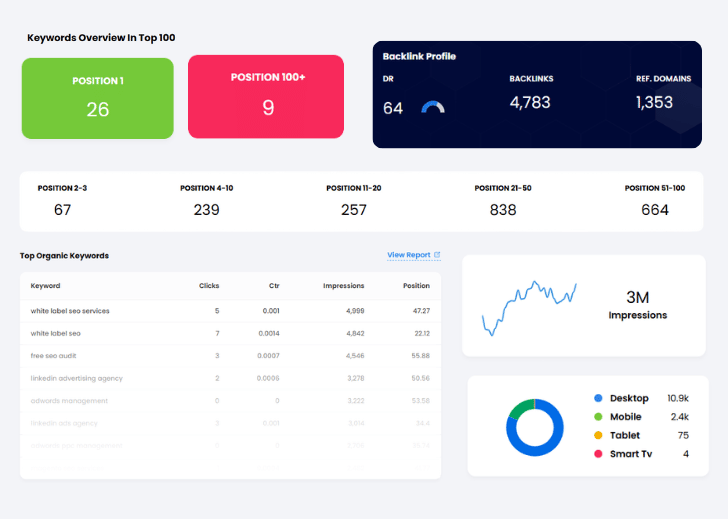
In your particular industry, you require a lot of moving parts to keep up. Without a dependable system to track these results, it becomes difficult to identify which areas of your SEO strategy require further refinement and which are already performing well. A dashboard reporting system solves any problems with SEO performance tracking. Our team, in particular, has developed an SEO dashboard that provides KPI and ROI reporting and monthly analytics insights. With full transparency, SEO reporting for universities couldn’t be easier.
SEO & AI Search Tips for Universities
Whether you choose to partner with us, do your SEO in-house, have a little of both, or go elsewhere, there are a few actionable university SEO tips we recommend doing first:
- Including schema for FAQ optimisation: Featured snippets may be a thing of the past, but they aren’t taking FAQs with them. They remain valuable for prospective students seeking quick, reliable answers throughout the customer journey. We also recommend this because it will play a vital role in helping you surface in AI search results.
- Semantic SEO: Keywords are still highly relevant in SEO, but how they are used has changed over time. Most experts now practice semantic SEO, which is all about optimising content around the meaning of a topic rather than on a specific keyword. The goal is to demonstrate comprehensive knowledge rather than to rank for a single term. It should cover related concepts, entities, and FAQs. This will help Google understand your page and determine more easily whether it is useful to your visitors. For anyone hoping to demonstrate their value, semantic SEO is the way forward.
AI search optimisation tips
AI is dominating many searches and continues to be popular with many people over traditional search engines. Therefore, you don’t want to delay any longer in taking part in this race. You need to take action for the following with AI Overview targeting:
- Direct and Concise Content: Your goal here is to help AI systems understand and summarise your content so you display in the Overviews. This is why we will always recommend creating content that is as direct as possible. Clear and concise always performs better.
- Structured Content: Use descriptive headings with a clear hierarchy, with short, easy-to-digest paragraphs beneath. If you can include comparison tables, that would further improve your chances.
- Demonstrate topical authority: show this through pillar content, topic clusters, internal linking, and supportive resources.
University SEO Pricing
SEO plans are never the same across the industry, and every agency varies in what they offer in terms of their university SEO pricing. Most reputable SEO agencies work on monthly retainers, meaning you agree to a set amount each month and they continue to provide the support based on this agreed amount until you say otherwise. The enterprise SEO cost can jump up and down depending on your specific circumstances. However, agencies like ours will aim to cater to as many different universities as possible, so that no matter your budget, you can get the SEO help you need. For example, we offer different plan structures for all avenues of our SEO services. Our Link building services offer the greatest scope of pricing to cater for budgets of all sizes.
Don’t make the mistake of assuming that cheaper university SEO rates offer better value. They may not deliver the same level of expertise, strategic insight, or student recruitment, but don’t assume the highest-priced agency will deliver the greatest ROI either. Your focus should not be on the exact price they offer, but on the measurable outcomes. Running ROI forecasting can help estimate the impact of the SEO investment.
If you would like to learn more about the SEO cost for universities, our Account Managers are available to chat at any time.
How to Choose the Right SEO Company for Universities
You know what will be involved in your SEO and AI search strategy, but how do you choose a university SEO agency to help bring this to life? First, you need to consider their expertise. Are they highly skilled in SEO, or are they highly skilled in SEO for universities? The difference can be critical to results. To determine this, their website should provide clarity; if not, check out their SEO case studies for proven results. The best SEO company for universities will be fully transparent on these case studies and across their website, detailing exactly how they carry out SEO. If they don’t and yet they are claiming fast results, there’s a risk they are not using white hat SEO, which, while it may produce quick results, could have a detrimental effect on your rankings long-term. One element that is becoming increasingly important in finding a partner is the AI knowledge they possess. If you cannot see anything on their website about AI SEO, you are missing out on huge opportunities. You need to select someone who not only has experience in your industry but also meets the demands of modern search, which is leaning towards AI.
Partner with Click Intelligence for University SEO
As some of the top-rated SEO and AI search experts for universities, we help grow applications for universities in the UK and beyond every single day. With advice, guidance, and support from our university SEO agency, UK and overseas businesses can finally take their challenging industry and see results. Whether you are ready to request an SEO audit right now or you want to book a consultation to discuss next steps, we are here for all your partnership needs, worries, and reassurance. Contact the Click Intelligence team today.