Picture this: you’re working at an SEO agency, managing multiple clients and delivering strong results. Monthly reports show steady year-over-year organic growth, and client feedback is positive, with increased visibility driving more sales enquiries. You’re proud of the impact your work is making, and your clients are happy with the progress. Everything is running smoothly until an urgent message suddenly appears in your inbox.
You open the email and quickly realise the client’s organic trafficOrganic search traffic (sometimes called natural or unpaid search) is the traffic that's driven to a website because of unpaid placement on a search engine results page. has dropped sharply. They’re already on the phone, clearly stressed, with other decision-makers demanding immediate answers. As the SEO, all eyes are on you to explain why their search visibility has fallen.
After investigating, the cause becomes clear: the client launched a redesigned website two days ago. The URL structure changed, no redirectsA redirect is a web page that loads in place of another web page. were implemented, and you weren’t involved in the process. If you’d been informed earlier, you could have stepped in and prevented the problem entirely.
This scenario is all too common in the digital world and often leads to hours spent fixing preventable damage.
It’s easy to underestimate the impact of URL changes. To humans, a single character difference may seem insignificant, but to search engines, it creates an entirely new page.
Suppose you change the web address from https://www. to https:// or the change the site from a trailing slash to a non-trailing slash, these subtle changes can have drastic consequences for the search engines. Unfortunately, not all web admins are aware of the detrimental impacts these changes can have.
Why Search Engines Prefer Stable URL Structures
As Google’s John Mueller has highlighted, “In particular, search engines like Google store their index on a per-page basis. So if you change the address or the URL of a page, that page’s data has to be forwarded somehow. Otherwise, it gets lost. It doesn’t matter if you’re completely rebuilding a website or if you’re just removing a slash from the end of URLs, these are all essentially site moves.”
In summary, Google uses a page’s URL as its unique identifier. In this scenario, there are three options available:
- Keep the current URL as it is
- Apply a 301 redirect301 redirects are permanent, so they only need to be set up once. They can signal to search engines that a page has been permanently moved or removed, which can help boost website traffic in the process. pointing to the new location
- Change the URL without applying any redirects
Choice 1: Leave the Existing URL As It Is
If possible, this would be the most favourable option and here’s why:
A well-established URL is currently within the search engine index. John Mueller at Google has mentioned that: “I’d really recommend keeping the same URLs for the long run.”
As the URL is the unique identifier for each page, the long-term benefits include:
Keeps link equity
If you’ve created an article on your site with an abundance of high-quality linksHyperlinks, also known as links, are the connection points on a webpage that take you to other webpages., it’s important to maintain those inbound links to that page. By keeping your URL the same, you won’t dilute your link buildingLink building is a process of acquiring links pointing to your website. These links are obtained by creating content, participating in social media or commenting on other blogs. efforts. Depending on who you ask in the SEO world, there are varied responses on how much link equity can be lost through 301 redirects.
That said, the Google Search Central Document states that: “External links: Try to contact the sites in the saved list of sites linking to your current content, asking them to update their links to your new site. Consider prioritising your efforts by the number of inbound visits for each link.”
Protects the rankings of your most valuable search terms and URLs
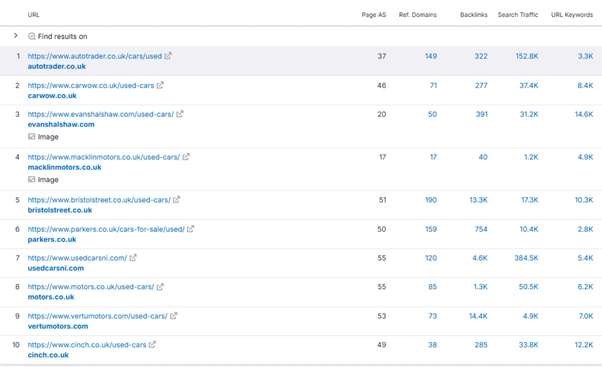
When planning a URL restructure, carefully review which search terms drive the most traffic and enquiries. Take “used cars for sale” as an example, a highly competitive keywordKeywords are the words and phrases that potential customers might search for to find your business. with an average UK monthly search volume of 49,500.
Imagine you’re a second-hand car dealership operating nationwide and have spent the past three to five years targeting “used cars for sale” as a long-term SEO goal. You’re finally approaching page one of Google. That progress represents significant time, budget, and strategic effort. SEO is a long-term investment, especially in competitive markets.
In situations like this, changing the URL of a high-performing page can undo years of work. Your highest-ranking, most-converting URLs have already built authority and trust with search engines. Altering them without a clear plan risks losing that momentum.
A quick look at the current top 10 results for “used cars for sale” shows just how tough the competition is, with established players like Auto Trader, Evans Halshaw, and Motors dominating the space. If you’re steadily climbing the rankings for such a competitive term, it makes far more sense to protect that progress rather than disrupt it with unnecessary URL changes.
By changing the URL structure of your best-performing URLs, you risk taking a step back in search engine rankings and undoing all that hard work.
- Improved SEO: Keeping your URL the same will help maintain your search engine rankings. If you have some pages that are ranking high in Google for highly competitive keywords and are generating revenue, why would you want to risk losing visibility for your most profitable search terms?
- Reduces technical implementations: If you decide to change a URL, you need to do 301 redirects, then you need to fix your internal link building and update the external URLs. This alone could become a mammoth task, adding hours of extra unnecessary work. Equally, if you’re emailing webmasters to update external links, the success rate can be fairly low. According to an article by Ahrefs, the average link outreach success rate can range from 1% to 5%. Keeping your URL structure consistent helps avoid this extra workload and reduces the risk of ranking fluctuations. When URLs change, search engines must rediscover and reprocess your site structure. The time this takes depends on the size of your website and the number of external links involved, meaning recovery can be slow and unpredictable.
Choice 2: Implement a 301 Redirect to the Updated Page
In some instances, keeping the URL structure the same is not an option, for example, if you’re rebranding your business or due to legal implications.
If you do change your URL structure, it’s essential to have all your redirects planned out well before the new site goes live. Doing so will save a lot of headaches prior to a site launch.
Keyword & URL Mapping: Redirects always carry risk, so careful planning is crucial. Creating a keyword and URL mapping spreadsheet helps you track priority keywords alongside their ranking URLs, making it clear which pages should be redirected and where they should point.
In the example of a fictional site, mycarcompany.co.uk, keywords are mapped to suggested destination URLs. For instance, “Toyota used cars” ranks 18th. Laying everything out this way makes it easier to spot growth opportunities and protect valuable pages during structural changes.
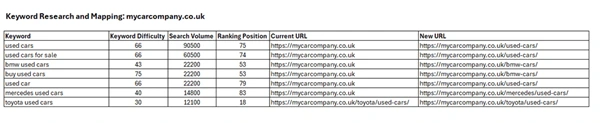
Equally, by planning a URL mapping and keyword document, you have a blueprint for future redirects.
What to Consider: Just like when driving down the road and discovering roadwork diversions, a redirect forces you to take a detour. Depending on the duration of the detour, it slows us down from reaching our direct location. When the search engines crawl our website, redirects are the search equivalent of roadwork diversions. Search engines need to understand these redirects, which takes time and can result in fluctuations in keyword rankings.
SEO Benefits of Implementing 301 Redirects:
- Can help preserve SEO value: When 301 redirects are applied, they can help reduce SEO loss by pointing a now non-existent page to a new location. However, it takes time for the search engines to acknowledge and implement these redirects. Depending on the size of the site, it can take months to crawl all the pages and external links that are now forced to go through a 301 redirect.
- 301 redirects prevent 404 Errors: Nobody likes a 404 error, especially the search engines. To prevent Google from deindexing 404 pages from its index, it’s highly advised to have 301 redirects in place for relevant pages.
Potential Drawbacks of 301 Redirects:
- Reduction in link equity: If you apply a 301 redirect to a URL with many internal and external links, every one of those links has to pass through the redirect. Instead of going directly to the final page, they move from point A to B (and sometimes to C), which can dilute link equity. You’re unlikely to retain 100% of the original SEO value. To preserve as much authority as possible, it’s always better to avoid unnecessary redirects in the first place. Manually updating every external link to point to the final destination would take significant time and resources, and the payoff may still be limited.
Choice 3: Update the URL Without Setting Up a Redirect
If you don’t have any 301 redirects on your website after changing your URL structure, search engines will see these pages as lost URLs (404 errors).
It’s wise to check any 404 URLs to see whether they received organic traffic or whether any links point to them.
If there aren’t any links or traffic pointing to those URLs, it’s fine for the URLs to serve a 404 error, as John Mueller suggests in this Google Search Central video.
If your website has a lot of relevant search traffic and any high-traffic pages were deleted, these pages will be lost.
One of the most common issues in site migrations is failing to account for redirects. The results for not using redirects can be catastrophic, so it’s highly advisable to do your due diligence first before deleting any URLs.
A 404 page should only be used when a page has been permanently removed and no longer serves a purpose. If you implement a 301 redirect, the new destination should closely match the original page’s content to maintain relevance and SEO value.
404 errors are frustrating for users, so, wherever possible, relevant pages should be redirected. Most importantly, these redirects should be planned and implemented before any site changes go live.
Closing Thoughts
Changing URLs carries risk, especially for businesses that rely heavily on online revenue. Having a clear process in place helps reduce potential damage. When redesigning a website, it’s best to keep the URL structure as consistent as possible.
Avoiding unnecessary changes saves time on creating redirects and updating links. When URLs do change, search engines need time to process and trust the new structure, and there’s no fixed timeline for this. The larger the site, the longer the recovery may take.
Careful planning can save significant time and protect your rankings. Keeping URLs consistent is one of the most effective ways to minimise disruption. It’s also important that stakeholders understand URL changes aren’t instantly recognised by Google and can impact visibility in the short term.

Latest articles
Popular articles
Share this article
Downloads


A Decade of Research Brings You Outreach Emails That WORK
Outreach emailing is a traditional marketing strategy that involves sending an email to someone with whom you have no previous…

An Introduction to Agile Workflow Management
It's clear that a new management approach can do wonders for your company, and one of the most cutting-edge and…
You may also be interested in...
Picture this: you're working at an SEO agency, managing multiple clients and delivering strong results…
You may have heard that Google has rolled out a notable new update: the February…

Search is evolving quickly. Large Language Models (LLMs) and Google AI overviews now have a…

Automation is on the rise in just about every industry, and SEO is no exception…

Backlinks have been part of the SEO conversation for years, despite countless algorithm updates, and…
It’s not just humans that use search anymore. Artificial intelligence plays a huge role in…

There’s no denying that Google’s AI Overviews changed the face of search seemingly overnight. After…

When a Google core update is being rolled out, digital marketers everywhere eagerly wait to…