
All You Need to Know: Agentic Browsing Update for Google Lighthouse
As one of the top SEO agencies out there, our duties extend beyond creating SEO…


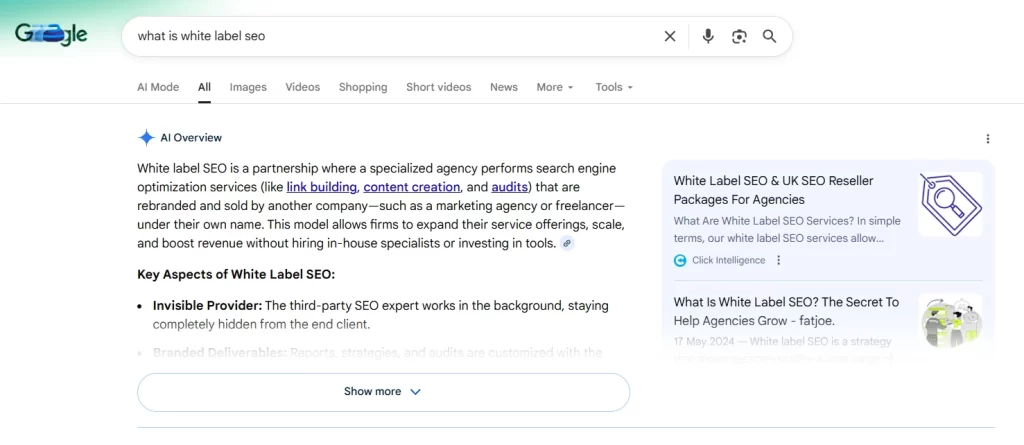
Search is evolving quickly. Large Language Models (LLMs) and Google AI overviews now have a much bigger role due to AI. Users are getting answers faster, without having to click and search across multiple websites.
AI is excellent at pulling pieces of information together, but it can only work with what already exists. There is no real-world experience, judgement or insight from doing the job day in, day out. This is where businesses have a clear advantage.
That is why Google E-E-A-T has become more important than it ever has before. In this article, we’ll take a look at how businesses can uncover and showcase genuine experience, helping them maintain visibility, credibility, and trust in an increasingly AI-led search environment.
Whether it’s Google AI Overviews, conversational search results, or answer engines, Large Language Models are now firmly part of the search experience. LLMs are increasingly responsible for how information is found, summarised, and presented to users.
At their core, LLMs work by pulling together information from across the web. By accessing and analysing existing content, they can identify patterns and mix the knowledge into clear, digestible answers. They are incredibly useful for quick research, but this can also be their biggest limitation. LLMs don’t create new understanding; they can only reflect what humans have already published online.
As a result, AI lacks several things that really matter. With no human emotion, real-life experiences, or accountability for the outcomes of its advice, it can only predict the most likely answers based on data available to it.
Google E-E-A-T has become more important as a direct result of these gaps. Google needs strong signals that content is grounded in real experience, written by knowledgeable people, and backed by trust, as AI continues to play a larger role in search. Without that human layer, even the smartest AI has nothing reliable to build on.
Google E-E-A-T stands for Experience, Expertise, Authoritativeness, and Trustworthiness. Each of these still matters, but with the rise of AI, one stands out among the rest: experience.
Expertise is knowing how something should work, whereas experience is knowing what actually happens when it doesn’t. Experience is about knowing the common mistakes, shortcuts, and warning signs that only appear in real life, through real-life situations.
This is the kind of insight that AI simply can’t generate on its own. LLMs rely entirely on human-written content to learn from, which means they depend on people who’ve been there, done it, and learned the real lessons along the way.
In an AI-driven search landscape, experience is the signal that separates valuable content from generic and useless information. It is exactly what Google looks for, and what LLMs rely on to surface answers that can actually be trusted.
Everything that LLMs produce is built from existing content from across the internet. They don’t learn from first-hand experience, test ideas in the real world, or take responsibility for how accurate (or not) their output is.
This is the main reason Google places such strong emphasis on high-quality content written by humans. Features like AI Overviews, conversational search, and answer engines all depend on trusted sources to function properly. Without reliable input, even the most advanced AI struggles to deliver useful or accurate answers.
The takeaway is simple: without strong Google E-E-A-T signals, Google has nothing trustworthy to surface.
Experience, expertise, and transparency aren’t just ranking factors; they are the basis on which AI-powered search is built.
AI is amazing at analysing data on a large scale, but it simply can’t replace lived experience. AI frankly doesn’t have the first-hand experience, emotional awareness, or sense of responsibility for the outcomes of what it says. It can’t repair equipment, deliver services under pressure, or adapt when something doesn’t go to plan, as a human can.
Your business does that. Every day. Whether it’s a technician diagnosing a fault or a team overcoming an unexpected challenge, these are the real-world moments packed with insight that AI simply cannot replicate.
When shared properly, experience becomes a powerful, often-overlooked competitive asset. Not just that, but it builds trust, demonstrates credibility, and gives both users and search engines something genuinely valuable to learn from.
Google’s main goal has always been to provide results that genuinely help users. This is why it consistently favours content that is rooted in first-hand experience, as well as practical insights.
Content that reflects lived experience naturally goes deeper than surface-level advice. It explains not just what should happen, but what actually happens. This can include common mistakes and unexpected outcomes, making the information more useful, more credible, and easier for users to trust.
By doing this, businesses strengthen their E-E-A-T signals across their entire site. It shows Google that their content is created by people who understand their subject beyond theory, helping build long-term authority and trust.
People want to feel confident, understood, and reassured before they commit, especially when it comes to money, health, or risk.
Human-led content naturally addresses things that AI can’t feel or experience, such as:
This is exactly where LLMs fall short, because they don’t have:
For Your Money or Your Life (YMYL) topics in particular, emotionally grounded, experience-led content builds far more trust. It’s more relatable, more reassuring, and far more likely to influence action, which is exactly why Google rewards it with stronger E-E-A-T signals.
Most buyers don’t start ready to purchase. They start by learning. LLMs reflect this by surfacing content that educates users well before they reach a decision.
LLMs tend to favour sites that support the full journey, including:
This information acts as proof of experience and expertise long before a sale is even mentioned. At Click Intelligence, for example, potential clients are educated on areas like technical SEO and strategy before making a commitment, often with specialists involved early in the process. That experience-led approach builds trust first.
Some examples of content formats that work particularly well here include:
These help users make informed decisions and give Google and LLMs the balanced, trustworthy content they’re looking to surface.
Buyers want clear and complete answers to any questions they may have before making a solid decision, and so do LLMs. Content that offers both positives and negatives helps users feel informed rather than sold to, which significantly reduces friction in the decision-making process.
Transparent and balanced content builds credibility because it shows both confidence and honesty. Acknowledging more than a single viewpoint gives the users all the information they need to decide for themselves. This is exactly the kind of approach Google prefers, as it signals trustworthiness and reduces bias.
LLMs also learn from this content. When articles clearly explain pros and cons, comparisons, and differences between options, AI systems are better able to surface accurate, helpful responses.
This is why listicles, comparisons, and buyer guides are such effective E-E-A-T formats, because they provide structure, balance, and genuine value for both users and search engines.
Even though search is evolving every day, the fundamentals still matter. Businesses that perform well in LLM-powered search usually have strong SEO foundations, clear site structure, and well-organised content that is easy to understand and trustworthy.
Directly answering questions is increasingly important. Clear explanations, logical headings, and straightforward language make content easier for AI and users to digest. Adding author bios, for example, is a great way to strengthen trust and credentials further.
In regulated sectors, having recognised qualifications and professional registrations is not optional. It’s mandatory. They are essential signals of credibility.
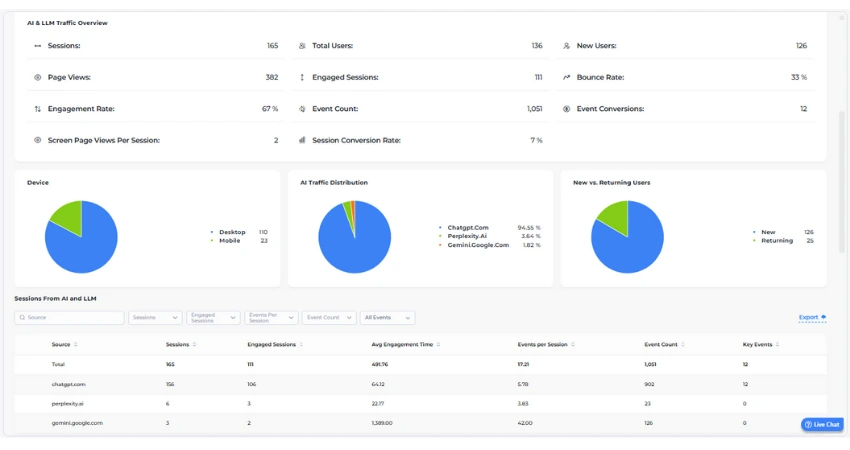
Knowing where and how your brand appears within LLMs is becoming increasingly important by the day. Visibility is no longer simply about traditional rankings, and instead, it is about how and if your content is being referenced, summarised, or relied on by generative engines.
Click Insights’ LLM prompt tracking makes this visibility measurable. By tracking specific prompts across platforms such as OpenAI, Gemini, Perplexity, and others, businesses can see how their content performs within AI-generated responses. This allows brands to monitor their presence, movement, and perceived authority over time, helping them understand which content LLMs trust and where improvements can be made.
AI may be transforming how information is delivered, but it still depends entirely on human experience to function. LLMs don’t create knowledge; they rely on the insights, lessons, and expertise people share online.
Businesses that invest in Google E-E-A-T today are laying the foundations to become tomorrow’s trusted sources. Showing real experience, practical insight, and genuine expertise gives both users and AI something reliable to build on.
Human experience isn’t being replaced. In an AI-driven search landscape, it’s becoming more valuable than ever.
Book a call today to explore tailored AI SEO audits and strategies designed to improve clarity, authority, and visibility in AI-driven search.

As one of the top SEO agencies out there, our duties extend beyond creating SEO…
There’s no hiding from it. AI search and large language models (LLMs) like ChatGPT and…

While the fundamentals of SEO remain the same no matter the size of your business, if you are an enterprise…
It's clear that a new management approach can do wonders for your company, and one of the most cutting-edge and…
Ever wondered why certain websites appear at the top of Google’s results page when you search for something? That’s no…

On June 24, 2026, Google announced that it had started rolling out its latest spam…
As one of the top SEO agencies out there, our duties extend beyond creating SEO…
There’s no hiding from it. AI search and large language models (LLMs) like ChatGPT and…

Businesses no longer need to create content solely for traditional search engine results pages. AI-powered…

While traditional SEO will always be important, brands are now also thinking about how they…

How people search and compare products online has changed. Just a few years ago, a…

Two weeks have passed since we first updated you about the Google May 2026 core…

Bringing on a new service is expensive, time-consuming, and not a decision to be taken…
If you are looking to increase your traffic, sales & leads, let's have a chat!

The team will usually respond within 1 hour.