
Google Ads Are Not Dead in the AI Overviews Era – Here’s Why
There’s no denying that Google’s AI Overviews changed the face of search seemingly overnight. After…


As a business online, you will naturally have plenty of competition within your niche who are all fighting for the attention of a similar pool of customers and trying to claw their way to the top of relevant SERP results. This should be expected; besides, a little bit of competition is good as it keeps you on your toes and pushes you to be a better digital marketer.
However, in the fight to be the number one digital brand in your industry, some people don’t play fair and implement dirty, black hat SEOBlack Hat SEO is a term used to describe practices by webmasters who try to manipulate search engine rankings in ways that are not in keeping with the intent of the search engines. tactics. One of the most utilised and potentially damaging tactics is PPC Click fraudClick fraud is an advertising scam that occurs when a person or company clicks on an ad with no intention of buying the product..
A pay-per-click campaign, also known as PPC, is a great marketing strategy that allows businesses to advertise their brand and products at the top of relevant search results. When paying for this exposure through Google ads, most brands opt for the pay-per-click option, which is where they’re charged for each click the advert generates. This is great for tracking your budgets and customers, but it does leave you vulnerable.
The act of PPC fraud is where an entity deliberately and maliciously continuously clicks on this advert, primarily through the use of a bot or algorithm.
Due to the nature of how PPCs work, it’s obvious why this is an issue. The more clicks that an advert generates, the more expensive it becomes, meaning that people partaking in PPC click fraud are just doing so to deplete the resources and funds of their competitors.
The big issue with this tactic is that it’s hard to notice when it’s happening. Initially, when being targeted by PPC fraud, your analysis may show that your advert is actually performing well due to a high click-through rate. However, this is not the case because, unlike genuine click-throughs, there is no intention to make a sale. When performed at mass, this illegal activity can cripple a company. Thankfully, we’ve found a solution that can stop it.
ClickCease is a fantastic piece of software that can help block click fraud significantly. We at Click Intelligence have used it ourselves, and since implementing the program on our campaigns, it’s helped us save over £4500.
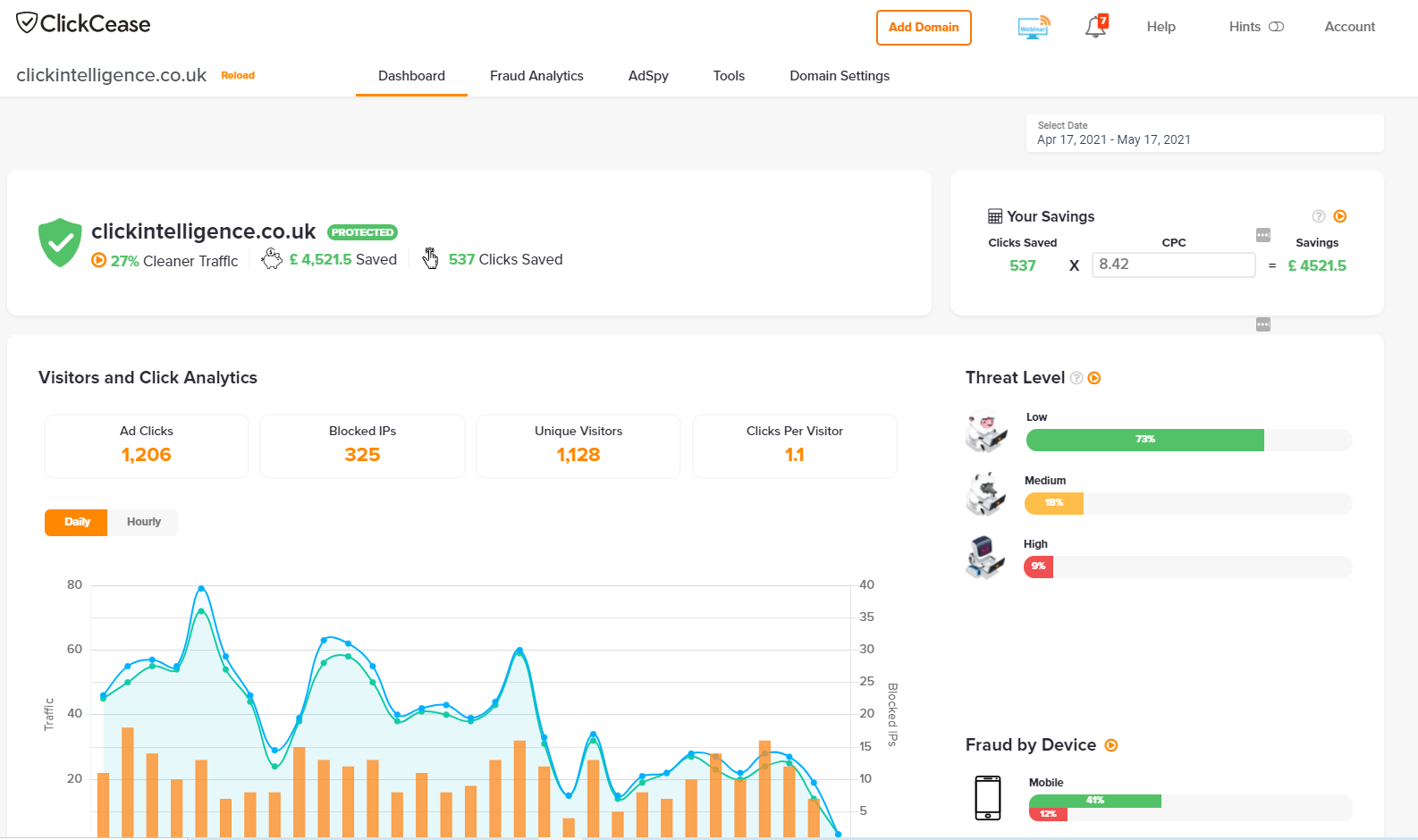
ClickCease is a great tool to help you block various types of click fraud, be it from your competitors, brand haters, bots, and click farms. The software also goes one step beyond and blocks accidental clicks too, meaning that the only users getting to your landing page will be valuable potential customers who have a high interest in doing business with your brand.
The software does this by tracking every click that happens on your advert, and by taking into the IP addressAn IP Address is a unique number that identifies a specific computer on the internet. of the source of the click, VPN, unique settings, and more, it can determine whether that click is genuine and good-willed, or if it has evil intent. Furthermore, each click also receives a score based on a dozen parameters that are analysed by a sophisticated algorithm. Based on this result, your competitors will be blocked from seeing your advert, which significantly reduces the number of fraudulent clicks you will receive.
To get this fantastic level of protection, all you have to do is signup and add some javascriptJavascript is one of the web’s key programming languages but coding it incorrectly can cost you in technical SEO terms. In order to avoid common mistakes, and understand how Java operates, here’s a quick guide to coding Java the right way. code that ClickCease will provide for you. It’s as easy as that to ensure you get the most robust PPC fraud protection on the market.
Thankfully, with tools such as this, as well as the efforts Google themselves are making, click fraud will be a dirty tactic lost to the past. Until then, ClickCease can be a guardian that protects your vital PPC campaigns.

There’s no denying that Google’s AI Overviews changed the face of search seemingly overnight. After…

If you want to reach more people on search engines, one method for doing so…
Ever wondered why certain websites appear at the top of Google’s results page when you search for something? That’s no…

While the fundamentals of SEO remain the same no matter the size of your business, if you are an enterprise…

The introduction of the internet forever changed how brands experienced visibility, and, with its updates…

Search is getting smarter by the day, and the way we create content needs to…

For years, success equated to being highly ranked in Google’s organic search results, but the…

When it comes to succeeding with modern SEO, there are many avenues to explore, but…

On March 24, 2026, Google announced that it was rolling out its latest spam update…

Simply appearing on a search page isn’t enough anymore, not in today’s world driven by…

Follow vs nofollow links have been debated in digital marketing for years. Questions are often…

Citations are a long-standing SEO trust signal that helps increase visibility in local search results…
If you are looking to increase your traffic, sales & leads, let's have a chat!

The team will usually respond within 1 hour.