- Norway leads the world in work-life balance, with its citizens working one of the shortest hours while earning some of the highest salaries globally.
- Europe dominates the rankings entirely, with Nordic countries in particular offering the best work hours and pay.
- Employees in top-ranked countries work 8 hours less than the global average, while maintaining high wages and disposable income.
At least 33% of workers globally report regularly working on weekends or more hours than they prefer. A new study by the marketing agency Click Intelligence analyzed labor markets across 180+ countries to identify where workers achieve the optimal balance between minimal working hours and maximum salaries.
The research examined countries using four main metrics: average weekly working hours, average weekly income, weekly cost of living, and weekly disposable income. Countries were ranked using an Earnings Efficiency Index that measured working hours against take-home pay after living costs, with higher scores indicating better income relative to work effort.
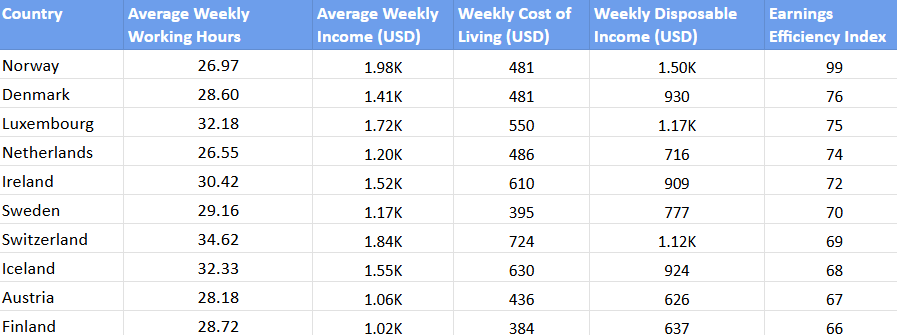
Here’s a look at the top 10 countries where people work the least and get paid the highest:
*You can access the complete research findings here.
Norway ranks first as the global leader in work-life financial balance. What makes Norway remarkable is how its workers earn nearly $2,000 per week while spending just 27 hours at the office – essentially a three-day work schedule. After paying for essential living costs of $481, Norwegian employees keep $1,503 each week – the highest spare sum worldwide.
Denmark secures second place in work-life balance rankings. Danish professionals work roughly 28.6 hours per week – about three and a half days – yet bring home $1,410 in gross income. Even after covering living expenses that cost $481, Danish workers still maintain $930 in spending money each week.
Luxembourg takes third position. The European financial hub requires 32 hours of work per week, which it compensates generously with $1,724 in gross pay. While living costs run at $550 per week – reflecting the country’s affluent lifestyle – Luxembourg workers still retain $1,174 in disposable income – the second highest globally after Norway.
The Netherlands holds fourth place with the least average working hours. Dutch employees spend barely 26.5 hours per week on the job – the shortest schedule globally – while earning $1,203 in weekly wages. After accounting for living expenses of $486, Dutch workers keep $716 for personal use each week.
Ireland ranks fifth in global earnings efficiency. Irish workers put in 30 hours per week and earn a substantial $1,519 in gross pay thanks to the country’s thriving tech and pharmaceutical industries. Living costs here reach $610, after which Irish employees can maintain $909 in take-home income.
Sweden captures sixth position. Swedish workers dedicate 29 hours per week to their jobs, earning $1,171 in gross pay. What sets Sweden apart is having the second-lowest living costs at just $395 per week, allowing workers to keep $777 in spending money. This Nordic nation shows how controlled expenses can be just as effective as high wages.
Switzerland takes seventh place, paying the second-highest salaries globally at $1,841 weekly. Swiss workers dedicate 34.6 hours per week to their jobs. After standard household expenses of $724, an average Swiss worker is left with $1,117 in disposable income – demonstrating how premium wages can compensate for higher cost of living.
Iceland secures eighth position as yet another Nordic country in the rankings. Icelandic workers spend 32 hours per week on the job, earning $1,553 in gross income from industries like fishing and renewable energy. Living costs amount to $630, allowing local workers to retain $924 in spending money each week.
Austria lands in ninth place with a balanced approach to work and compensation. Austrian employees work 28 hours per week – about three and a half days – while earning $1,062 in gross wages. Reasonable living costs of $436 mean workers keep $626 in disposable income each week.
Finland completes the top 10 by offering the lowest living costs among the leading countries. Finnish workers spend 29 hours per week at their jobs, bringing home $1,022 in gross earnings. With house expenses at just $384, Finnish employees preserve $637 in take-home pay each week.
“In many developed economies, higher wages are often tied not just to industry type, but to broader systems that support productivity and economic stability,” says James Owen, Co-founder & Director at Click Intelligence. “It’s not necessarily about working fewer hours, but about how effectively that time is structured, the value placed on employee well-being, and the cost of everyday life. These factors together shape how sustainable a work-life balance can really be – and why it looks so different from one country to another.”
(When using the data, please credit: https://www.clickintelligence.co.uk/)